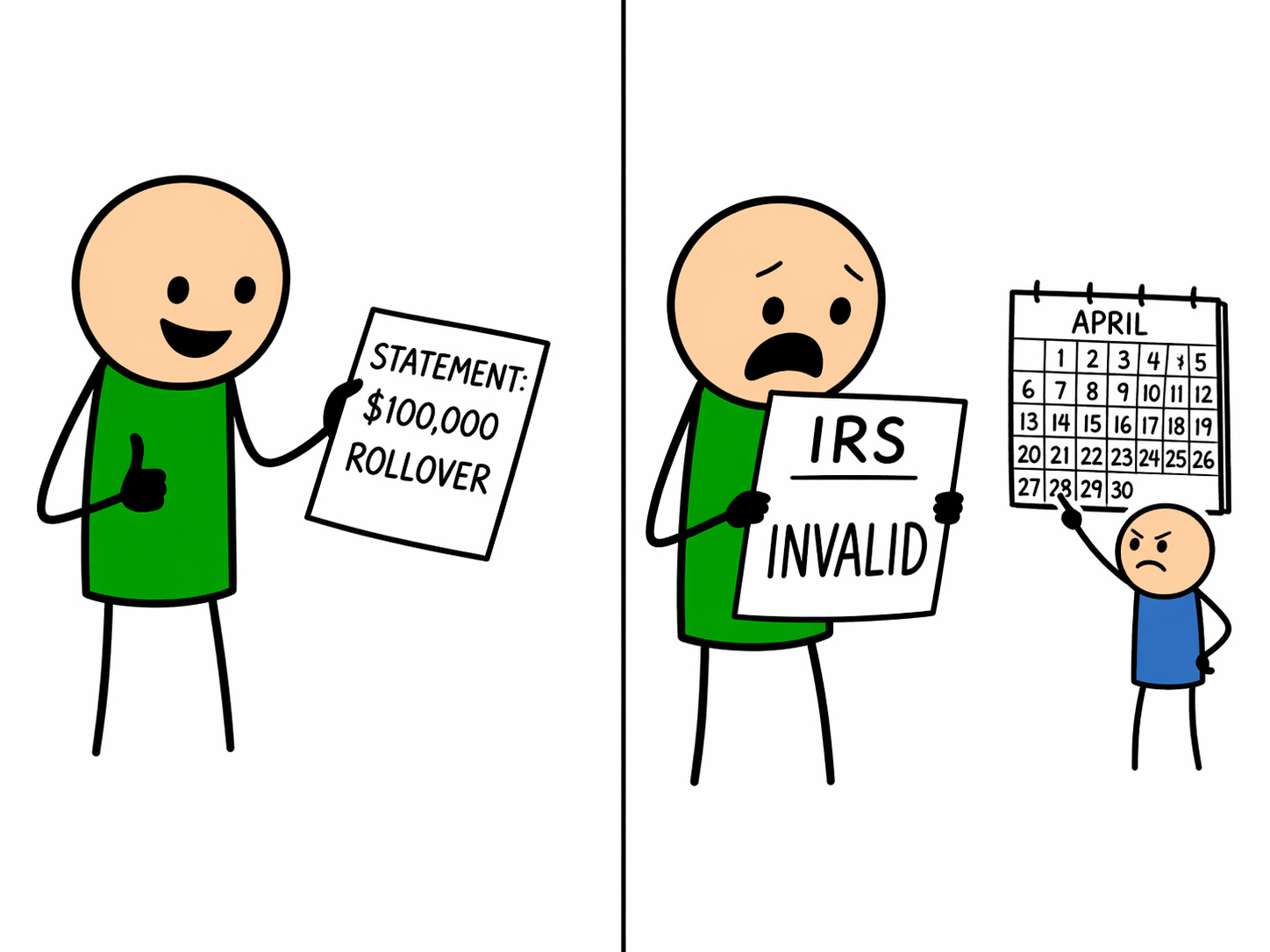
Your custodian accepted the deposit. Your account statement shows the new balance. The money is sitting in your IRA, invested and growing. Everything looks correct. But your custodian does not validate rollovers. They accept deposits. Those are not the same thing.
This is one of the most dangerous assumptions in the entire retirement system. People see the money in the account and assume the transaction is complete, compliant, and tax-free. The custodian processed it, so it must be fine. Except custodians do not work for the IRS. They work for you. They accept the money you send them. They do not verify that the money qualifies as a rollover, that the 60-day window was met, that you haven’t already done an indirect rollover in the last 12 months, or that the source account was eligible for the type of rollover you’re attempting.
That verification happens later. On your tax return. Or worse, during an audit.
When you deposit money into an IRA or employer plan and call it a rollover, the custodian records it as a rollover contribution. That label shows up on your statement. It also shows up on IRS Form 5498, which your custodian files with the IRS the following year (usually by May 31). Form 5498 reports how much was contributed, how much was rolled over, and the fair market value of the account.
Here is the critical detail. Form 5498 reports that you told the custodian the deposit was a rollover. It does not confirm that the deposit actually qualified as one. The custodian has no way to verify whether you received the distribution within the last 60 days. They do not know if you already completed another indirect IRA-to-IRA rollover in the past 12 months. They do not check whether the distributing account was an eligible plan type. They accept what you tell them and report it accordingly.
The IRS receives Form 5498 from your receiving custodian and Form 1099-R from your distributing custodian. Then it compares. Form 1099-R shows a distribution. Form 5498 shows a rollover contribution. If the dates, amounts, and types align, the IRS treats it as a completed rollover. If they don’t, you get a letter.
The gap between “my custodian accepted it” and “the IRS agrees it was valid” is where problems live. And those problems sometimes don’t surface for a year or two, long after you’ve stopped thinking about the transaction.
The most common scenario where a statement shows a rollover that isn’t actually valid involves the once-per-year rule. You can only do one indirect IRA-to-IRA rollover in any 12-month period. This is not a calendar-year rule. It is a rolling 12-month window measured from the date you received the previous distribution.
Say you took a distribution from IRA #1 on March 15, 2025 and deposited it into IRA #2 within 60 days. Valid rollover. Now on January 10, 2026, you take a distribution from IRA #3 and deposit it into IRA #4 within 60 days. Your custodian at IRA #4 accepts the deposit, labels it a rollover, and your January statement shows the new balance.
But it is not a valid rollover. The 12-month window from your March 15, 2025 distribution doesn’t expire until March 15, 2026. You attempted a second indirect rollover within that window. The IRS does not care that it involved different accounts. The once-per-year rule applies across all your IRAs combined.
The result: the deposit into IRA #4 is not a rollover. It is a regular contribution. If it exceeds your annual contribution limit (which a rollover-sized deposit almost certainly will), the excess must be removed or you owe a 6% penalty for every year it remains. Meanwhile, the distribution from IRA #3 is now fully taxable income for 2026, plus the 10% early withdrawal penalty if you are under 59½.
Your statement at IRA #4 still shows a rollover. Form 5498 will still report it as a rollover. But the IRS will flag the discrepancy when it cross-references the two 1099-R forms from IRA #1 and IRA #3 and sees two indirect rollovers within 12 months. At that point, the burden is on you to prove the second one was valid. It wasn’t.
Another common version of this problem involves source account eligibility. Not every retirement account can be rolled into every other retirement account. You cannot roll a Roth IRA into a traditional IRA. The reverse, however, is a perfectly valid and common strategy.
Moving money from a traditional IRA into a Roth IRA is a Roth conversion. You pay income tax on the converted amount in the year of the conversion, and the money grows tax-free going forward. The direction matters. Pre-tax money can move into a post-tax account because you're paying the tax on the way in. Post-tax money cannot move back into a pre-tax account because the tax benefit was already used. The mismatch the IRS flags is when someone tries to reverse the tax treatment, not when they accelerate it.
You cannot roll an inherited IRA into your own IRA (with limited exceptions for surviving spouses). You cannot roll a SIMPLE IRA into a traditional IRA within the first two years of participation without triggering a 25% penalty instead of the usual 10%.
In each of these cases, the receiving custodian will accept the deposit. They will label it however you instruct them to label it. And your statement will look perfectly clean until the IRS reconciliation process catches the mismatch.
The SIMPLE IRA two-year rule is especially dangerous because the custodian at the receiving IRA has no way to know when you first participated in the SIMPLE. That information lives with your employer and the SIMPLE IRA custodian. If you roll SIMPLE IRA funds into a traditional IRA 18 months after your first contribution, the receiving custodian sees an incoming deposit and records it. Your statement looks fine. But you just triggered a 25% early distribution penalty on the entire amount instead of the standard 10%, and the rollover itself may not be valid.
The deeper issue is that most people treat a custodian the way they treat a bank. If the bank accepts your deposit, the money is yours and the transaction is final. Custodians don’t work that way. They are record-keepers, not compliance officers. They record what you tell them. They file the forms. The IRS makes the final determination about whether the transaction was valid, and that determination can happen a year or more after the money moved.
A rollover showing on your statement means one thing: money was deposited and your custodian recorded it as a rollover. It does not mean the 60-day window was met. It does not mean the once-per-year rule was satisfied. It does not mean the source account was eligible. It does not mean the IRS will agree.
The only document that confirms a rollover was valid is your tax return, properly filed, with the correct codes and amounts, after the IRS has accepted it. Everything before that is provisional. Your statement is a receipt, not a ruling.
If you moved retirement money in the last 12 months and are not sure whether the transaction met every requirement, the time to check is now. Not when Form 5498 is filed. Not when the IRS sends a notice. Now, while there may still be time to correct the issue before it compounds.
I write one of these every day, one retirement rule, explained in plain language and verified against the source. The daily email is free: subscribe here.
Full archive, worksheets, and search live at RetirementNewsRundown.com.
Disclaimer This article is for educational and informational purposes only. It is not tax, legal, or financial advice and does not create an advisor-client relationship. Always consult appropriate professionals regarding your specific situation.