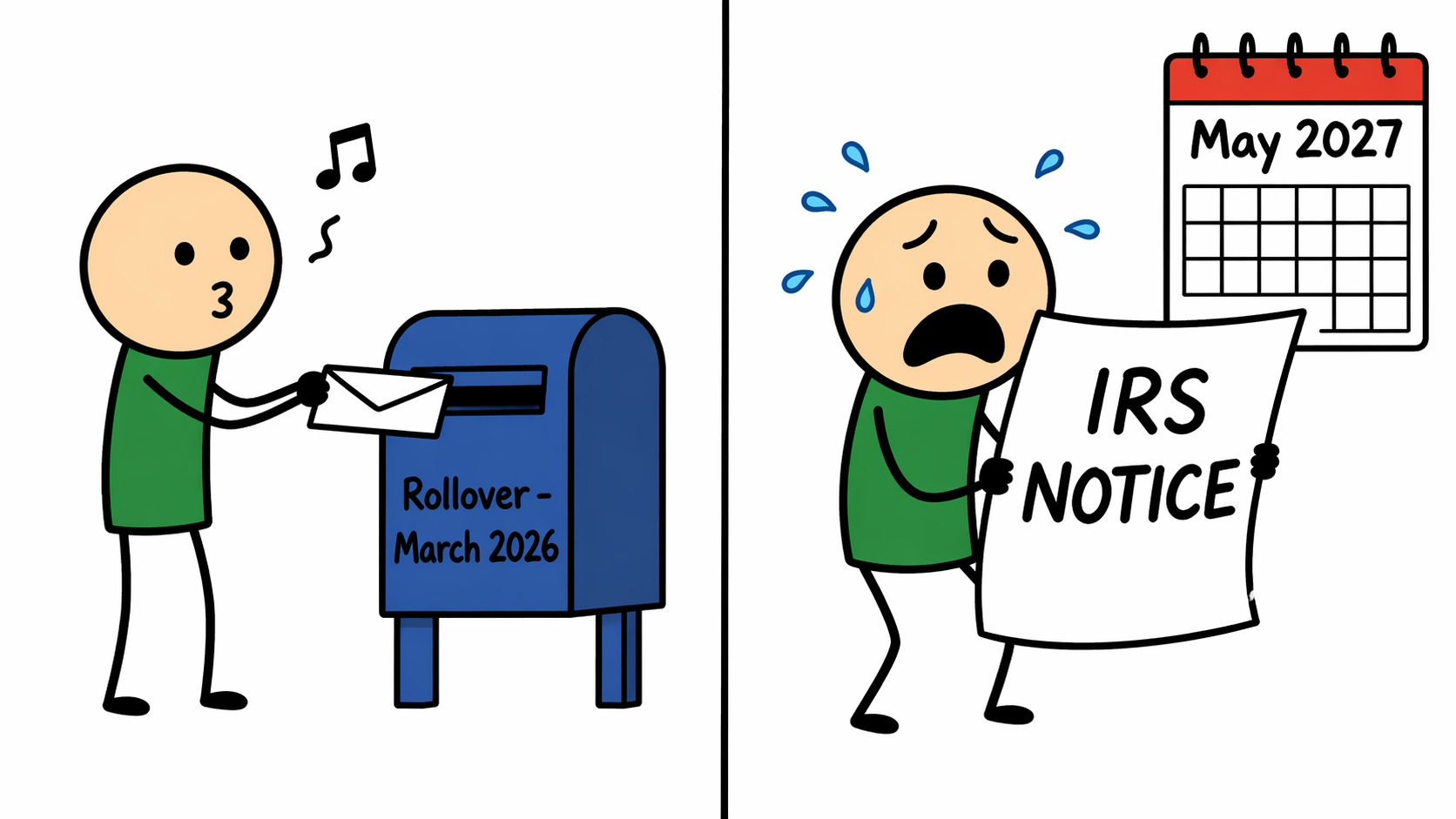
People think of IRS reporting as a real-time ledger, when in reality, it's more like a slow-motion game of telephone between two different institutions and a government computer.
The IRS does not find out about your rollover when it happens. It finds out months later, on its own schedule, through paperwork filed by your custodians. That time between the transaction and the reporting is where confusion and sometimes real problems live.
Tax-payers assume that when they move retirement money from one account to another, the IRS is notified in real time. As if there is some system that pings the IRS the moment a distribution leaves one custodian and arrives at another. There isn’t. The IRS learns about your rollover the same way it learns about your income: through forms, filed after the fact, on deadlines that don’t align with yours.
This means you can complete a rollover in March and the IRS won’t see both sides of the transaction until the following year. During that gap, your tax return is the only place the full story exists. If you tell it wrong, the IRS has no way to correct it until the matching forms arrive months later. And by then, the correction comes with a letter, not a conversation.
Two forms tell the IRS about a rollover. Form 1099-R reports the distribution from the account the money left. Form 5498 reports the contribution (or rollover deposit) into the account the money entered. These two forms are filed by two different custodians on two different timelines.
Form 1099-R is due to you and the IRS by January 31 of the year following the distribution. If you took a distribution in June, your old custodian must send you Form 1099-R by the following January 31. The IRS receives a copy on the same timeline.
Form 5498 is due to the IRS by May 31 of the year following the contribution. If you deposited the rollover into your new IRA in July, your new custodian files Form 5498 by the following May 31.
That means the IRS receives the distribution report in January and the rollover confirmation four months later in May. For four months, the IRS has a record showing you took money out of a retirement account and no record showing you put it back. If you filed your tax return in February reporting the transaction as a non-taxable rollover, the IRS is taking your word for it until May, when the matching form either confirms or contradicts what you reported.
This is not a flaw in the system. It is the system. The IRS uses a matching process that compares 1099-R data against 5498 data against your tax return. But those three pieces of information arrive at different times. The 1099-R comes first. Your tax return comes second. The 5498 comes last. If all three agree, nothing happens. If they don’t, you hear about it.
Say you leave your employer in April. You request a direct rollover of your 401(k) balance of $200,000 into your traditional IRA. The money moves from your old plan to your new custodian by early May.
The following January, your old custodian sends you Form 1099-R showing a $200,000 distribution. Box 7 shows distribution code G, which means direct rollover. This form also goes to the IRS.
You file your tax return in February. On your return, you report the $200,000 distribution and indicate it was rolled over. No tax owed.
In May, your new custodian files Form 5498 showing a $200,000 rollover contribution to your IRA. This form goes to the IRS. It also comes to you, though many people ignore it or don’t recognize what it is.The IRS now has all three pieces. The 1099-R matches the 5498 matches your tax return. The transaction is reconciled. You never hear a word.
Now change one detail. Say Fidelity uses the wrong distribution code on your 1099-R. Instead of code G (direct rollover), they use code 1 (early distribution, no known exception). This happens more often than you would expect. The IRS receives a form saying you took an early distribution of $200,000. Your tax return says it was a rollover. The 5498 confirming the rollover deposit won’t arrive for another four months.
In the meantime, the IRS matching system flags the discrepancy. You may receive a CP2000 notice proposing additional tax on $200,000 in income you never actually received as income. This is an automated notice. No human reviewed your return. The IRS matching system saw a distribution without a corresponding rollover deposit and generated the letter automatically. The notice is not a bill. It is a proposed adjustment. But it requires a response, documentation, and sometimes months of back-and-forth to resolve.
The fix is straightforward. You respond with a copy of your 1099-R, a letter explaining the code was incorrect, and ideally a corrected 1099-R from Fidelity. But the process takes time, and during that time, the IRS has a proposed tax assessment sitting on your account. If you ignore the notice or miss the response deadline, the proposed assessment becomes an actual assessment. Then you owe money you never should have owed, and unwinding it becomes significantly harder.
The time gap also creates problems for people who complete rollovers across calendar years. If you take a distribution in November and deposit it into an IRA the following January (within the 60-day window), the 1099-R for the distribution is reported on the year the money came out. But the 5498 for the deposit is filed for the following tax year, because that is when the money arrived at the new custodian.
Your tax return for the distribution year shows a distribution. Your Form 5498 for that same year does not show a matching rollover deposit because the deposit happened the next calendar year. The IRS matching process sees a distribution with no corresponding rollover. Another potential CP2000 notice.
The way to handle this is on your tax return. When you report the distribution on your return, you indicate that it was rolled over, even though the deposit occurred in January at the beginning of the following year. The IRS allows this because the 60-day window spans across the calendar year. But you need to report it correctly, and you need to keep documentation showing the deposit date fell within the 60-day window. If the IRS questions it, the timeline is your defense.
The reporting gap is not something you can close. You cannot make Fidelity file Form 1099-R faster or make Schwab file Form 5498 sooner. The timeline is set by IRS filing deadlines, and custodians follow those deadlines, not yours.
What you can control is your own documentation. Keep a record of when the distribution was taken, when the money was received, when the deposit was made, and into which account. Keep copies of both forms when they arrive. If a rollover spans two calendar years, note the dates clearly so you can explain the gap on your return if the IRS asks.
The process works. It just works slowly. And in the months between when you move the money and when the IRS confirms the move was valid, your records and your tax return are the only proof that the transaction went the way you intended.
I write one of these every day, one retirement rule, explained in plain language and verified against the source. The daily email is free: subscribe here.
Full archive, worksheets, and search live at RetirementNewsRundown.com.
Disclaimer This article is for educational and informational purposes only. It is not tax, legal, or financial advice and does not create an advisor-client relationship. Always consult appropriate professionals regarding your specific situation.