A rollover is not valid because you intended it to be a rollover, or because your custodian accepted the deposit. It’s not valid because your statement labels it as one. A rollover is valid because it met every requirement the IRS set for that specific type of transaction. Miss one requirement, and the entire deposit gets reclassified as something else. Usually something taxable, like a distribution.
People treat rollovers like bank transfers. Money leaves one account, lands in another, done. But the IRS does not see it that way. A rollover is a tax-privileged event. It lets you move money between retirement accounts without triggering income tax. That privilege comes with conditions. The IRS does not grant tax-free treatment and then verify later. It assumes the transaction is taxable and waits for you to prove it wasn’t.
There is no single rule that determines whether a rollover is valid. There are several, and every one of them must be satisfied simultaneously. Fail any single condition and the rollover fails entirely, regardless of how many other conditions you met.
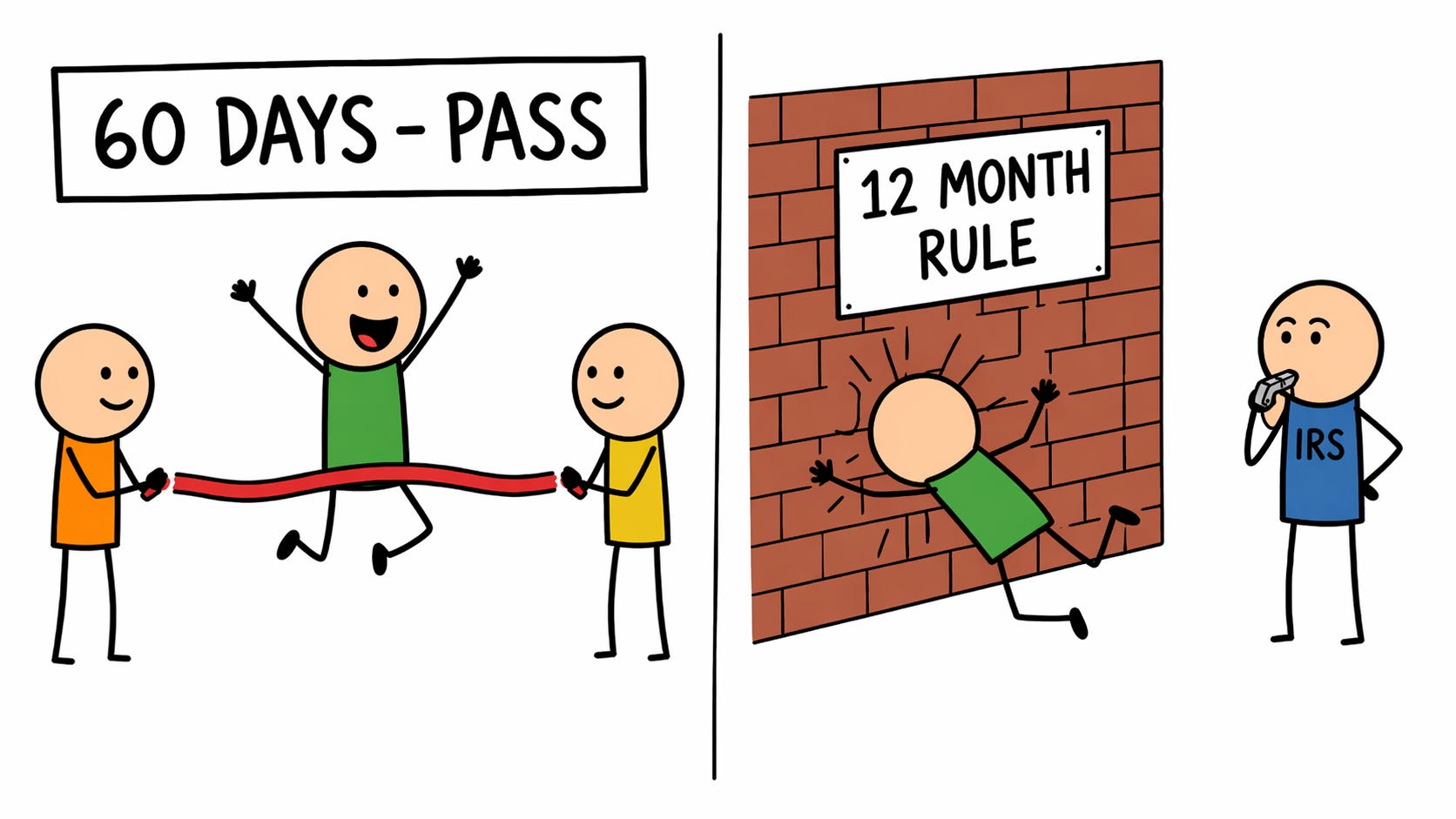
The first condition is the 60-day window. For an indirect rollover where the money passes through your hands, the full amount must be deposited into an eligible retirement account within 60 calendar days of the date you received the distribution. Not 60 business days. Not 60 days from when you requested it. Sixty calendar days from the day the check arrived or the funds hit your bank account.
The second condition is the once-per-year limit. For IRA-to-IRA indirect rollovers, you are allowed one per rolling 12-month period across all of your IRAs combined. This is not a calendar-year rule. If you completed an indirect IRA rollover on March 10, you cannot complete another one until March 11 of the following year. This limit does not apply to direct trustee-to-trustee transfers, and it does not apply to rollovers from employer plans like 401(k)s into IRAs.
The third condition is account eligibility. The money must move between compatible account types. Traditional IRA funds can roll into another traditional IRA or into a Roth IRA (which is a conversion, not a rollover, and triggers income tax). Roth IRA funds can roll into another Roth IRA but cannot go into a traditional IRA. Inherited IRA funds generally cannot be rolled into your own IRA unless you are a surviving spouse who elects to treat the account as your own. SIMPLE IRA funds cannot be rolled into a traditional IRA within the first two years of participation without triggering a 25% penalty.
The fourth condition is the full amount requirement. If your distribution was subject to mandatory 20% withholding (which applies to indirect rollovers from employer plans), you must deposit the full pre-withholding amount, not just the check you received. The difference must come out of your own pocket. If you deposit only the net amount, the withheld portion is treated as a taxable distribution.
The fifth condition is proper reporting. You must report the rollover correctly on your tax return. The distribution appears on your return as reported on Form 1099-R. You then indicate the amount that was rolled over. If you fail to report it, or report it incorrectly, the IRS treats the distribution as taxable income, even if the money is sitting in an IRA.
Every one of these conditions operates independently. You can meet the 60-day window, deposit the full amount, and move it into the right type of account, but if you already completed an indirect IRA rollover in the last 12 months, the transaction fails. You can satisfy the once-per-year rule and the account eligibility rule, but if you deposit the money on day 61, it fails. Each condition is a gate. The rollover must pass through all of them.
Say someone leaves a job in March and has $150,000 in a 401(k). They request a distribution. The plan withholds 20%, so they receive $120,000. They deposit the $120,000 into a traditional IRA within 45 days. They have met the 60-day window. The account types are compatible. They have not done another indirect IRA rollover recently. They report it on their tax return.
But they only deposited $120,000. The distribution was $150,000. The $30,000 that was withheld is treated as a taxable distribution because it was not replaced within the 60-day window. Four out of five conditions met. One missed. The IRS taxes the $30,000 as ordinary income, and if the person is under 59½, adds the 10% early withdrawal penalty on top. That is $3,000 in penalty plus income tax at their marginal rate on money that went straight from their old plan to the IRS.
Now take a different scenario. Someone has two traditional IRAs. They take an indirect rollover from IRA #1 to IRA #2 in January. Everything goes perfectly. Sixty-day window met. Full amount deposited. Properly reported. Valid rollover.
In September of the same year, they want to move IRA #3 to IRA #4. They take a distribution, deposit it within 60 days, and their custodian accepts it. Statement shows a rollover. But this is the second indirect IRA-to-IRA rollover within a 12-month period. The first one used up their allowance. The second one is not a rollover. It is a taxable distribution. And the deposit into IRA #4 is now an excess contribution, subject to a 6% penalty for every year it remains.
The custodian at IRA #4 did not flag this. They had no way to know about the rollover from IRA #1 to IRA #2. The once-per-year rule is tracked by the IRS, not by your custodian. The problem won’t surface until the IRS compares the 1099-R forms and sees two indirect rollovers within 12 months.
The question people ask most often is whether the IRS will catch a failed rollover. The answer is almost always yes, but not immediately. The IRS matching process compares Form 1099-R (distribution) against Form 5498 (deposit) against your tax return. That process runs on a delay. The 1099-R arrives in January. The 5498 arrives in May. The matching happens sometime after that. A notice can show up a year or more after the transaction.
The delay creates a false sense of security. The money is in the account. The statement looks right. No letter from the IRS. Everything must be fine. Then a CP2000 notice arrives 14 months later proposing additional tax on a distribution the IRS does not believe was a valid rollover.
The simplest way to ensure a rollover is valid is to avoid the conditions that can fail. A direct rollover, where the money moves from one custodian to another without passing through your hands, eliminates the 60-day window, the withholding problem, and the once-per-year limit for IRA-to-IRA moves. It does not eliminate the account eligibility requirement, so you still need to confirm the source and destination accounts are compatible. But it removes the three conditions that trip up the most people.
If you completed an indirect rollover recently, or are planning one, the checklist is short. Was the money deposited within 60 days of receipt? Was the full distribution amount deposited, including any withheld taxes? Was this the only indirect IRA-to-IRA rollover in the last 12 months? Are the source and destination account types compatible? Is it reported correctly on the tax return?
Five questions. All must be yes. Anything less and the rollover is not valid, regardless of what your statement says.
I write one of these every day, one retirement rule, explained in plain language and verified against the source. The daily email is free: subscribe here.
Full archive, worksheets, and search live at RetirementNewsRundown.com.
Disclaimer This article is for educational and informational purposes only. It is not tax, legal, or financial advice and does not create an advisor-client relationship. Always consult appropriate professionals regarding your specific situation.