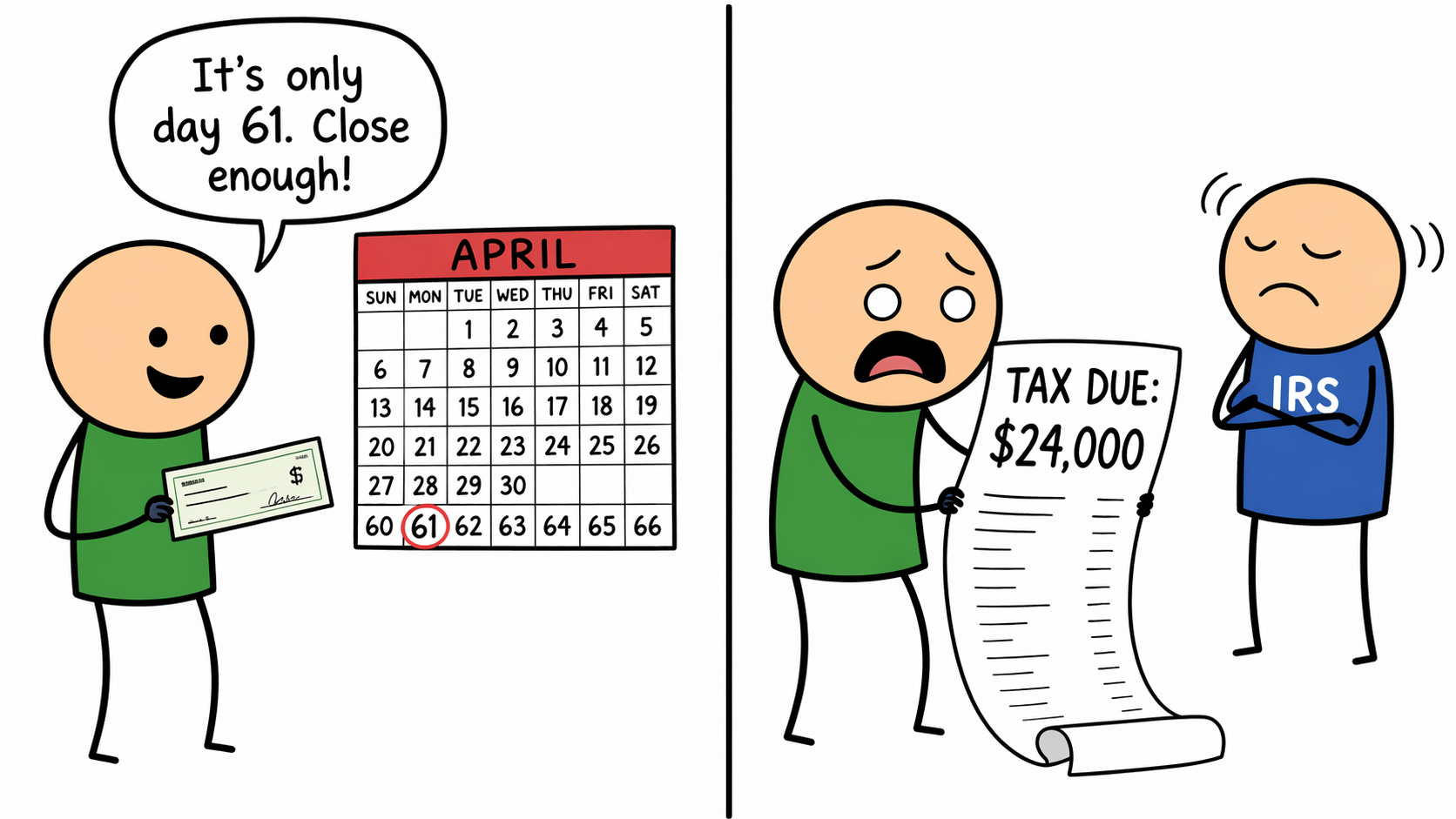
The retirement system is full of mistakes that can be corrected. Excess contributions can be withdrawn. Recharacterizations can undo the wrong IRA contribution type. Even a missed RMD has a correction path with a reduced penalty. But a missed 60-day rollover deadline sits in a category almost by itself. Calendar reference: Retirement Account Deadlines (60-day rolling window section). The fix is narrow, the burden of proof is on you, and the IRS default position is that you owe the tax.
Most people who miss the deadline assume there is an appeals process or a form they can file to make it go away. Something like an extension request or a penalty abatement. There isn’t. The 60-day rule is not a soft deadline with a built-in grace period. When the window closes, the distribution is reclassified as taxable income, and the IRS treats that reclassification as final unless you can prove that the delay was caused by something specific, documented, and outside your control.
The difference between a missed RMD and a missed rollover deadline is the correction architecture. RMDs have a formal correction process. Rollovers have a narrow exception and a lot of hope.
The IRS offers exactly two paths for someone who missed the 60-day window. The first is the self-certification process under Revenue Procedure 2016-47 (updated and expanded in Revenue Procedure 2020-46). The second is a private letter ruling. One is free and fast. The other costs over $3,500 and takes months. Neither one is guaranteed to work.
The self-certification process allows you to make a late rollover contribution and certify in writing to the receiving custodian that the delay was caused by one of twelve specific reasons listed by the IRS. These reasons include a distribution check that was misplaced and never cashed, a deposit that was made into the wrong account type through no fault of your own, a death in the family, a serious illness that prevented you from completing the rollover (the IRS sets a high bar here, a routine procedure or minor injury is unlikely to qualify, but an ICU stay or extended hospitalization that physically prevented you from managing the deposit would), a postal error, a bank error, or a federally declared disaster. You sign a letter. The custodian accepts the deposit. The rollover is treated as timely.
The key word is “specific.” You cannot self-certify because you forgot. You cannot self-certify because you were busy. You cannot self-certify because you didn’t understand the rule. You cannot self-certify because your financial advisor didn’t tell you about the deadline. None of those qualify. The IRS listed twelve reasons, and if yours is not on that list, the self-certification path is closed.
The certification is also not a free pass. The IRS reserves the right to audit the certification. If the IRS determines that your stated reason was inaccurate, the rollover is disqualified retroactively. You owe the tax, the penalty, and potentially accuracy-related penalties on top. Self-certifying is not the same as being approved. It is a conditional acceptance that can be challenged later.
The second path is a private letter ruling. You submit a formal request to the IRS asking them to grant you additional time to complete the rollover. The current filing fee is $3,500. The process can take six months or longer. And the IRS can say no. A private letter ruling makes sense when the amount involved is large enough to justify the cost and the delay was clearly caused by circumstances that fall outside the self-certification list but still demonstrate reasonable cause.
For most people, a private letter ruling is still a steep price for a mistake. If you missed the 60-day window on a $25,000 distribution, spending $3,500 to request a ruling on $6,000 in tax is a painful but at least plausible calculation.
Say someone takes a distribution of $75,000 from a traditional IRA in March. They receive the check and set it on their desk. Life gets busy. By the time they get around to depositing it, 68 days have passed. Eight days late.
The $75,000 is now taxable income. At the 22% bracket, that is $16,500 in federal tax. If they are under 59½, add the 10% early withdrawal penalty: $7,500. Total exposure: $24,000.
They call their custodian. The custodian says they can still deposit the money, but they cannot accept it as a rollover because the 60-day window has passed. The deposit would be treated as a regular contribution, subject to annual contribution limits. A $75,000 “contribution” would exceed the annual limit by roughly $68,000, creating an excess contribution with its own 6% annual penalty.
They look into self-certification. None of the twelve approved reasons apply. They weren’t sick. The check wasn’t lost in the mail. There was no disaster. They simply didn’t deposit it in time.
They look into a private letter ruling. The fee is $3,500. Their tax exposure is $24,000. They would spend $3,500 for a chance (not a guarantee) of saving $24,000, with a decision arriving six months from now. During those six months, the tax liability sits on their return, potentially accruing interest.
The realistic outcome: they report the distribution as taxable income, pay the tax, pay the penalty if applicable, and move on. The $75,000 is no longer in a retirement account. It is after-tax money in a bank account. The tax-deferred status is gone permanently. They can contribute to an IRA going forward using normal annual contribution limits, but rebuilding $75,000 in tax-deferred savings at $7,000 per year takes over a decade.
Eight days cost them $24,000 and a decade of contribution capacity.
The reason this deadline is so hard to fix is structural. The IRS designed the 60-day window as a limited exception to the general rule that distributions are taxable. The default is taxation. The rollover is the exception. When the exception’s conditions aren’t met, the default takes over. There is no middle ground, no partial rollover for partial compliance, and no sliding scale based on how close you came.
Other retirement mistakes have correction mechanisms because Congress or the IRS built them into the rules. Excess contributions have removal deadlines and absorption options. Missed RMDs have the corrective distribution process with a reduced penalty. Recharacterizations had explicit statutory authority (until Congress eliminated them for conversions). These corrections exist because lawmakers recognized that people make honest mistakes and provided structured ways to fix them.
The 60-day rollover received a much smaller safety net. The self-certification process is relatively new (the original revenue procedure was issued in 2016) and covers a limited set of scenarios. Before 2016, the only option for a missed deadline was the private letter ruling. The IRS has expanded the relief over time, but it remains narrow compared to other retirement correction mechanisms.
If you are inside a 60-day window right now, treat the deadline the way you would treat a flight departure time. Being at the gate five minutes after the door closes produces the same result as being there five hours late. The plane left. The deadline passed. And the cost of missing it is disproportionate to the effort required to meet it.
The clearest way to avoid the problem entirely is to never start the clock. A direct rollover moves the money from one custodian to another without a distribution to you. No check in your name. No 60-day window. No deadline to miss. No self-certification to hope for. The money moves and the IRS never treats it as a distribution.
I write one of these every day, one retirement rule, explained in plain language and verified against the source. The daily email is free: subscribe here.
Full archive, worksheets, and search live at RetirementNewsRundown.com.
Disclaimer This article is for educational and informational purposes only. It is not tax, legal, or financial advice and does not create an advisor-client relationship. Always consult appropriate professionals regarding your specific situation.