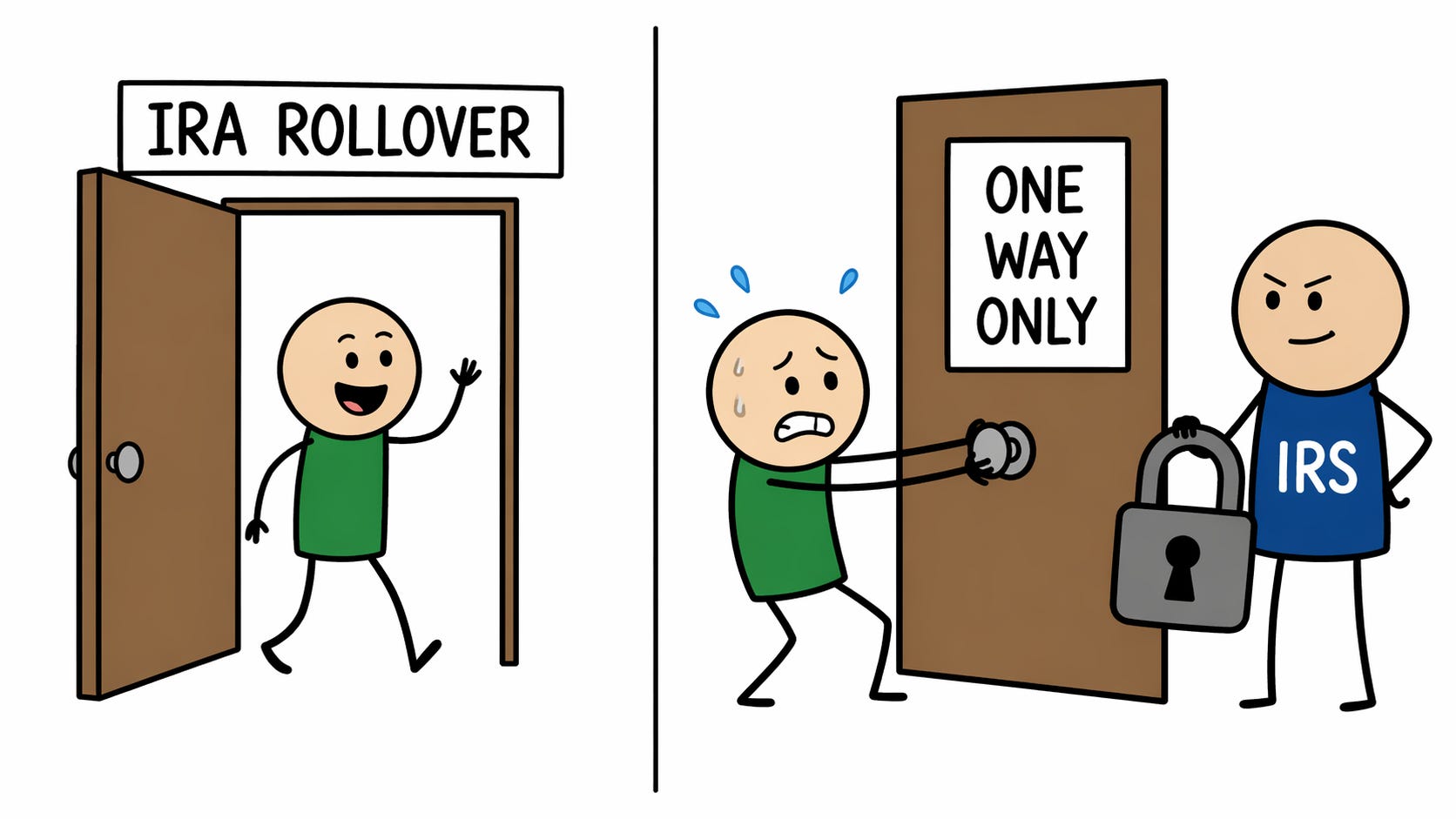
Most financial transactions have an undo button somewhere. Cancel the trade. Reverse the wire. Dispute the charge. Retirement accounts do not work that way. Once a rollover is complete, the money has a new home and the old home does not have to take it back. There is no reversal mechanism built into the system. The IRS considers a completed rollover a finished transaction, and your only options going forward are the options that exist inside the new account.
People discover this at the worst possible time. They roll a 401(k) into an IRA, realize they lost access to a feature the 401(k) offered, and call their old plan to ask if they can send the money back. The answer is almost always no. Not because the plan administrator is being difficult. Because the plan is not required to accept incoming rollovers, and most plans that do accept them have restrictions on what they will take and when.
The moment the money lands in the new account and the rollover is recorded, the transaction is final. Everything after that is a new decision, not a correction of the old one.
A rollover becomes irreversible at the point of completion. For a direct rollover, that is the moment the funds arrive at the receiving custodian and are deposited into the new account. For an indirect rollover, that is the moment you deposit the distribution into the receiving account within the 60-day window. In both cases, the receiving custodian records the deposit, reports it on Form 5498, and the IRS treats the rollover as a closed transaction.
There is no IRS mechanism to reverse a completed rollover. You cannot call your new custodian and say “send it back.” You cannot file a form requesting that the IRS treat the rollover as if it never happened. You cannot amend your tax return to undo the reporting. The money moved. The forms were filed. The transaction is done.
This was not always the case for every type of retirement account movement. Before the Tax Cuts and Jobs Act, you could recharacterize a Roth conversion. That meant if you converted traditional IRA funds to a Roth, decided it was a mistake (usually because the account dropped in value and you owed taxes on money that had since disappeared), you could reverse the conversion by the tax filing deadline, including extensions. The money went back to the traditional IRA and the IRS treated the conversion as if it never occurred.
The Tax Cuts and Jobs Act eliminated that option for conversions. Starting with conversions made after December 31, 2017, recharacterization of Roth conversions is permanently off the table. If you convert $100,000 from a traditional IRA to a Roth and the account drops to $60,000 the next month, you still owe income tax on $100,000. You cannot send the money back to the traditional IRA and undo the tax hit.
Recharacterization still exists for contributions. If you contribute to a Roth IRA and later realize your income was too high, you can recharacterize that contribution as a traditional IRA contribution by your tax filing deadline, including extensions. But this applies only to contributions, not to conversions and not to rollovers from employer plans.
A rollover from a 401(k) to an IRA has never been reversible through recharacterization. That was always a one-way door. The recharacterization rules applied to IRA-to-IRA movements and Roth conversions. A 401(k)-to-IRA rollover was final the moment it was complete, even before the Tax Cuts and Jobs Act changed the rules.
Say someone retires and rolls $500,000 from their 401(k) into a traditional IRA. Direct rollover. Clean transaction. No tax consequences. The money is now in the IRA.
Six months later, they learn that their old 401(k) offered access to an institutional share class of a fund that charges 0.02% in fees. The same fund in their IRA charges 0.50%. On $500,000, that is the difference between $100 per year and $2,500 per year. Over 20 years, the fee difference compounds into tens of thousands of dollars.
They call their old employer’s plan. Can I roll the money back? The plan administrator says no. Their plan does not accept incoming rollovers from IRAs. Many 401(k) plans do not. There is no IRS rule requiring them to. The employer plan has the discretion to accept or reject incoming rollovers, and most plans that do accept them only accept rollovers from other employer plans, not from IRAs.
The money stays in the IRA. The fee difference is permanent. The decision cannot be undone.
Now take another scenario. Someone rolls a traditional IRA into a Roth IRA. This is a Roth conversion, and it triggers income tax on the full converted amount. They convert $200,000 in January, expecting their income to be low enough that the conversion stays in the 22% bracket.
By October, their income is higher than expected. A bonus, a stock sale, freelance income. The $200,000 conversion now pushes them into the 32% bracket. The tax cost jumped from $44,000 to $64,000. An extra $20,000 in tax they did not plan for.
Before the Tax Cuts and Jobs Act, they could have recharacterized the conversion by the tax filing deadline, moved the money back to the traditional IRA, and erased the tax bill. After the Tax Cuts and Jobs Act, that door is closed. The conversion stands. The $64,000 tax bill is real. Their only option is to pay it.
They could convert some of the Roth funds back to a traditional IRA through a new contribution or rollover, but that creates a new taxable event going in the other direction and does not undo the original conversion. It is a new transaction with its own rules and consequences, not a reversal.
The irreversibility of rollovers catches people most often in three scenarios. The first is the 401(k)-to-IRA rollover where the person loses access to plan-specific features like institutional pricing, loan provisions, or creditor protection under ERISA (which is stronger for 401(k) assets than for IRA assets in most states). The second is the Roth conversion where income turns out higher than expected and the tax bill is larger than planned. The third is the SIMPLE IRA rolled to a traditional IRA within the first two years of participation. The two-year clock starts on the date of your first contribution to the SIMPLE, not the date the account was opened. If you roll the funds out before that clock expires, the IRS does not treat it as an invalid rollover that can be corrected. It treats the distribution as taxable income and applies a 25% early withdrawal penalty instead of the standard 10%. The penalty is punitive by design. And because the rollover itself is considered a completed transaction, you cannot send the money back to the SIMPLE IRA to undo the damage. The distribution happened. The penalty applies. The money is now in the traditional IRA with a tax bill attached to the transfer that was supposed to be tax-free.
In each case, the person assumed they could reverse course if things didn’t work out. They couldn’t. The system does not offer a return policy.
The question to ask before completing any rollover is not “can I undo this?” The answer to that question is almost always no. The question to ask is “do I understand every consequence of this transaction before it becomes permanent?” That includes the tax impact, the fee impact, the feature access, the creditor protection differences, and the reporting requirements.
A rollover is a one-way door. You can walk through it carefully after examining what is on the other side, or you can walk through it quickly and hope for the best. But once you are through, the door locks behind you. The retirement system was designed that way on purpose. Tax-privileged transfers come with finality because the IRS does not want people moving money back and forth between accounts to game the tax code. The trade-off for tax-free movement is that the movement is permanent.
I write one of these every day, one retirement rule, explained in plain language and verified against the source. The daily email is free: subscribe here.
Full archive, worksheets, and search live at RetirementNewsRundown.com.
Disclaimer This article is for educational and informational purposes only. It is not tax, legal, or financial advice and does not create an advisor-client relationship. Always consult appropriate professionals regarding your specific situation.