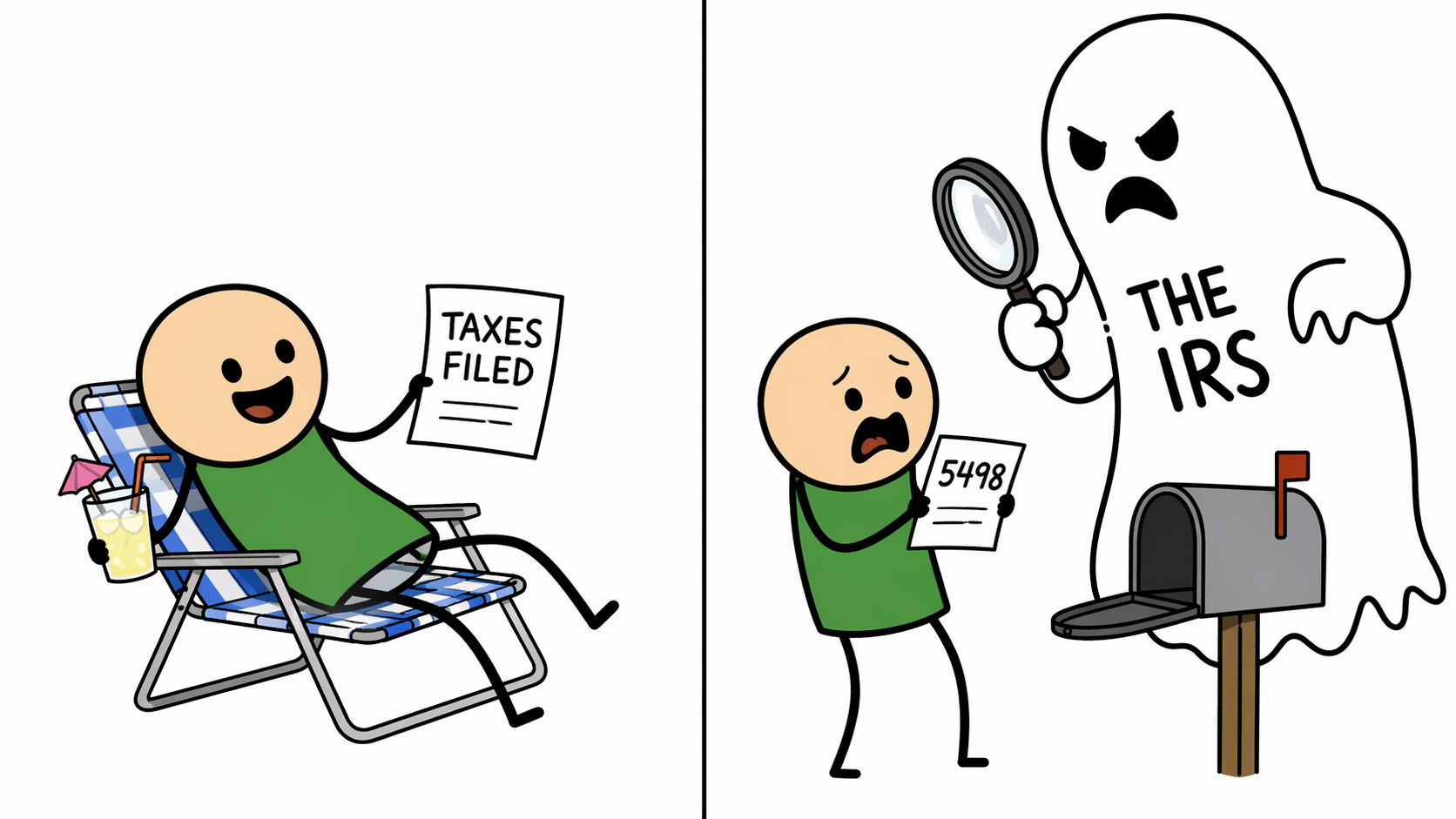
Filing your tax return feels like closing the book on the year. Everything is reported. Everything is reconciled. You hit submit, get your refund or pay your balance, and move on. Except the IRS is not done with your retirement accounts just because you filed. Not even close.
The retirement reporting system operates on a different calendar than your tax return. Some forms arrive before you file. Some arrive after. And some of the most important ones land in your mailbox in May or June, long after your return has been accepted and your refund has been spent. Most people throw them in a drawer or ignore them entirely because they assume anything that matters was already on their return. That assumption is where problems start.
Your tax return captures one side of your retirement account activity: the taxable events. Distributions show up on Form 1099-R, which arrives by January 31. Roth conversions show up there too. If you had taxable income from a retirement account, it is on your return. Filed and done.
But the other side of the equation, the contributions, rollovers, fair market values, and required minimum distributions, is reported on Form 5498. And Form 5498 is not due to you or the IRS until May 31 of the year following the activity. That means your custodian is still compiling and filing information about your retirement accounts months after your tax return has been submitted.
Form 5498 reports several things the IRS cares about. It shows the total contributions you made to your IRA for the tax year, broken down by type (traditional, Roth, rollover, SEP, SIMPLE). It shows the fair market value of the account as of December 31. And for people who are subject to required minimum distributions, it shows whether an RMD is required for the following year and what the fair market value is that will be used to calculate that RMD.
None of this information is on your tax return. Your return reports what came out of your accounts. Form 5498 reports what went in and what the accounts are worth. The IRS needs both halves to build a complete picture.
The timing gap between your return and Form 5498 creates a window where the IRS is working with incomplete information. You file in February. Your 1099-R is on file. The IRS sees your distributions and how you reported them. But the 5498 confirming your rollover deposit, your contribution amounts, or your year-end balance does not arrive until May.
During that window, the IRS matching system has a distribution with no corresponding rollover. It has a reported contribution with no custodian confirmation. It has a return that says “I rolled this over” with no third-party verification. The IRS accepts your return, processes your refund, and waits. When the 5498 arrives, the matching begins.
If everything matches, nothing happens. If the 5498 shows a different rollover amount than what you reported, or shows no rollover at all, or shows contributions that exceed the annual limit, the IRS flags it. The result is usually a CP2000 notice, which is an automated letter proposing changes to your return. Not an audit. Not a penalty notice. A computer-generated letter that says “we think your return is wrong based on the forms we received.”
The notice can arrive a year or more after you filed. By that point, you have probably forgotten the details of the transaction. The 1099-R is in a folder somewhere. The 5498 might have been thrown away. The letter references amounts and dates you don’t immediately recognize. And you have 30 days to respond with documentation or the proposed changes become the actual changes.
This is why Form 5498 matters even though it arrives after your return is filed. It is the confirmation document. It is the receipt the IRS uses to verify what you told them. Throwing it away is like throwing away the receipt for a warranty claim you might need to make later.
Say someone makes a $7,000 traditional IRA contribution in March and rolls over $85,000 from an old 401(k) in September. They file their tax return in February of the following year. The return reports the $85,000 rollover as non-taxable. The $7,000 contribution is claimed as a deduction.
The 1099-R from the old 401(k) custodian arrives in January, showing the $85,000 distribution with the appropriate rollover code. That matches the return. So far, so good.
The Form 5498 from the IRA custodian arrives in May. It shows the $85,000 rollover in Box 2 and the $7,000 contribution in Box 1. The fair market value of the account as of December 31 is in Box 5.
If the 5498 shows $85,000 in rollover contributions and $7,000 in regular contributions, the IRS matching system confirms the return is accurate. No notice. No follow-up.
But say the IRA custodian made an error. They recorded the $85,000 as a regular contribution instead of a rollover. Box 1 shows $92,000 in contributions. Box 2 shows $0 in rollovers. The IRS now sees $92,000 in IRA contributions for someone whose annual limit is $7,000. That is an $85,000 excess contribution. The IRS sends a notice. You now have to prove the $85,000 was a rollover, not a contribution, and get the custodian to file a corrected 5498.
The error was not yours. But the burden of resolving it is. And it surfaces months after you filed, triggered by a form most people never look at.
Form 5498 is not the only post-filing document that matters. Form 8606 tracks your non-deductible IRA basis over time. It is filed with your tax return, but its importance extends far beyond the current year. The basis you report on Form 8606 carries forward to every future year in which you take a distribution or make a conversion. If you made non-deductible contributions and did not file Form 8606, your basis is not recorded. When you eventually take distributions, the IRS has no record that some of your IRA money was already taxed. The result is double taxation on money you already paid tax on, and reconstructing the basis years later requires bank statements and custodian records that may no longer exist.
Form 5329 is another post-filing concern. If you had a required minimum distribution and did not take it, Form 5329 is where the 25% excise tax is calculated and reported. If you had an excess contribution that was not corrected, Form 5329 is where the 6% annual penalty is reported. These forms are sometimes filed separately from your main return, and the penalties they calculate can apply for multiple years if the underlying issue is not resolved.
Filing your tax return settles your income tax for the year. It does not settle your retirement account reporting. The forms that arrive after your return confirm, contradict, or extend what you reported. They are the second half of the conversation between you and the IRS, and ignoring them because you already filed is how small mismatches become large tax problems months or years later.
When Form 5498 arrives in May or June, open it. Compare the rollover amount in Box 2 against what you reported. Compare the contribution amount in Box 1 against what you claimed. If the numbers match your return, keep the form with your tax records. If they don’t, contact your custodian immediately and request a correction before the IRS matching system finds the discrepancy for you.
I write one of these every day, one retirement rule, explained in plain language and verified against the source. The daily email is free: subscribe here.
Full archive, worksheets, and search live at RetirementNewsRundown.com.
Disclaimer This article is for educational and informational purposes only. It is not tax, legal, or financial advice and does not create an advisor-client relationship. Always consult appropriate professionals regarding your specific situation.