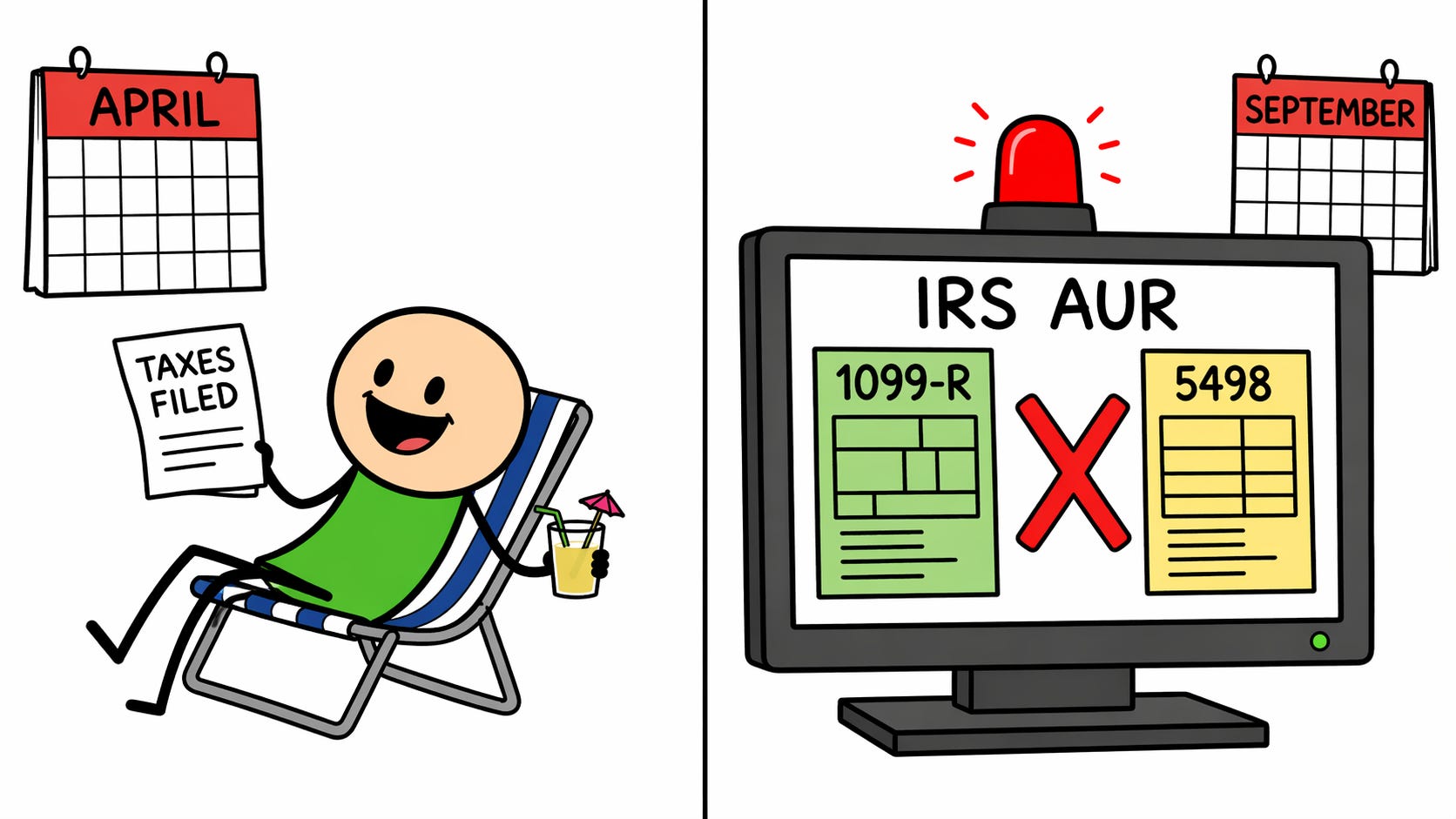
The IRS does not review your retirement account activity in real time. It collects forms from multiple sources on different schedules, stores them, and then runs a matching program that compares everything at once. The comparison does not happen when you file your return. It happens months later, after every custodian, employer plan, and financial institution has submitted their side of the paperwork.
Most people picture a person at a desk reading their tax return line by line. That is not how it works. The IRS runs an automated system called the Automated Underreporter Program, or AUR. It compares the income, deductions, and credits on your return against the information returns filed by third parties. For retirement accounts, that means your 1099-R, your 5498, your 8606, and your return all get fed into the same system and checked against each other by a computer that is looking for one thing: mismatches.
The matching process starts after the IRS has received all three pieces of information: your tax return, Form 1099-R from the distributing custodian, and Form 5498 from the receiving custodian. Your return is typically filed between January and April. The 1099-R is due January 31. The 5498 is due May 31.
The earliest the IRS has all three documents for any given taxpayer is June. For people who file extensions, it could be as late as November or December before the full picture is assembled. The AUR program does not run on a fixed date. It processes in cycles throughout the year, typically beginning in the summer and continuing into the following year.
This means a mismatch from a rollover you completed in March might not generate a notice until the following fall or winter. The gap between the transaction and the notice can be 12 to 18 months. Sometimes longer.
The AUR system is comparing three things. First, did the distribution reported on Form 1099-R appear on your tax return? If your custodian reported a $50,000 distribution and your return does not mention it, the system flags it. Second, if you reported the distribution as a non-taxable rollover, does a Form 5498 from another custodian confirm a rollover deposit in the same amount? If not, the system flags it. Third, do the distribution codes on the 1099-R match how you reported the transaction? If the 1099-R shows code 1 (early distribution) and you reported it as a rollover, the system flags the discrepancy.
The system does not flag every mismatch immediately. Some discrepancies are resolved internally if the amounts are small or the codes are ambiguous. But material mismatches, especially those involving five-figure distributions reported as non-taxable, almost always generate a notice.
Say someone rolls $120,000 from a 401(k) into a traditional IRA in August. Direct rollover. The old plan custodian files a 1099-R in January showing a $120,000 distribution with code G (direct rollover). The new IRA custodian files a 5498 in May showing a $120,000 rollover contribution. The taxpayer files their return in March reporting the rollover as non-taxable.
The IRS receives the return in March, the 1099-R in January, and the 5498 in May. By June, all three are in the system. The AUR runs its comparison. Code G on the 1099-R matches the rollover treatment on the return. The 5498 confirms the deposit. All three agree. Nothing happens. The taxpayer never hears a word.
Now change one fact. The new custodian records the deposit as a regular contribution instead of a rollover. The 5498 shows $120,000 in Box 1 (contributions) and $0 in Box 2 (rollovers). The AUR sees a $120,000 distribution and no rollover confirmation. It also sees $120,000 in IRA contributions, which exceeds the annual limit by roughly $113,000. The system generates a CP2000 notice proposing tax on the distribution and flagging an excess contribution. Two problems created by one custodian error, surfacing 12 months after the money moved.
The CP2000 notice is not an audit. It is not a penalty. It is a proposed adjustment. The IRS is saying “the forms we received don’t match your return, and here is what we think you owe based on what we have.” You have 30 days to respond. If the notice is wrong, you respond with documentation showing the correct information: a corrected 5498 from the custodian, a copy of the rollover confirmation, or a letter explaining the discrepancy. If you do not respond within 30 days, the IRS assumes the proposed changes are correct and adjusts your account. At that point, the proposed tax becomes actual tax owed, and reversing it requires a formal dispute.
The 30-day response window on a CP2000 is administrative. The IRS will sometimes accept late responses, and you can request additional time. But if you ignore the CP2000, the IRS escalates to a Statutory Notice of Deficiency, also called a 90-day letter. That deadline is not flexible. Once the 90-day letter is issued, you have exactly 90 days to petition the Tax Court. The IRS cannot extend it. The court cannot extend it. If you miss it, the proposed tax becomes assessed tax and your only option is to pay it and then file for a refund. The CP2000 is your chance to resolve this with a phone call and some paperwork. The 90-day letter is the legal threshold. Everything after that involves the court system.
The AUR system also catches less obvious mismatches. If you reported a distribution as a rollover but your 1099-R shows a code that does not correspond to a rollover (code 1 instead of code G, for example), the system flags it even if the 5498 shows a matching rollover deposit. The code mismatch creates ambiguity the system cannot resolve on its own. The result is the same: a notice, a proposed adjustment, and a 30-day clock.
The IRS matching system is not trying to catch you doing something wrong. It is trying to reconcile what you reported against what your custodians reported. When all three sources agree, the system moves on. When they disagree, the system asks you to explain.
The practical takeaway is that retirement account transactions are not settled when you file your return. They are settled when the IRS completes its matching cycle, which is months later. Any transaction involving a distribution, a rollover, a conversion, or a large contribution will eventually be cross-referenced against third-party forms. If the forms agree, you never hear about it. If they don’t, you hear about it at the worst possible time, well after you’ve forgotten the details.
Keep your 1099-R. Keep your 5498 when it arrives in May or June. Keep your rollover confirmation letters. If a CP2000 ever arrives, those documents are your defense. Without them, the IRS has their numbers and you have your memory. The IRS wins that comparison every time.
I write one of these every day, one retirement rule, explained in plain language and verified against the source. The daily email is free: subscribe here.
Full archive, worksheets, and search live at RetirementNewsRundown.com.
Disclaimer This article is for educational and informational purposes only. It is not tax, legal, or financial advice and does not create an advisor-client relationship. Always consult appropriate professionals regarding your specific situation.