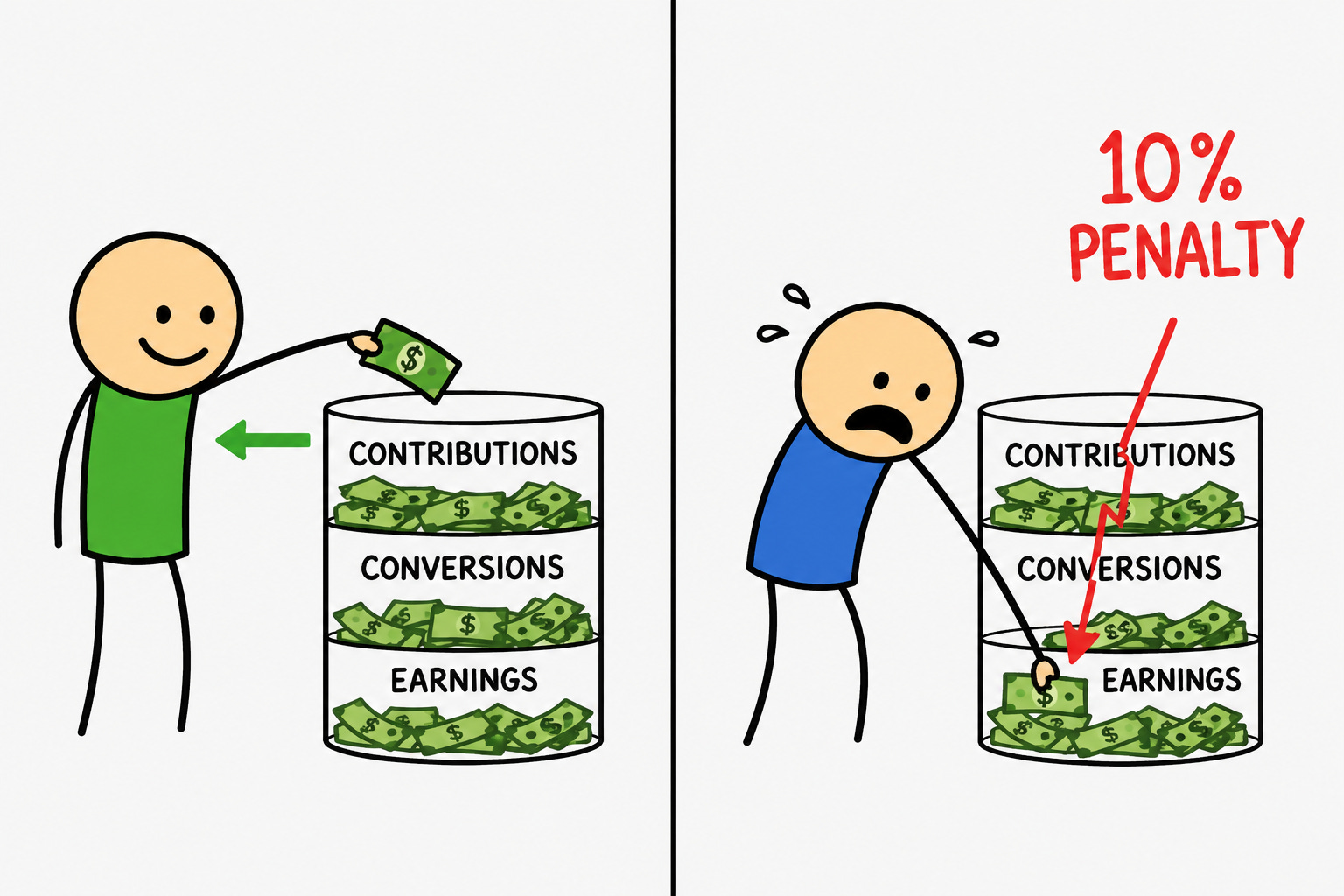
The Roth IRA holds three separate layers of money, and the tax system tracks each one as distinct even though the account statement shows a single balance. The three layers are the annual contributions the owner has made, the amounts converted or rolled into the Roth IRA, and the investment earnings the account has generated over time. A withdrawal does not come from whichever layer the owner prefers. The order is fixed by rule, and the layer a distribution reaches determines whether that distribution is tax-free, taxable, penalized, or some combination of the three.
Someone decides to pull money out of a Roth IRA before age 59½. They assume the entire balance is available tax-free, because tax-free is the reputation the Roth carries everywhere it is discussed. Whether that assumption holds has nothing to do with the Roth label and everything to do with which layer the withdrawal actually reaches.
Roth IRA distributions follow a fixed ordering rule. Contributions come out first. Converted amounts come out second, oldest conversion before newer ones. Earnings come out last. The account owner cannot choose a different order, and the custodian does not track withdrawals by what the owner intended. Every distribution draws from contributions until they are exhausted, then from conversions, then from earnings.
These ordering rules apply to Roth IRAs only. A designated Roth account inside a 401(k) or 403(b) uses pro-rata treatment instead, so a non-qualified withdrawal there pulls a proportional mix of contributions and earnings.
Contributions are the cleanest layer. Annual Roth contributions can be withdrawn at any time, at any age, free of tax and free of penalty. The money was already taxed before it went in, and the rules impose no waiting period on getting it back out. A person who has contributed twenty thousand dollars over several years can withdraw up to twenty thousand dollars without tax or penalty, regardless of age or how long the account has existed.
Earnings are the layer with real conditions attached. For earnings to come out tax-free, the distribution must be qualified. A qualified distribution requires two conditions, both satisfied at once. At least five years must have passed since January 1 of the year of the first Roth contribution, and one qualifying event must apply: reaching age 59½, death, disability, or a first-time home purchase up to a ten thousand dollar lifetime limit.
That five-year clock is a single clock. It starts January 1 of the tax year of the first Roth contribution and never resets. Opening new Roth accounts later does not start new clocks. Once five years have passed, the clock is satisfied permanently.
If earnings come out before the distribution is qualified, those earnings are ordinary income. If the owner is also under 59½ without a penalty exception, the earnings carry an additional 10% penalty on top of the income tax.
Conversions occupy the middle layer and carry their own separate rule. Each conversion starts its own five-year clock, beginning January 1 of the year of that conversion. If a conversion is withdrawn within five years and the owner is under 59½, the taxable portion of that conversion can carry a 10% penalty, even though income tax was already paid at the time of conversion. The rule exists because someone figured out that converting and immediately withdrawing was a tidy way around the early withdrawal penalty, and the IRS closed the door behind them. Once the owner reaches 59½, this conversion penalty no longer applies.
These clocks run on the calendar, not the tax-filing date, with one wrinkle. A contribution made before the tax-filing deadline and designated for the prior tax year counts as January 1 of that prior year for the five-year clock. There is no correction window that shortens either five-year period. Time passing is the only thing that satisfies them.
What happens if a withdrawal is taken later instead? Waiting works in the owner’s favor. Once the owner is 59½ and the original five-year clock is satisfied, every dollar in the account, including all earnings, comes out tax-free and penalty-free. The conversion clocks become irrelevant at that point too.
Devon made his first Roth IRA contribution in his early forties. Over the following years he contributed a total of thirty thousand dollars. The account grew to forty-five thousand dollars, meaning fifteen thousand dollars of earnings.
At age fifty Devon withdraws twenty thousand dollars. Under the ordering rule, that withdrawal comes entirely from his thirty thousand dollars of contributions. It is tax-free and penalty-free, even though Devon is under 59½ and the account holds earnings. He has only reached the contribution layer.
Now assume Devon instead withdraws the full forty-five thousand dollars at age fifty. The first thirty thousand dollars is contributions, tax-free and penalty-free. The remaining fifteen thousand dollars is earnings. Because Devon is under 59½ and the distribution is not qualified, that fifteen thousand dollars is ordinary income and also carries a 10% penalty. The same account produced two very different tax outcomes depending on how far into the layers the withdrawal reached.
If Devon waits until he is 59½ and his first contribution was more than five years earlier, the entire forty-five thousand dollars comes out tax-free and penalty-free. Nothing about the account changed except time.
A Roth IRA holds three layers with different rules, and a distribution is taxed based on the deepest layer it reaches. Contributions are always available without tax or penalty. Conversions sit behind a five-year penalty clock that matters only before age 59½. Earnings are tax-free only when the distribution is qualified, meaning the five-year clock and a qualifying event are both in place.
For anyone withdrawing an amount equal to or less than total contributions, none of the complexity applies. The fear that surrounds Roth withdrawals usually comes from assuming a withdrawal reaches the earnings layer when it does not. Knowing the size of each layer is what tells a person where they actually stand.
The rules reward patience in a straightforward way. Reach 59½, clear the five-year mark, and the entire account becomes what people assumed a Roth was the whole time.
I write one of these every day, one retirement rule, explained in plain language and verified against the source. The daily email is free: subscribe here.
Full archive, worksheets, and search live at RetirementNewsRundown.com.
Disclaimer This article is for educational and informational purposes only. It is not tax, legal, or financial advice and does not create an advisor–client relationship. Always consult appropriate professionals regarding your specific situation.