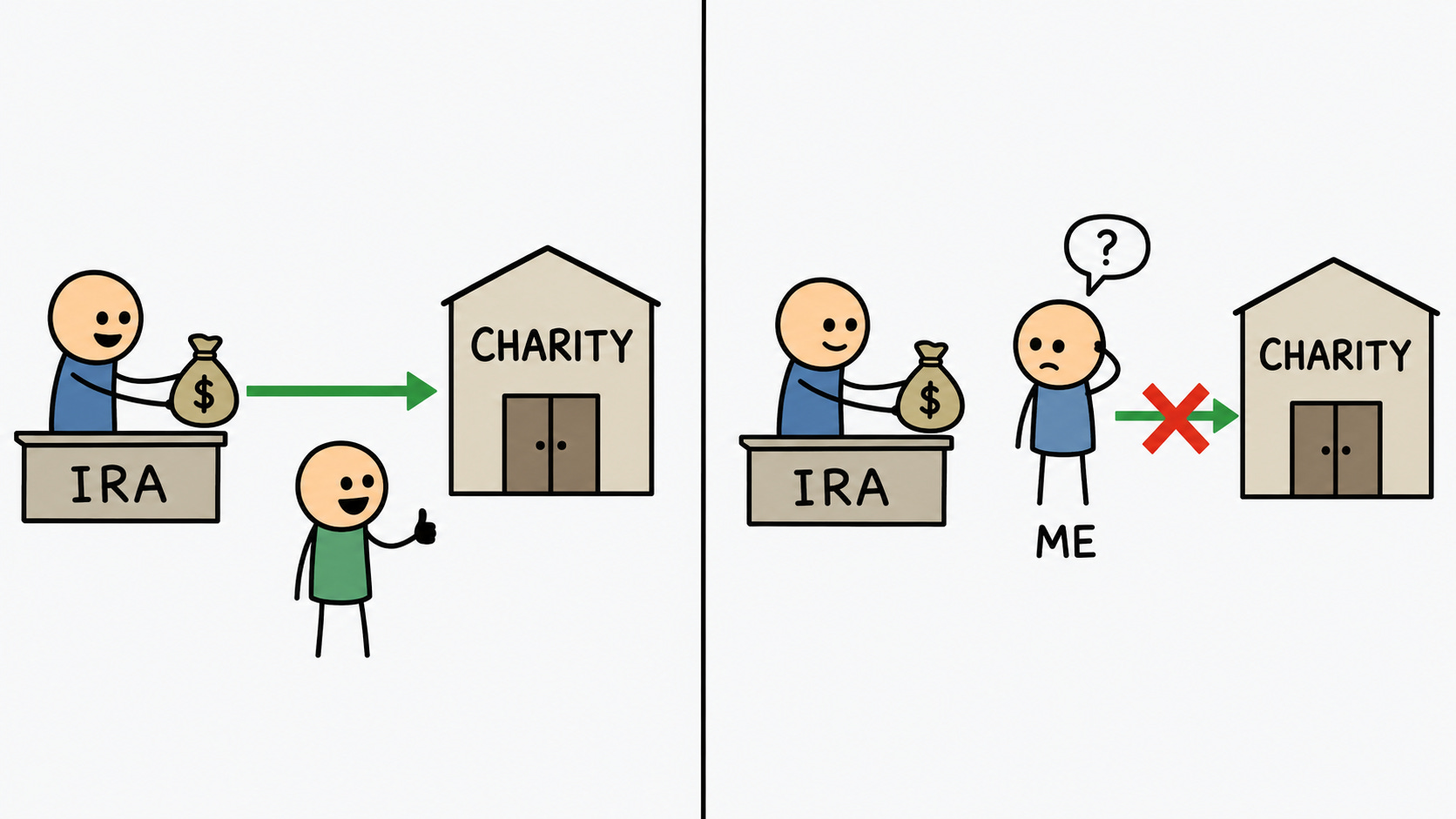
A QCD works only because the retirement system follows the money’s path. It does not care that your heart was generous. It does not care that the charity was real. It does not care that you meant well, which is unfortunate, because “I meant well” is apparently not a line on Form 1040.
For a Qualified Charitable Distribution to receive QCD treatment, the money has to leave the IRA and go directly to the charity. That direct path is the whole trick. The IRA owner cannot receive the money first, deposit it, write a personal check, and then declare victory. That is a regular IRA distribution followed by a charitable gift. Similar vibe. Different tax result. The IRS rules treat QCDs as direct transfers from an IRA trustee to an eligible charity, and the annual exclusion limit is indexed for inflation.
That is where many QCD mistakes begin. Someone hears, “I can give my RMD to charity,” and assumes the tax code has suddenly developed a charitable personality. See also: RMD Mistakes & Fixes (QCDs that satisfy the RMD). It has not. The rule is generous, but only if the mechanics are respected.
A QCD is available once the IRA owner is age 70½ or older. Not “turning 70½ later this year.” Not “basically there.” The owner must actually be 70½ when the distribution is made. The money generally must come from an IRA, not a 401(k). Traditional IRAs are the usual source. Inherited IRAs can also work if the beneficiary meets the age requirement. SEP and SIMPLE IRAs are more limited, because an active SEP or SIMPLE IRA generally cannot be used for a QCD. IRS guidance treats a SEP or SIMPLE IRA as ongoing if an employer contribution is made for the plan year ending with or within the IRA owner’s tax year.
The annual QCD limit is per individual, not per tax return. A married couple filing jointly does not share one combined bucket. Each spouse has their own IRA, their own eligibility, and their own annual limit. If both spouses qualify and both have IRAs, each may be able to make QCDs up to that individual limit. The limit is indexed, so the number should be checked for the distribution year rather than memorized like a sacred carving on a stone tablet. The tax code enjoys moving the furniture.
A QCD can count toward the IRA owner’s required minimum distribution for the year, but timing matters. The QCD has to be completed by December 31 to count for that calendar year’s RMD. The tax-filing deadline does not extend the transaction window. Filing in April does not let you move money in April and pretend it happened last December. That would be convenient, and the retirement rules are often allergic to convenience.
There is also no magical correction window for a failed QCD. If the IRA distribution is paid to you first, then you donate the money later, the direct-transfer requirement was missed. You may still have made a charitable gift, but the IRA distribution is not transformed into a QCD after the fact. The system saw the money hit your hands. Once that happens, the QCD treatment is generally gone.
Take Elaine. She is over age 70½ and has a required minimum distribution due from her traditional IRA. On November 18, she asks her IRA custodian to send money directly to a qualified public charity. The check is made payable to the charity, not Elaine. The custodian processes it before year-end.
That distribution can qualify as a QCD if the other requirements are met. It can also count toward Elaine’s RMD for that calendar year. She does not also claim a charitable deduction for the amount excluded as a QCD, because getting the income exclusion and a deduction would be double dipping. The IRS, to its eternal credit, does occasionally notice when people try to eat the same cookie twice.
Now change one fact. Elaine takes the IRA distribution into her own bank account on November 18. Then, on November 20, she writes a personal check to the charity.
That may still be a charitable donation. It may even be deductible if she itemizes and meets the normal deduction rules. But it is not a QCD. The IRA distribution went to Elaine first. The direct path was broken.
Change another fact. Elaine waits until January 3 to request the direct transfer. That QCD may count for the new calendar year, but it does not fix the prior year’s RMD. December 31 was the transaction deadline. The April tax-filing deadline is only the reporting season. It does not reopen the retirement distribution calendar. If the December 31 deadline for the RMD itself was also missed, the IRA owner may face the missed-RMD excise tax even if the January transfer otherwise qualifies as a QCD for the new year.
Executing a QCD correctly is mostly about refusing to improvise.
The request should tell the IRA custodian that the distribution is intended to be a Qualified Charitable Distribution. The charity should be eligible to receive QCDs. Donor-advised funds, supporting organizations, and private foundations are common problem areas, so this is not a “charity-ish enough” situation. The payment should go directly from the IRA custodian to the charity. If the custodian mails a check to the IRA owner, the check should still be payable to the charity. Some IRA custodians also allow check writing from the IRA. That can still work for QCD purposes, but the check must be payable to the eligible charity, not to the IRA owner, and it must clear in time to count for the intended calendar year.
The IRA custodian will issue Form 1099-R showing the gross IRA distribution. Historically, the form did not separately identify the QCD amount. A QCD reporting code has been introduced for Form 1099-R, but adoption can vary and the taxpayer still has to report the QCD correctly on the tax return. IRS Publication 590-B explains that QCDs are reported on Form 1040 by showing the full IRA distribution and excluding the qualified portion from taxable income.
Starting with 2025 Form 1099-R reporting, the IRS added Code Y for Qualified Charitable Distributions. For 2025 forms, the IRS made Code Y optional during the rollout period, so some custodians may use it and some may not. A QCD may appear as a combined code, such as Y7 for a normal IRA distribution intended to be a QCD, or Y4 for a beneficiary distribution intended to be a QCD. The important part does not change: the taxpayer still has to report the QCD correctly on Form 1040. Code Y helps identify the transaction. It does not file the tax return for you, because apparently even mercy has paperwork.
That reporting step matters. The custodian reports the distribution. The taxpayer claims the QCD treatment. Those are not the same job. Retirement tax reporting loves splitting one event into multiple responsibilities, because apparently one form was too merciful.
The clean version is simple. Make sure you are old enough. Use an eligible IRA. Send the money directly to an eligible charity. Stay within the annual limit. Complete it by December 31 if you want it to count for that calendar year’s RMD. Report it correctly on the return.
That is the whole QCD story.
I write one of these every day, one retirement rule, explained in plain language and verified against the source. The daily email is free: subscribe here.
Full archive, worksheets, and search live at RetirementNewsRundown.com.
Disclaimer
This article is for educational and informational purposes only. It is not tax, legal, or financial advice and does not create an advisor–client relationship. Always consult appropriate professionals regarding your specific situation.