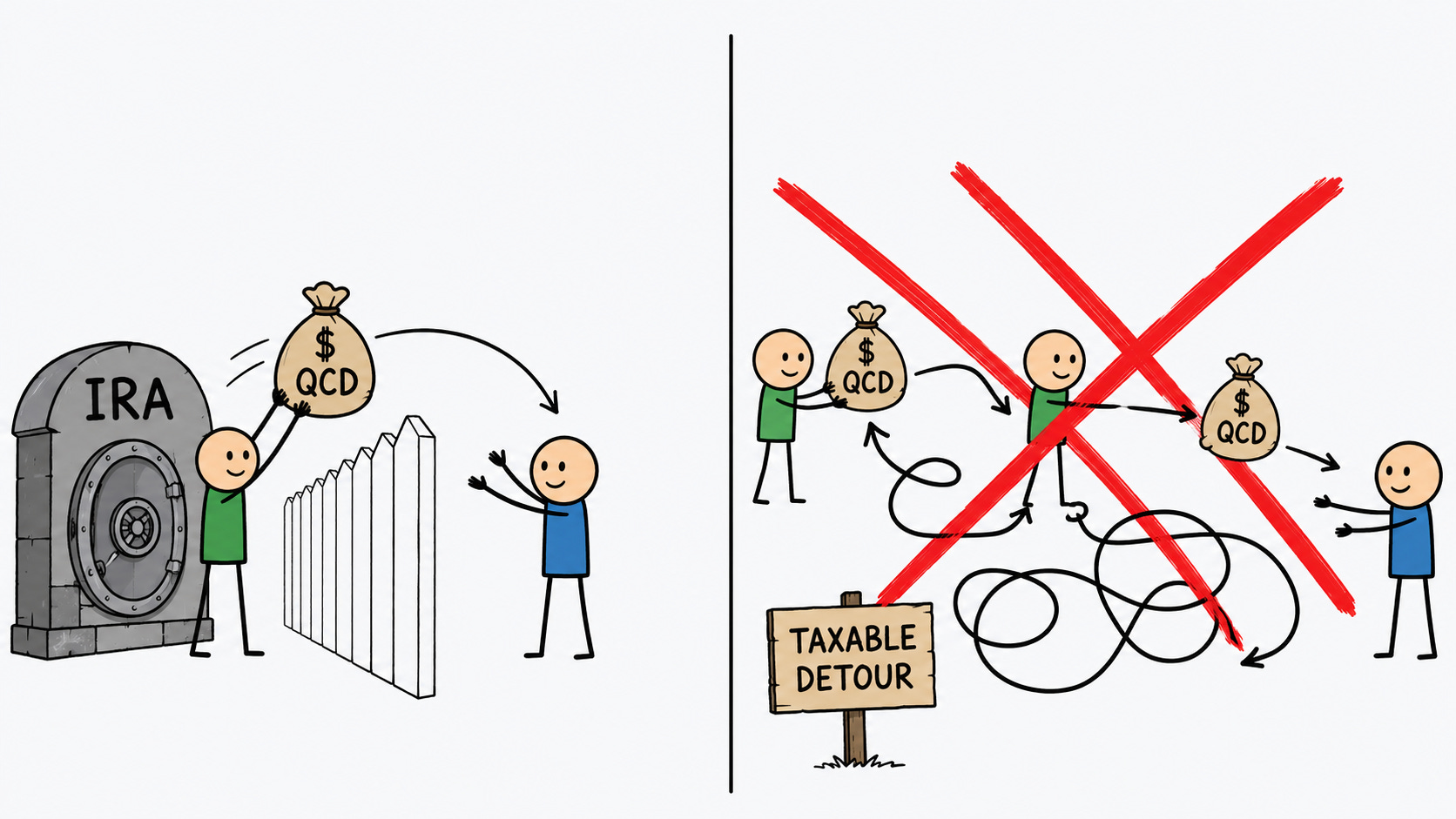
A QCD works because the tax system cares about the path the money takes.
That is the part people miss. They think the charity is the important part. The charity matters, obviously. The IRS does not hand out tax breaks because someone vaguely intended to be generous while clicking around their IRA website at midnight.
For a Qualified Charitable Distribution, the money has to leave the IRA and go directly to the charity. If the IRA owner takes the distribution personally, deposits it into a checking account, and then writes a check to the charity, the system sees a taxable IRA distribution followed by a charitable gift.
That may still be generous. It may still be lovely. It may still make the charity happy.
But it is not the same QCD result.
The QCD rule is one of those retirement provisions that is genuinely useful, which means it naturally comes wrapped in enough conditions to make everyone suspicious.
A Qualified Charitable Distribution is a direct transfer from an IRA to an eligible charity. The IRA owner must be at least age 70½ at the time of the distribution. Not turning 70½ later in the year. Not close enough. Not “my birthday is coming and I feel spiritually qualified.” The age test applies when the distribution is made.
The distribution generally has to come from an IRA. Traditional IRAs are the main account people think of here. QCDs may also be available from certain other IRA arrangements, but not from an ongoing SEP IRA or ongoing SIMPLE IRA. Employer plans like 401(k)s are not the standard QCD source.
The money must go directly from the IRA trustee or custodian to the eligible charitable organization. Some custodians send the check directly to the charity. Some issue a check payable to the charity and mail it to the IRA owner for delivery. The key is that the check is payable to the charity, not to the IRA owner.
Eligible charity does not mean every charity-adjacent account. QCDs generally cannot be made to donor-advised funds, private foundations, or supporting organizations. That is one of the easiest ways to turn a well-intended IRA gift into a regular taxable distribution followed by a separate charitable contribution issue. The charity may still be thrilled. The tax result may be less charming.
If the check is made payable to the IRA owner, the clean QCD line has likely been crossed. At that point, the distribution is generally taxable unless another rule applies. The taxpayer may still have a charitable deduction issue to analyze, but that is a different lane. And if the taxpayer takes the standard deduction, that lane may be less useful than expected. The tax code enjoys reminding people that good intentions and good mechanics are two separate hobbies.
A QCD can count toward the IRA owner’s Required Minimum Distribution for the year. That is one reason people care about it. The IRA owner can satisfy part or all of the RMD by sending IRA money directly to charity See also: RMD Mistakes & Fixes (how QCDs satisfy the RMD)., and the amount that qualifies as a QCD is excluded from income.
The timing matters. RMDs are satisfied by distributions actually taken during the year. Once an IRA owner has already taken a taxable IRA distribution that satisfies the RMD, a later QCD does not retroactively turn that earlier distribution into a QCD. The system does not let you grab a taxable distribution in January, discover QCDs in November, and repaint the January money as charity money after the fact. Again, rude, but at least consistent.
There is an annual QCD exclusion limit. That limit is indexed, so the exact dollar cap can change over time. The right number is the limit for the calendar year in which the QCD is made. Amounts above the limit are treated like regular IRA distributions to the extent they otherwise would be taxable.
A QCD is reported on the tax return. The custodian reports the IRA distribution, but the taxpayer is responsible for making sure the return shows the QCD treatment correctly. The charity should also provide the same type of acknowledgment that would be needed for a charitable contribution deduction.
And no, the taxpayer does not get to exclude the QCD from income and also claim a charitable deduction for the same excluded amount. The IRS may tolerate many things, but double-dipping tends not to be one of its favorite flavors.
There is no tax-filing deadline extension that allows a prior-year QCD after December 31. A QCD belongs to the calendar year in which the IRA distribution is made. If the IRA owner wants it to count for that year’s RMD, the transfer has to be completed during that calendar year. Filing the tax return later does not move the distribution into the prior year.
There may be correction discussions if a custodian, charity, or taxpayer misreports something, but that is reporting cleanup. It does not turn a January distribution into a December distribution. Calendar-year distribution timing is the clock that matters.
Assume Linda is over age 70½ and has a Traditional IRA. She gives to the same local food pantry every year.
Her IRA RMD for the year is $18,000. In February, she takes $10,000 from her IRA and has it deposited into her checking account. Later, she gives $10,000 to the food pantry from that checking account.
That February distribution is not a QCD. The money went to Linda first. It may be a charitable gift after that, but the IRA distribution was paid to her. If she wants a deduction, she has to deal with the regular charitable deduction rules. If she uses the standard deduction, the tax benefit may not show up the way she expected.
Now assume Linda has not yet taken her full RMD. In November, she tells her IRA custodian to send $8,000 directly from her IRA to the food pantry. The check is payable to the charity. Linda is old enough. The charity is eligible. The transfer happens before year-end.
That $8,000 can qualify as a QCD and can count toward her RMD for the year. It does not erase the $10,000 she already took in February. It does help satisfy the remaining RMD while keeping the qualifying QCD amount out of income.
The order mattered. The payee mattered. The calendar year mattered.
Tiny details, naturally, carrying large tax consequences. Retirement rules do enjoy that trick.
QCDs are useful because they solve a very specific problem.
They let an eligible IRA owner send money directly from an IRA to charity, potentially satisfy RMD obligations, and keep the qualifying amount out of income. That can matter for people who give to charity anyway, especially when itemizing deductions is not doing much for them.
The fear is usually bigger than the rule. A QCD is not mysterious once the path is clear.
The person must be old enough when the distribution happens. The money must come from the right type of IRA. The payment must go directly to an eligible charity. The transfer must be completed in the calendar year. The annual limit must be respected. The tax return must report it correctly.
That is the whole machine.
Miss the direct-transfer requirement, and the QCD treatment can be lost. Wait until after year-end, and the prior-year RMD clock does not care. Take the RMD first, and a later QCD does not rewrite the earlier distribution.
Do it through the right channel at the right time, and the rule can work exactly the way people hoped it would.
A rare sentence in retirement planning. Enjoy it responsibly.
I write one of these every day, one retirement rule, explained in plain language and verified against the source. The daily email is free: subscribe here.
Full archive, worksheets, and search live at RetirementNewsRundown.com.
Disclaimer
This article is for educational and informational purposes only. It is not tax, legal, or financial advice and does not create an advisor–client relationship. Always consult appropriate professionals regarding your specific situation.