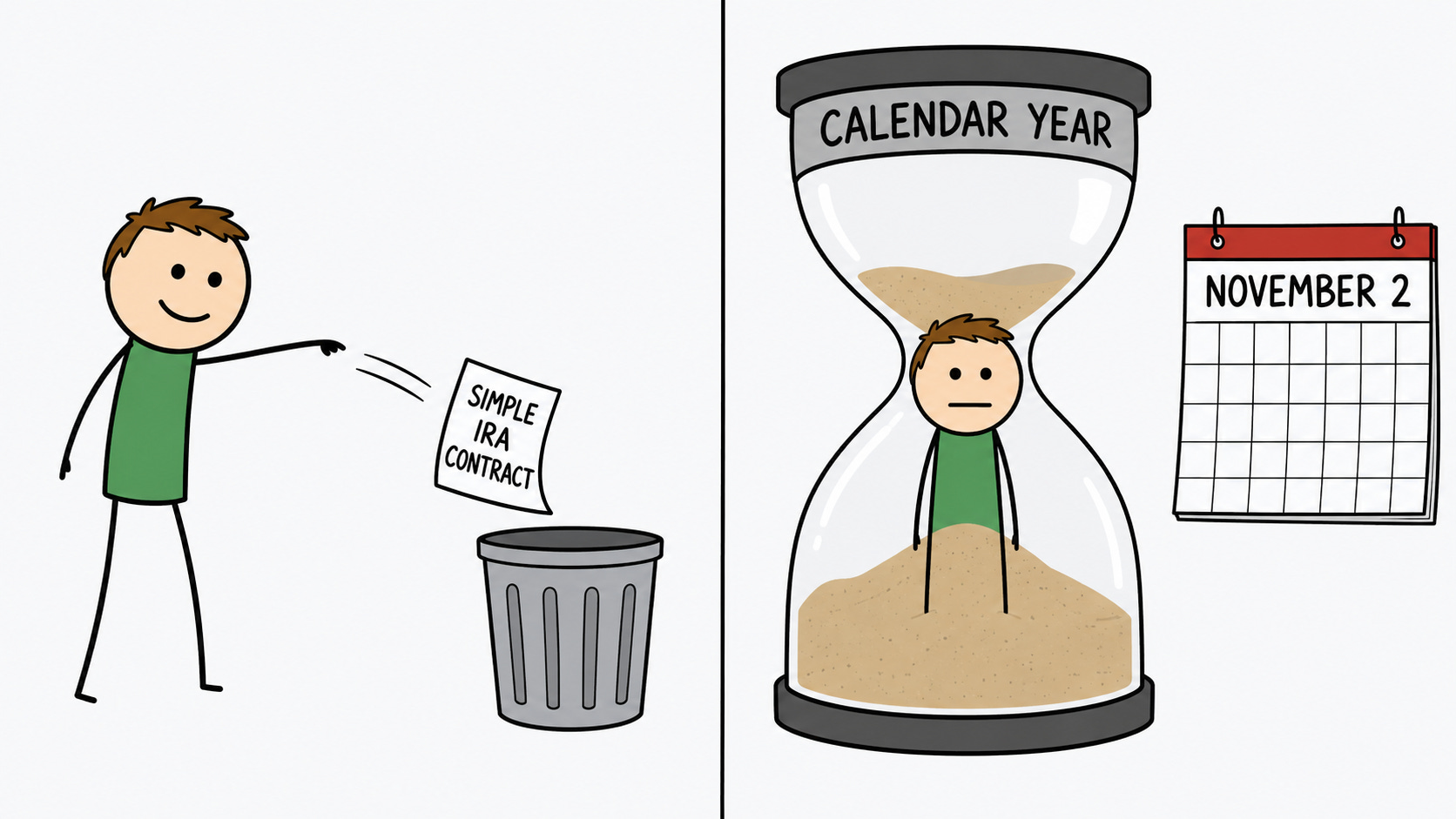
A SIMPLE IRA does not disappear just because the employer decides the plan is annoying now.
That is the part business owners sometimes miss. They think terminating a SIMPLE IRA works like canceling a subscription. Click a button, stop the billing, pretend the whole thing never happened, and move on with your life.
The retirement system, being the retirement system, has other plans.
A SIMPLE IRA is an employer plan with employee notices, salary reduction elections, employer contribution obligations, financial institution records, and timing rules. Once the plan is running for a calendar year, the employer generally has to keep it running through the end of that year.
You can decide you are done with the SIMPLE IRA. You usually cannot decide that the year is also done with you.
Very inconsiderate of the calendar.
The standard SIMPLE IRA termination rule is calendar-year based.
Other than the first year a SIMPLE IRA is established, a SIMPLE IRA generally must be maintained for the full calendar year. If an employer wants to discontinue the SIMPLE IRA for the next year, the employer should notify employees within a reasonable time before November 2 that the plan will end effective the following January 1.
That date matters because SIMPLE IRA employees generally need their annual election period before the next calendar year begins. If the employer is not going to offer the SIMPLE IRA next year, employees need to know before they start making salary reduction elections for a plan that is about to leave the building.
The employer should also notify the SIMPLE IRA financial institution and payroll provider that contributions will stop for the next calendar year. Payroll needs to stop taking salary deferrals. The financial institution needs to know the employer is no longer sponsoring the plan. The IRS, surprisingly, does not need a breakup letter. The employer should keep records of the termination steps, but there is generally no special IRS filing just to say, “We are done with this SIMPLE IRA.”
The important part is that termination normally affects the employer’s plan going forward. It does not erase the SIMPLE IRA accounts that already exist for employees. Those accounts belong to the employees. The employer stops sponsoring and contributing to the plan, but employees still have their individual SIMPLE IRA assets.
If the employer tries to terminate the plan too late for the next year, the problem is timing. Miss the employee notice window, and the employer may not have properly discontinued the SIMPLE IRA for the upcoming year. That can mean the plan continues, with the related contribution obligations still attached. Retirement plans have a charming way of turning “we meant to stop” into “please continue funding what you promised.”
A tax-filing deadline does not fix this. The SIMPLE IRA termination notice is not tied to the business return due date. Filing an extension does not extend the employee notice deadline. The calendar-year deadline controls the plan year. The tax-filing deadline may affect when employer contributions must be deposited for an existing obligation, but it does not rewrite when employees should have been told the plan was ending.
There may be correction issues if notice was missed, contributions were not made correctly, or payroll failed to stop when it should have. Those are correction-window problems inside plan administration. They are not the same as properly terminating the plan on time.
There is also a special mid-year termination path when a SIMPLE IRA is replaced by an eligible safe harbor 401(k) arrangement. That rule has its own requirements, including timing, notice, replacement plan mechanics, and contribution coordination. That is a different situation from an employer simply deciding in the middle of the year that the SIMPLE IRA has become spiritually inconvenient.
Assume a business has maintained a SIMPLE IRA for several years.
In late October, the owner decides the business will switch to a 401(k) next year. The owner sends employees a notice before November 2 saying the SIMPLE IRA will be discontinued effective January 1. The owner also notifies the SIMPLE IRA financial institution and payroll provider that no SIMPLE IRA contributions will be made for the next calendar year.
That is the clean version.
The SIMPLE IRA runs through the end of the current calendar year. Employee salary reductions and required employer contributions continue for compensation covered under the current year’s plan terms. Then, starting January 1, the employer no longer sponsors that SIMPLE IRA plan. That does not mean the employer is done writing checks. Final employer contributions for the ending year still have to be deposited by the business’s tax-filing deadline, including extensions, during the next tax season.
The employees’ SIMPLE IRA accounts do not vanish. They remain their accounts. Depending on their own timing, the two-year SIMPLE IRA rollover rule, and the destination account’s rules, employees may later move the money elsewhere. Terminating the employer plan does not automatically shove every employee’s SIMPLE IRA balance into a new account. That would be efficient, so naturally the system does not work that way.
Now change the facts.
Assume the owner decides on December 15 that the SIMPLE IRA should end for the next year, and no employee notice was provided before November 2. That is late. The employer may have missed the normal notice timing for discontinuing the plan for the upcoming year. The plan may need to continue for another calendar year, and the employer may still be stuck with the contribution formula promised under the plan.
The tax return is irrelevant to that notice deadline. Filing the business return later does not make the December 15 notice earlier. Time remains stubborn that way.
If contributions are missed because the employer thought the plan was already terminated, that becomes a correction issue. The employer may need to determine what should have been contributed, who was affected, and how to make employees whole under the applicable correction process.
Terminating a SIMPLE IRA is mostly about understanding what ends and what does not.
The employer’s sponsorship can end. The employer’s future contribution obligation can end if the termination is handled for the next calendar year. Payroll deductions can stop. The financial institution can be told the employer will no longer contribute.
The employees’ existing SIMPLE IRA accounts continue. Prior contributions remain in the accounts. The two-year SIMPLE IRA rollover clock still matters. And the calendar does not care that the owner found a better plan design after the notice window closed.
The clean mental model is simple enough. To end a SIMPLE IRA the normal way, think before November 2 for a January 1 stop. Think calendar-year plan. Think employee notice. Think payroll and financial institution coordination.
Do not think tax extension. Do not think retroactive cancellation. Do not think the plan disappears because everyone agrees it would be convenient.
Convenience is lovely. Retirement rules have never been accused of overvaluing it.
I write one of these every day, one retirement rule, explained in plain language and verified against the source. The daily email is free: subscribe here.
Full archive, worksheets, and search live at RetirementNewsRundown.com.
Disclaimer
This article is for educational and informational purposes only. It is not tax, legal, or financial advice and does not create an advisor–client relationship. Always consult appropriate professionals regarding your specific situation.