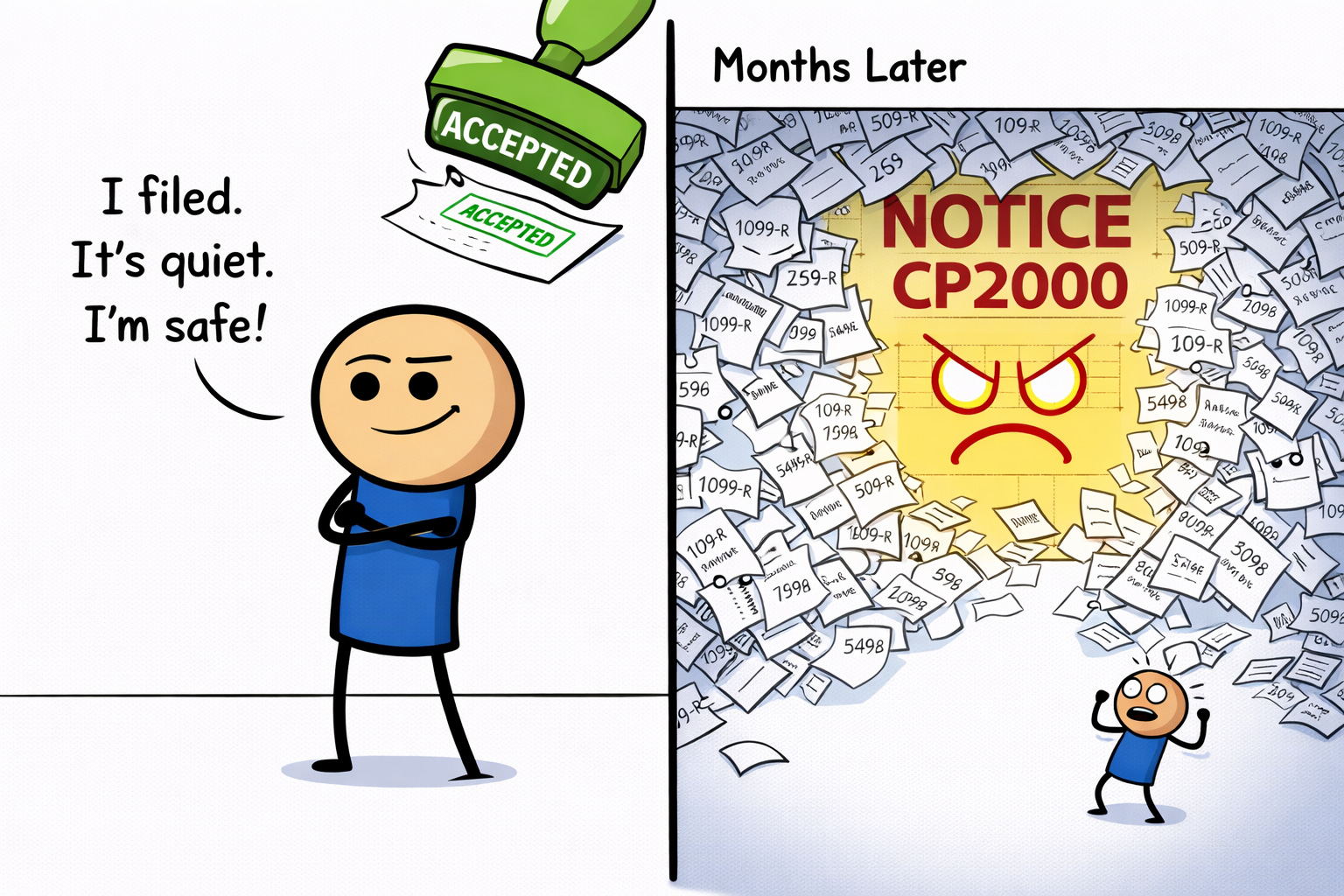
The system does not need to act quickly to be effective. It only needs to act eventually.
That’s the part most people underestimate.
Someone makes a retirement move and nothing happens.
No alert. No rejection. No immediate consequence.
So they assume everything worked.
They move on.
Months later, something shows up.
A notice. A correction. A tax bill tied to a decision they barely remember making.
From their perspective, the system suddenly reacted.
From the system’s perspective, it simply waited until it had everything it needed.
People are naturally impatient with financial decisions.
They want confirmation that something worked.
They want closure.
If nothing goes wrong right away, they assume nothing went wrong at all.
The system does not operate on that timeline.
It records transactions when they happen.
It evaluates them later.
And it does not forget.
Every retirement transaction starts a clock.
A distribution creates a fixed timeline for how it can be treated.
A rollover begins a limited window that must be completed within a specific number of days.
A contribution is tied to a tax year and governed by that year’s filing deadline.
A correction window allows certain mistakes to be fixed, but only within a defined period.
These clocks begin when the transaction occurs.
They do not pause while you think about it.
They do not adjust based on when you file.
Calendar-year deadlines determine which year something belongs to.
If a distribution happens on December 31, it is locked into that year.
Tax-filing deadlines determine when certain actions can still be taken for that year.
IRA contributions often follow this timeline.
Correction windows determine whether something can be fixed without ongoing consequences.
Each of these timelines exists independently.
Completing one does not extend the others.
If something is completed within the allowed timeframe, the system applies one set of rules.
If it is completed after that timeframe, it applies another.
A rollover completed inside the allowed window is treated as a rollover.
If it is completed after that window, it is treated as a distribution.
A contribution made before the tax-filing deadline may apply to the prior year.
If it is made after that deadline, it belongs to the current year.
An excess contribution corrected within its window avoids ongoing penalties.
If it is corrected later, a recurring penalty may apply for each year it remains.
Doing something later does not preserve the original outcome.
It creates a new one.
What makes this difficult is that the system does not immediately tell you when something falls outside the allowed timing.
There is no instant feedback.
There is only silence.
That silence is where people get comfortable.
They assume the absence of a problem means everything is fine.
They assume the system has already evaluated what they did.
It hasn’t.
The system is still collecting information.
Custodians report transactions after they occur.
Forms such as the 1099-R and 5498 arrive later.
Employers and plan administrators report activity on their own timelines.
Only after all of that information is received can the system compare what was reported with what actually happened.
That comparison takes time.
The system is patient.
Consider a situation involving a contribution.
An individual intends to make an IRA contribution for the 2024 tax year.
The tax-filing deadline for that year is April 15, 2025.
If the contribution is made on or before that date, it can be applied to 2024.
If it is made after that date, it belongs to 2025.
That rule is determined by the tax-filing deadline.
Now consider what happens next.
The individual contributes on April 20, 2025, believing they are still within the allowed window.
They file their return and report the contribution for 2024.
The return is accepted.
Nothing appears to be wrong.
Later, the system receives the reporting from the custodian showing when the contribution actually occurred.
It evaluates the timing against the rule.
The contribution was made after the tax-filing deadline.
It does not qualify for 2024.
If that creates an excess contribution for 2025, a new clock begins.
A correction window opens.
If the excess is corrected within that window, it is handled one way.
If it is corrected after that window has closed, the treatment changes and may involve a recurring penalty.
None of that was determined when the return was filed.
It was determined when the contribution was made.
The system simply waited to apply the rule.
This same pattern applies across retirement decisions.
The outcome is determined by timing at the moment of the transaction.
The system does not need to react immediately.
It only needs to match the data eventually.
This is why problems feel delayed.
They are not delayed.
They are revealed.
The system does not forget transactions.
It does not lose track of timing.
It does not adjust outcomes based on when something is noticed.
It applies the rule when it has the information to do so.
Understanding this changes how these situations feel.
The delay is no longer confusing.
It becomes expected.
Filing a return is a reporting step.
Acceptance confirms receipt.
Neither of those steps determines whether the underlying transaction met the required timing.
The only moment that matters is when the transaction occurred and which clock governed it at that time.
Everything else is the system catching up.
I write one of these every day, one retirement rule, explained in plain language and verified against the source. The daily email is free: subscribe here.
Full archive, worksheets, and search live at RetirementNewsRundown.com.
Disclaimer
This article is for educational and informational purposes only. It is not tax, legal, or financial advice and does not create an advisor–client relationship. Always consult appropriate professionals regarding your specific situation.