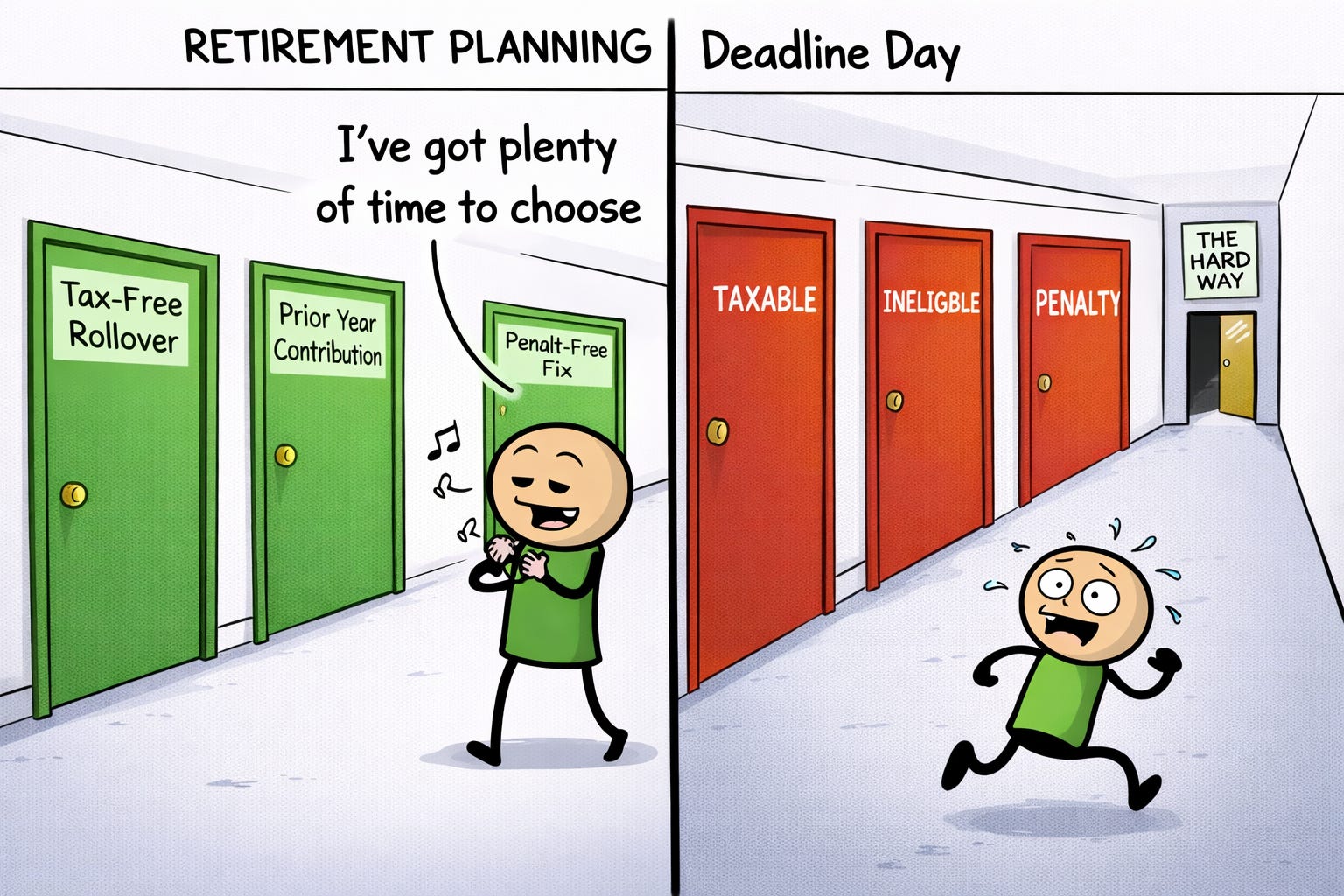
The system does not charge more because you waited. It removes the choices that would have cost less.
That difference is easy to miss until it matters.
Someone realizes near the deadline that something needs to be done.
A contribution wasn’t made. A rollover wasn’t completed. An excess might exist. Something feels off.
There is still time on the calendar, so it feels like there is still flexibility.
That assumption is where the cost begins.
Time in the retirement system is not just a countdown to a deadline.
It is a series of windows.
While those windows are open, you have options.
Once they close, those options disappear.
This is why last-minute decisions tend to cost more.
Not because the system becomes harsher at the deadline, but because the lower-cost paths are no longer available.
Retirement rules are governed by timing, and that timing is structured around different types of deadlines.
Calendar-year deadlines determine which year a transaction belongs to.
Tax-filing deadlines determine when certain actions can still be taken for that year.
Correction windows determine whether a mistake can be fixed in a way that avoids additional consequences.
These timelines overlap, but they are not interchangeable.
A contribution tied to a tax year must be made by that year’s tax-filing deadline.
If it is made before that deadline, it can apply to that prior year.
If it is made after that deadline, it belongs to the current year.
Waiting does not extend the original option.
It removes it.
A rollover must be completed within a fixed number of days after receiving the funds.
If it is completed within that window, the transaction is treated as a rollover.
If it is completed after that window, it is treated as a distribution.
Waiting does not preserve the rollover.
It converts the transaction.
An excess contribution can be corrected within a defined window.
If it is removed within that window, it is handled one way.
If it is removed after that window has closed, the treatment changes and may involve a recurring penalty for each year it remains.
Waiting does not simplify the correction.
It complicates it.
What happens if something is done later instead is consistent across these rules.
The system does not hold the door open.
It applies a different rule.
This is where the cost shows up.
Not as a fee for being late, but as the loss of the better outcome.
Consider a situation involving an IRA contribution.
An individual intends to make a contribution for the 2024 tax year.
The tax-filing deadline for that year is April 15, 2025.
If the contribution is made before that date, it can be applied to 2024.
If it is made after that date, it belongs to 2025.
Now consider the timing.
The individual waits until mid-April to decide.
They are unsure about their eligibility. They are unsure about the amount.
They delay while they think through it.
April 15 passes.
They make the contribution on April 20.
From their perspective, the decision was only a few days late.
From the system’s perspective, the window has already closed.
The contribution cannot be applied to 2024.
If they already contributed for 2025, this may create an excess.
That excess introduces a new clock.
A correction window begins.
If the excess is corrected within that window, it is handled one way.
If it is corrected after that window has closed, a recurring penalty may apply for each year it remains.
The cost did not come from making the contribution.
It came from making the decision after the original window had closed.
The same pattern applies to rollovers.
An individual takes a distribution and intends to move the funds into another retirement account.
The rollover window begins when the funds are received and runs for a fixed number of days.
If the funds are deposited within that window, the transaction is treated as a rollover.
If the deposit happens after that window has closed, it is treated as a distribution.
Now consider the timing.
The individual waits until the end of the window to act.
They are deciding where to move the funds.
They are comparing options.
They are waiting for clarity.
They complete the deposit a few days later.
From their perspective, the money still ended up in a retirement account.
From the system’s perspective, the rollover did not occur within the allowed timeframe.
The transaction is treated as a distribution.
The amount becomes taxable income for that year. If applicable, an additional penalty may apply.
Again, the cost was not a late fee.
It was the loss of the rollover treatment.
Last-minute decisions create pressure.
Pressure reduces clarity.
Reduced clarity leads to actions being taken at the edge of a window rather than within it.
That is where the system shifts from one set of rules to another.
The system itself remains consistent.
It does not change its rules based on urgency.
It applies them based on timing.
Understanding this removes some of the frustration.
The issue is not that the system is punishing last-minute decisions.
It is that those decisions are being made after the most flexible options have already expired.
The earlier a decision is made within an active window, the more paths are available.
The later it is made, the fewer remain.
By the time the deadline arrives, the outcome is often already determined.
Not because of what happens at the deadline, but because of what was or was not completed before it.
I write one of these every day, one retirement rule, explained in plain language and verified against the source. The daily email is free: subscribe here.
Full archive, worksheets, and search live at RetirementNewsRundown.com.
Disclaimer
This article is for educational and informational purposes only. It is not tax, legal, or financial advice and does not create an advisor–client relationship. Always consult appropriate professionals regarding your specific situation.