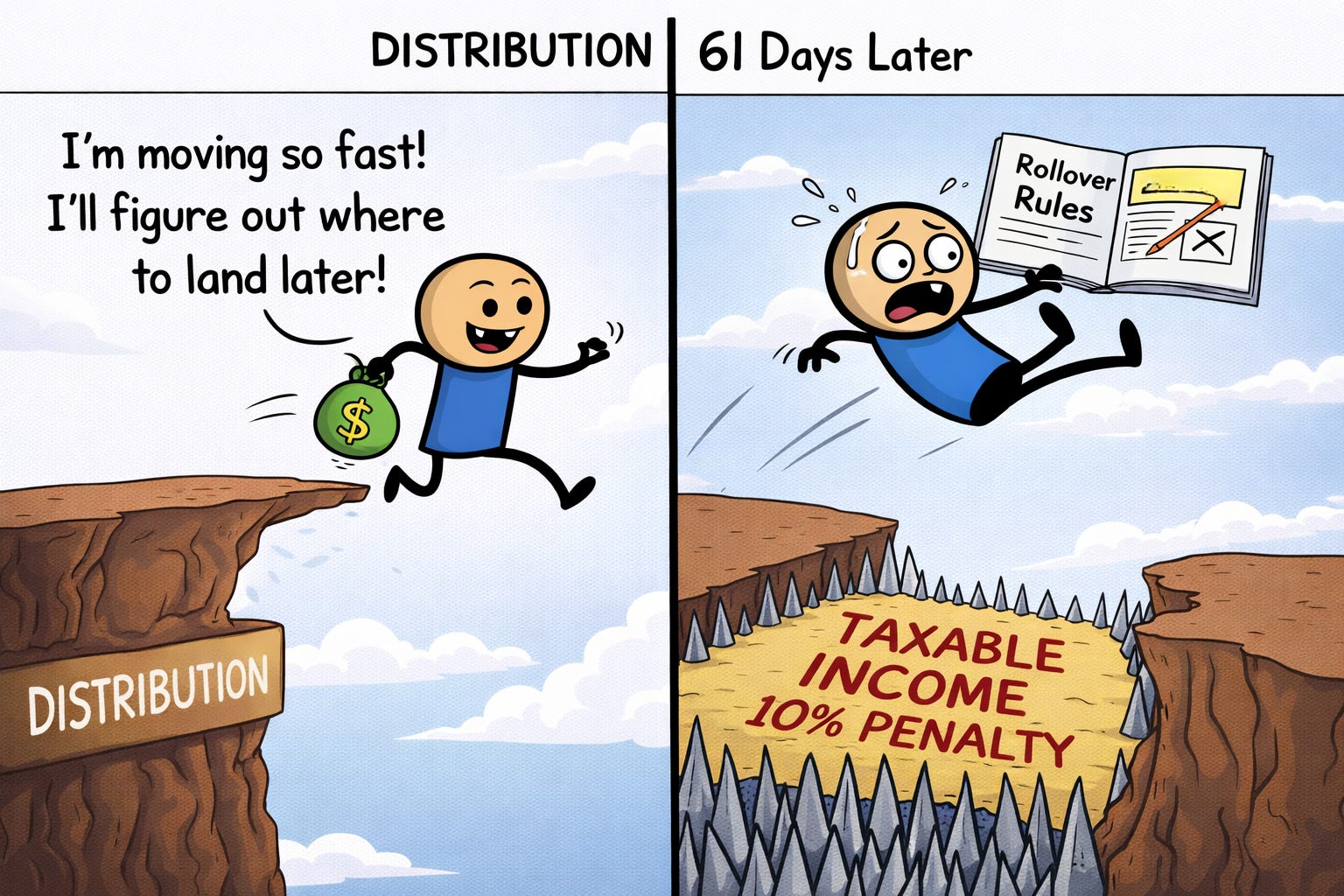
The system does not reward speed. It rewards structure.
That distinction is easy to miss because fast decisions feel productive.
Money moves. Accounts update. Things look done.
But the system is not measuring how quickly something was completed.
It is measuring whether it was completed within the rules that apply.
Someone wants to move quickly.
They take a distribution and plan to figure out where it goes later.
They make a contribution before fully understanding eligibility.
They fix something after the fact instead of structuring it correctly up front.
From their perspective, they are staying efficient.
From the system’s perspective, they are starting clocks without a plan.
Speed creates a sense of progress.
Structure determines the outcome.
Retirement rules are built around timing and sequencing.
When money moves, a clock starts.
That clock depends on the type of transaction.
A rollover has a fixed number of days to be completed.
A contribution is tied to a specific tax year and governed by that year’s filing deadline.
A correction window allows certain issues to be fixed, but only within a defined period.
These rules do not adjust based on how quickly a decision was made.
They apply based on when the transaction occurred and whether it followed the required structure.
Calendar-year deadlines determine which year something belongs to.
A distribution taken on December 31 is part of that year.
Tax-filing deadlines determine when certain actions can still be taken for that year.
IRA contributions often follow this timeline.
Correction windows determine whether something can be fixed without additional consequences.
Each of these timelines operates independently.
Moving quickly does not extend them.
If something is completed within the required structure and timeframe, it is treated one way.
If it is completed outside of that structure or after that timeframe, it is treated differently.
A rollover completed within the allowed window is treated as a rollover.
If it is completed later, it is treated as a distribution.
A contribution made before the tax-filing deadline may apply to the prior year.
If it is made after that deadline, it belongs to the current year.
An excess contribution corrected within its window avoids ongoing penalties.
If it is corrected later, a recurring penalty may apply for each year it remains.
Speed does not preserve the intended result.
What happens if something is done later instead is consistent.
The system applies a different rule.
It does not revisit the original intent.
This is where fast decisions create hidden costs.
The transaction itself may be completed quickly.
The outcome is determined more slowly, when the system evaluates whether the structure was correct.
Consider a situation involving a rollover.
An individual takes a $55,000 distribution from a retirement plan on January 3.
They intend to move the funds into another retirement account.
They want to act quickly, so they take the distribution before deciding exactly where it will go.
The rollover window begins when the funds are received and runs for a fixed number of days.
That window closes in early March.
Now consider the sequence.
The individual spends time comparing options after taking the distribution.
They are trying to make the right long-term decision.
They eventually complete the deposit, but it happens a few days after the rollover window has closed.
From their perspective, the process was handled efficiently.
The money was moved.
The account was funded.
Everything appears in place.
From the system’s perspective, the structure was not completed within the required timeframe.
The rollover did not occur.
The transaction is treated as a distribution.
The $55,000 becomes taxable income for that year. If applicable, an additional penalty may apply.
The cost did not come from taking too long to decide.
It came from starting the process before the structure was in place.
Now consider a contribution.
An individual wants to make an IRA contribution for the prior tax year.
They move quickly near the deadline.
They contribute without fully confirming their eligibility or contribution limits.
The tax-filing deadline passes.
From their perspective, they acted in time.
From the system’s perspective, the contribution either belongs to a different year or creates an excess.
If it creates an excess contribution, a correction window begins.
If the excess is removed within that window, it is handled one way.
If it is removed after that window has closed, the treatment changes and may involve a recurring penalty for each year it remains.
Again, the issue is not speed itself.
It is speed without structure.
Fast decisions often shift the order of events.
The transaction happens first.
The understanding comes later.
The system evaluates based on the order that actually occurred, not the order that was intended.
The system is consistent.
It does not adjust for urgency.
It does not reinterpret timing based on intent.
It applies the rule that matches the structure of the transaction.
Understanding this changes how these situations are viewed.
The goal is not to move slower.
It is to ensure that the structure is clear before the clock starts.
Once the transaction occurs, the timing rules are already in motion.
At that point, the outcome is being shaped whether or not it feels like a decision has been finalized.
Speed feels efficient in the moment.
Structure determines the result over time.
I write one of these every day, one retirement rule, explained in plain language and verified against the source. The daily email is free: subscribe here.
Full archive, worksheets, and search live at RetirementNewsRundown.com.
Disclaimer
This article is for educational and informational purposes only. It is not tax, legal, or financial advice and does not create an advisor–client relationship. Always consult appropriate professionals regarding your specific situation.