Federal retirement paperwork tends to move in one direction. An employee separates, the agency processes the retirement, and somewhere in the stack is a decision about the Thrift Savings Plan. A lot of people roll the whole balance into an IRA at that point, because an IRA feels like the grown-up place for retirement money and a brokerage firm offers more choices than five core funds and a lifecycle lineup.
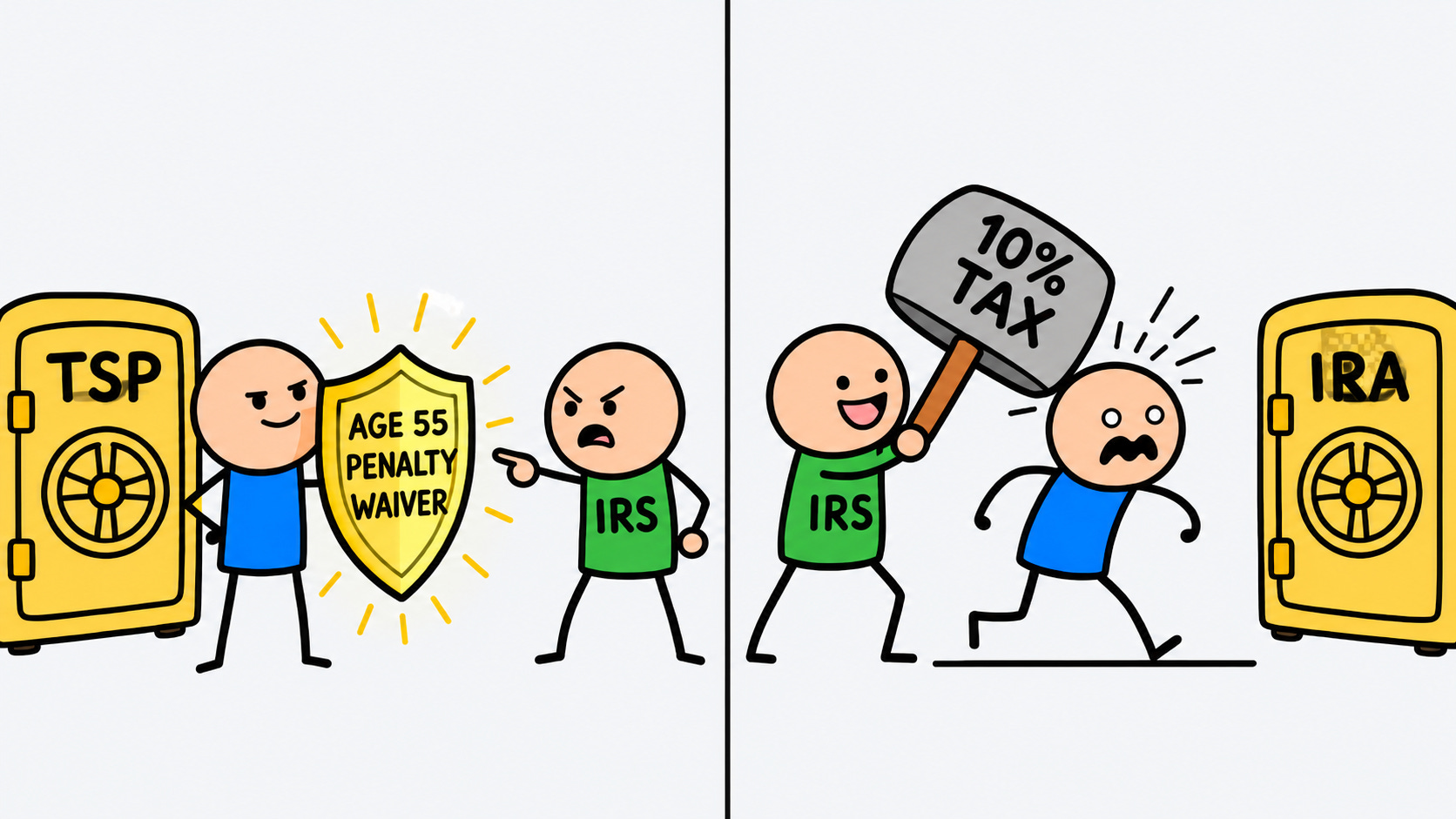
For someone who leaves federal service in their mid-50s, that rollover can cancel one of the most useful rules in the tax code. The TSP carries an exception to the 10% early withdrawal tax that an IRA does not have.
Withdrawals from the TSP before 59.5 generally face the 10% early withdrawal penalty tax on their taxable portion, on top of regular income tax. The TSP’s own tax booklet lists the exceptions, and the first one is the one that matters here: payments made after the participant separates from service during or after the year they reach age 55.
The wording is precise. What counts is the year of separation, measured against the year the person turns 55. Someone whose 55th birthday falls in November can separate in February of that same year and still qualify, because they separated during the year they reached 55. Someone who separates at 54, in the year before they turn 55, does not qualify, even if they wait until 55 to take the money. The IRS says it directly in its publication on retirement plan distributions: the separation itself has to happen in or after the qualifying year.
Public safety employees get an earlier version. For those who meet the federal definition, which includes federal law enforcement officers and customs and border protection officers, the age drops to 50, or 25 years of service under the TSP, whichever comes first.
The exception belongs to the plan. The IRS lists it among the exceptions that apply to distributions from qualified retirement plans, and it does not appear among the exceptions for IRAs. Money that stays in the TSP keeps it. Money rolled into an IRA loses it, and withdrawals from that IRA before 59.5 face the 10% tax unless some IRA exception applies.
The exception covers the 10% penalty only. The withdrawal is still income, and the traditional portion is taxed like any other TSP payment. When the TSP pays an eligible distribution directly to the participant, it is required to withhold 20% for federal income tax. That 20% is a prepayment toward the tax bill, and any overwithholding comes back at filing.
Roth TSP money follows its own rules. The penalty never applies to Roth contributions coming back out, but earnings in a distribution that is not qualified can be both taxable and subject to the penalty unless an exception, like this one, applies.
So the dates that matter sort out like this. The calendar year of separation decides eligibility, and it is fixed the day the person leaves. After that, the exception follows the money for as long as it stays in the TSP. A rollover to an IRA removes the exception from the money that moves, because the exception does not apply to IRA withdrawals. Separated participants with an open TSP account can roll eligible traditional IRA money back into the TSP, but money withdrawn directly from the IRA cannot use the age-55 exception.
Mike is a federal employee who turns 55 in October. He retires in March of that year, at 54, with $400,000 in the traditional TSP and nothing in Roth. He plans to bridge the years before his pension and Social Security with withdrawals.
In April he requests a $40,000 partial withdrawal from the TSP. Because he separated during the year he turned 55, the 10% penalty does not apply. The TSP withholds 20%, or $8,000, and sends him $32,000. The $40,000 is income for the year, and the withholding is credited against his tax when he files.
In the second version, Mike rolls the entire $400,000 into an IRA in March because he wants more investment options. In April he takes the same $40,000 from the IRA. He is 54, the IRA has no age-55 separation exception, and none of the IRA exceptions apply. The $40,000 is income, plus a $4,000 additional tax.
In the third version, Mike retired the previous December, at 54, in the year before he turned 55. Even if he leaves every dollar in the TSP and waits until his 55th birthday to withdraw, the exception does not apply, because his separation came before the year he reached 55.
Had Mike been a customs and border protection officer meeting the public safety definition, the threshold would have been 50, or 25 years of service under the TSP, whichever came first.
The age-55 exception is generous, and keeping it costs nothing except leaving money where it already is. The rule also works with partial moves, since whatever stays in the TSP keeps the exception and only the amount rolled out loses it.
What matters is the year of separation and where the money sits when it comes out. For people weighing what moves into an IRA and what it changes, our rollover IRA guide lays out the trade-offs that come with the move.
I write one of these every day, one retirement rule, explained in plain language and verified against the source. The daily email is free: subscribe here.
Full archive, worksheets, and search live at RetirementNewsRundown.com.
Disclaimer
This article is for educational and informational purposes only. It is not tax, legal, or financial advice and does not create an advisor-client relationship. Always consult appropriate professionals regarding your specific situation.