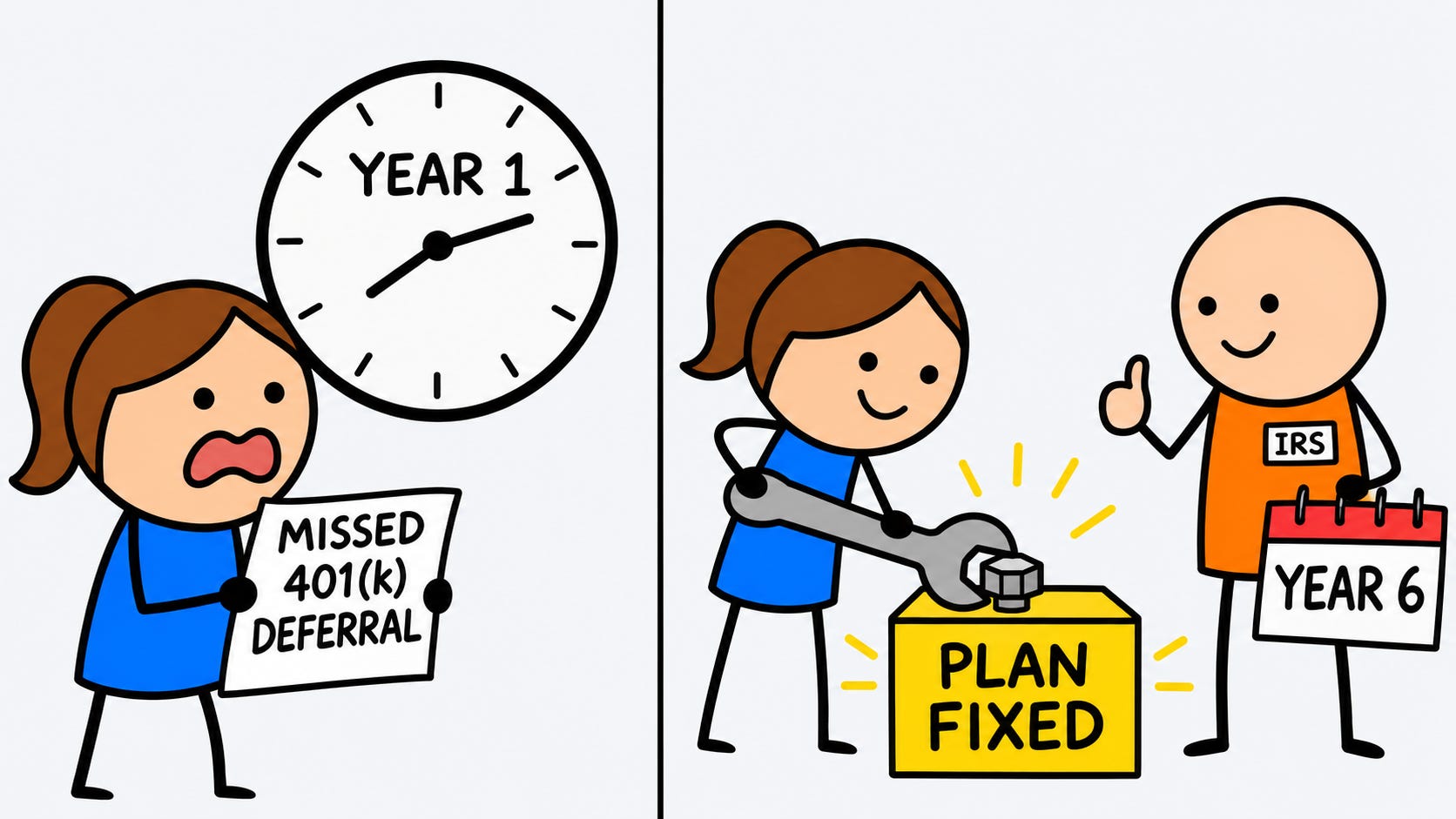
Every retirement plan runs on a document, and every small business eventually does something the document did not say. An eligible employee gets left out. A bonus gets skipped for deferrals when the plan says it counts. A loan gets paid out without the paperwork the plan requires. Technically, any of these can threaten the plan’s tax-qualified status, and the IRS has long run a correction program so that employers can fix them without losing the plan.
The program’s self-correction track, the one that costs nothing and requires no filing with the IRS, used to be narrow. The IRS’s latest update to the program widened it considerably and put a clearer clock on it, and that clock starts when the employer finds the mistake.
The IRS correction program has three tracks. Self-correction requires no IRS submission and no fee. The voluntary correction track involves a filing and a fee, and the IRS signs off on the fix. The audit track applies when a mistake turns up during an IRS examination, and it is the most expensive of the three.
Self-correction now covers what the IRS calls eligible inadvertent failures. That means a mistake that happened despite the employer having practices and procedures, formal or informal, reasonably designed to keep the plan in compliance, as long as the mistake is not egregious, does not involve diverting plan assets, and is not tied to an abusive tax scheme. A plan document alone does not count as procedures. The procedures have to have been in place and routinely followed, with the mistake happening through an oversight in applying them. Employers no longer need a favorable IRS letter on the plan to use self-correction, and the track now reaches more kinds of mistakes, including certain loan failures and certain plan document failures, along with SEP and SIMPLE IRA plans that use the IRS model forms or an approved prototype.
Some things stay outside self-correction. Never adopting a written plan in the first place cannot be self-corrected. Neither can most significant mistakes in a plan that has already been terminated, mistakes in orphan plans, or a fix that leaves excess contributions sitting in a SEP or SIMPLE IRA. A mistake also cannot be fixed by amending the plan to match what actually happened if that change would leave participants worse off than the original terms.
The clock is the part employers need to watch. A self-correction has to be finished within a reasonable period after the employer identifies the mistake. The IRS treats a correction as timely if it is completed by the later of two dates: the last day of the third plan year after the year the mistake happened, or 18 months after the employer identifies it. A mistake found quickly gets the three-plan-year runway. A mistake found years later still gets 18 months from discovery.
What happens if the correction comes later than that? The reasonable-period safe harbor is gone, and whether the fix still counts depends on the facts and circumstances. The bigger risk is an IRS examination. Once the plan or the employer comes under examination for that year, the self-correction window generally closes, except for insignificant mistakes or cases where the employer had already shown a specific commitment to correcting the problem. From there, the mistake moves to the audit track.
Documentation carries the whole arrangement. If the IRS asks during an examination, the employer has to be able to show what the mistake was, the years and number of employees affected, when it was found, how it happened despite the procedures in place, how and when it was fixed, and what changed so it will not happen again.
So the clocks line up this way. The plan year when the mistake happened starts one clock running three plan years forward. The date the employer finds the mistake starts an 18-month clock. The later of the two is the safe-harbor deadline. An IRS examination can cut either clock short.
Elena runs a 12-person design firm with a calendar-year 401(k). In May of the second year of the plan, while reviewing the prior year with her payroll provider, she learns that a part-time designer became eligible the previous March and was never offered the chance to defer. Elena has an annual eligibility checklist her office manager runs each January, and it missed this employee because her hours were logged under the wrong code.
The mistake happened in the first plan year. The last day of the third plan year after that is December 31 of the fourth year. Eighteen months after Elena identified the mistake lands in the third year, in November. The later date controls, so Elena has until December 31 of the fourth year for the correction to be deemed timely. She makes the corrective contribution for the employee’s missed deferral opportunity, adjusted for earnings, fixes the payroll coding, adds a mid-year eligibility check, and keeps a written record of each step.
In the other version, Elena’s office never noticed, and the mistake surfaces when her plan’s new provider runs a conversion review in October of the fourth year. December 31 of that fourth year is barely two months away, but the 18-month clock from discovery runs into April of the sixth year, and that later date controls. She still has a timely window, as long as the IRS has not opened an examination first.
Plan mistakes are common enough that the IRS built a program around them, and the self-correction track exists so that a small employer with reasonable procedures can fix a problem without paying a fee or asking permission. The widened program means more mistakes qualify, and the clock gives a clear safe harbor.
What matters is when the mistake was found, whether procedures existed when it happened, and whether the IRS is already looking. For how deferrals, eligibility and plan operations fit together in a workplace plan, our 401(k) guide lays out the moving parts.
I write one of these every day, one retirement rule, explained in plain language and verified against the source. The daily email is free: subscribe here.
Full archive, worksheets, and search live at RetirementNewsRundown.com.
Disclaimer
This article is for educational and informational purposes only. It is not tax, legal, or financial advice and does not create an advisor-client relationship. Always consult appropriate professionals regarding your specific situation.