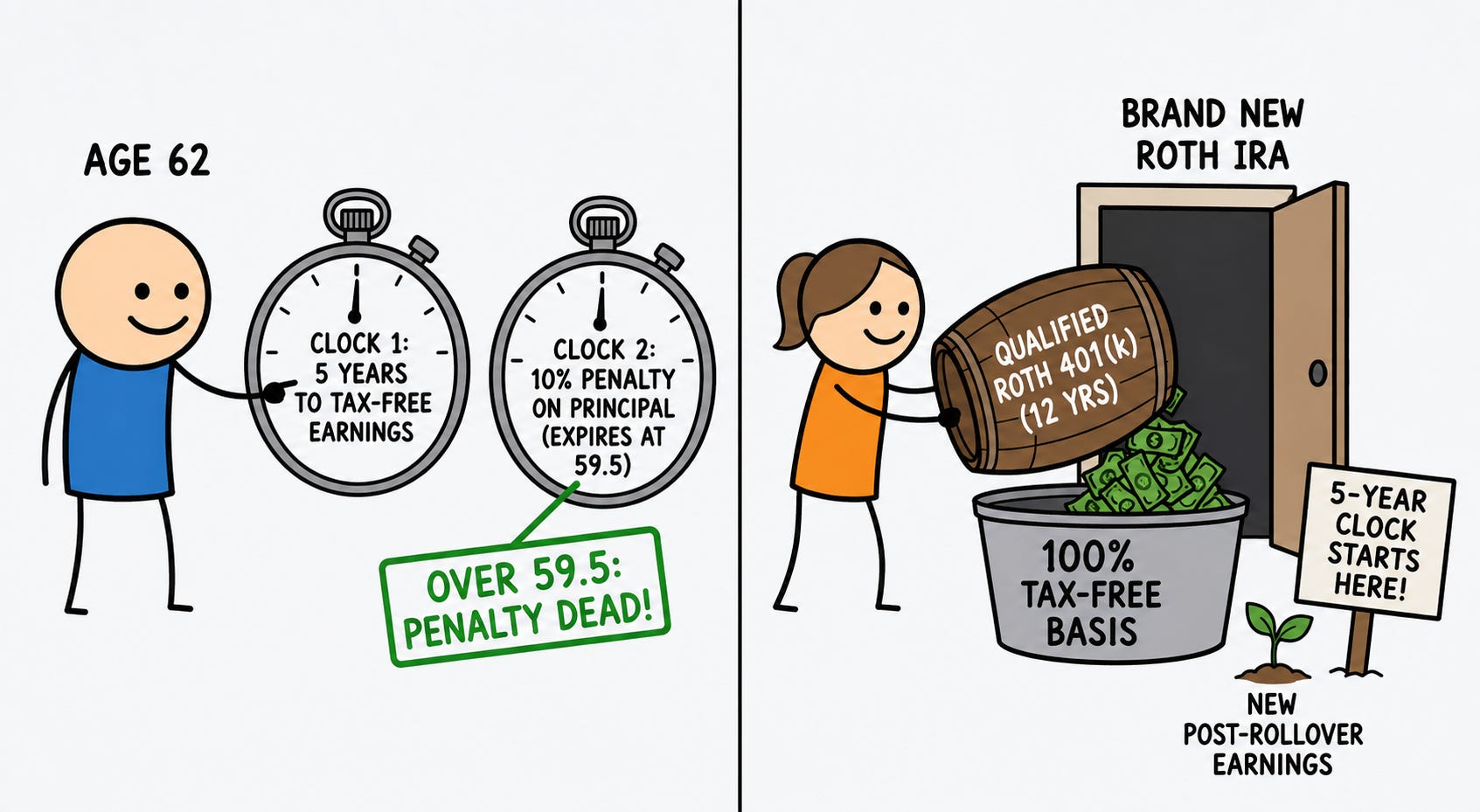
People talk about the Roth five-year rule the way they talk about the speed limit, as though there is one of them and everybody knows what it is. There are two inside a Roth IRA. They start on different dates, they answer different questions, and satisfying one tells you nothing about whether you have satisfied the other. There is also a third clock, running on a different system entirely, if any of the money sits in a workplace plan.
The confusion is not the reader’s fault. All three are described with the same phrase, and the phrase does not distinguish between a rule about whether earnings come out tax free and a rule about whether a penalty applies to principal.
The first clock decides whether a distribution is qualified. It begins on January 1 of the first tax year for which money was contributed to any Roth IRA for your benefit, whether through a regular contribution, a conversion, or an eligible rollover into a Roth IRA. It runs once per person rather than once per account. Open a second Roth IRA a decade later and it inherits the clock that is already running. Empty an account and open a new one and the clock does not reset.
Meeting that five-year period is only half of what a qualified distribution requires. It also needs a triggering event: reaching age 59.5, death, disability, or a first-time home purchase up to a $10,000 lifetime limit. Satisfy both and the entire distribution, earnings included, comes out tax free. Satisfy only one and you have not arrived. Someone who opens a first Roth IRA at 62 and withdraws earnings at 64 is comfortably past 59.5 and has still not met the clock, so those earnings are taxable.
The second clock does a different job. Every conversion carries its own five-year period, beginning January 1 of the year the conversion occurred. Convert in three separate years and you have three separate clocks running at once. The purpose of this rule is narrow. Without it, someone under 59.5 could convert traditional IRA money and immediately withdraw it, avoiding the 10% additional tax that a direct withdrawal from the traditional IRA would have carried. So distributing converted amounts before that conversion’s five years has run, while under 59.5, can trigger the 10% additional tax on the portion that was taxable when converted, unless another early distribution exception applies.
That narrow purpose explains what happens after 59.5. The 10% additional tax generally does not apply at that age in the first place, so the conversion clock stops having practical bite for the penalty once you get there. It never controlled whether earnings are tax free. That has always been the first clock’s job, and the first clock keeps running regardless of your age.
The ordering rules are what make this manageable in practice, and most explanations skip them. Money leaves a Roth IRA in a fixed sequence. Regular contributions come out first, and those are always available without tax or penalty because you already paid tax on them. Conversions and rollovers come out next, oldest first, with the portion that was taxable at conversion coming out before the portion that was not. Earnings come out last. Because of that sequence, a modest withdrawal from an account with years of regular contributions often never reaches a conversion layer at all, which means neither clock ends up mattering to that particular distribution.
The third clock belongs to a different system. Designated Roth money inside a 401(k) or similar plan uses a separate five taxable year participation period tied to that plan’s designated Roth account. Rollovers between workplace plans have their own carryover rules, so that clock cannot be assumed to transfer automatically.
What it never does is tack onto a Roth IRA. When a designated Roth account is rolled into a Roth IRA, the Roth IRA’s own holding period governs whether the five-year requirement has been met, and the years accumulated inside the plan do not come along. There is an important softener, though. If the distribution from the plan was itself a qualified distribution, the entire amount rolled over becomes basis in the Roth IRA, so only the earnings generated after the rollover fall under the new clock.
Consider someone who turns 62, opens their first Roth IRA, and converts $50,000 from a traditional IRA in the same year. A year later they withdraw $20,000.
They are over 59.5, so the 10% additional tax is not in play and the conversion clock has nothing to do. Under the ordering rules, the account holds no regular contributions, so the withdrawal comes out of the conversion layer. Converted principal was already taxed at conversion and is not taxed again. The $20,000 comes out with no tax and no penalty, one year after a conversion, which surprises people who have heard they must wait five years to touch converted money.
Change one thing. Suppose they withdrew enough to exhaust the conversion layer and reach earnings. Those earnings would be taxable, because the qualification clock started only when they opened that first Roth IRA and does not finish until five years have passed. Age did not save the earnings. Nothing does except time.
Now consider someone else. She contributed to a Roth 401(k) at work for twelve years, retires at 60, and rolls the whole balance into a Roth IRA she opens the same week. She has never had a Roth IRA before.
She is over 59.5, so the normal 10% early distribution penalty is no longer the issue. But because this is her first Roth IRA, the Roth IRA’s own five-year qualified distribution period starts with the rollover year. Assuming her plan distribution was qualified, the amount she rolled in arrives as basis and remains available without tax. What the new clock governs is the earnings her Roth IRA generates from that point forward, and those can still be taxable if distributed before the five-year period is satisfied, even though she is already past 59.5.
A person in the same position who had opened a small Roth IRA years earlier, for any amount, would already be past that period and would have no waiting to do at all.
The practical version is that the two Roth IRA clocks answer two different questions. The first asks whether earnings can come out tax free, and it is one clock per person that never restarts. The second asks whether a penalty applies to converted principal taken early, and it is one clock per conversion that stops mattering at 59.5.
The plan clock is a separate matter and does not merge with either of them. Money moving from a designated Roth account into a Roth IRA lands under the Roth IRA’s rules and the Roth IRA’s timeline, and what survives the move is basis rather than elapsed time.
For anyone who has never held a Roth IRA, the consequence is arithmetic rather than strategy. The clock cannot begin until money goes into one, so the date of the first contribution, conversion, or rollover sets the earliest possible date that any earnings in any Roth IRA could ever be qualified.
Anyone weighing how Roth and before tax balances behave differently over time can work through the comparison with the Roth versus traditional tool, and anyone wanting the broader conversion mechanics in one place can read the Roth conversion guide.
Where you stand depends on which question you are actually asking. One clock governs the earnings. The other governs a penalty you may already have aged out of.
I write one of these every day, one retirement rule, explained in plain language and verified against the source. The daily email is free: subscribe here.
Full archive, worksheets, and search live at RetirementNewsRundown.com.
Disclaimer
This article is for educational and informational purposes only. It is not tax, legal, or financial advice and does not create an advisor–client relationship. Always consult appropriate professionals regarding your specific situation.