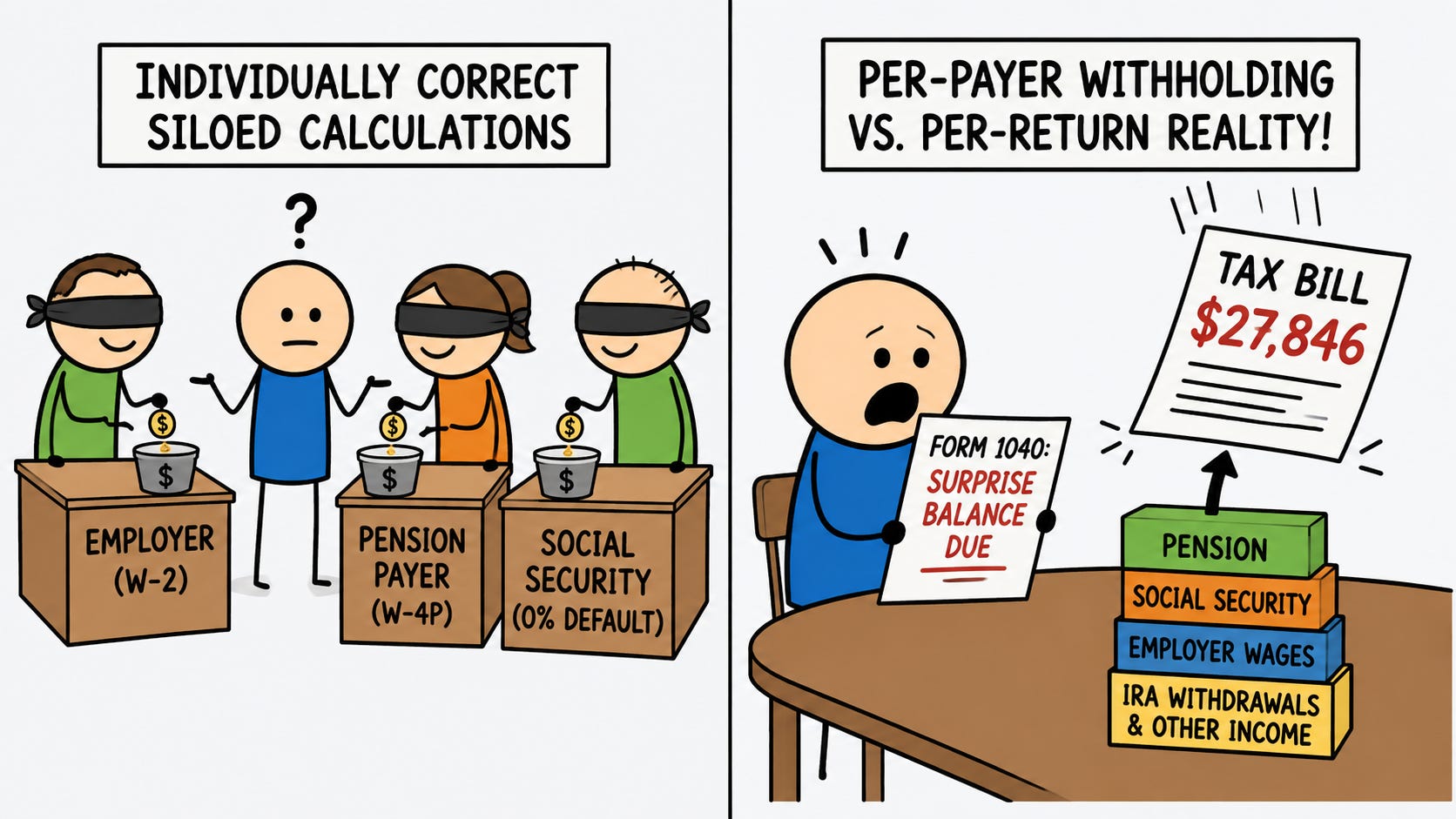
Withholding is built for a person whose income looks the same in December as it did in January. One employer, one steady salary, one calculation repeated twenty-six times. The system handles that person well enough that most people go their entire working lives without thinking about it.
The first year of retirement is the single year that person does not exist. Income arrives from sources that did not exist in January, stops from sources that did, and none of the payers involved know about each other. The result is a tax bill in April that nobody expected, produced by a series of calculations that were each individually correct.
Start with what a pension payer actually does. Periodic pension and annuity payments are subject to federal income tax withholding, and the payer withholds based on the election you filed on Form W-4P. If you never filed one, the payer withholds as if your filing status is single with no adjustments in Steps 2 through 4 of that form.
That default is not generous. Single with no adjustments withholds more than most married retirees would choose. The problem is not that the default is too small. The problem is that it is blind.
A pension administrator computes withholding as though the payment it sends is your only income. It does not know your spouse is still working. It does not know about your second pension, your IRA withdrawals, your part-time consulting, or your Social Security. It annualizes what it pays you, applies the tables to that figure alone, and sends the money. Another payer does exactly the same thing with its own payment. Both calculations are right. The combined result is wrong, because income stacks and withholding does not.
The first retirement year concentrates every version of this problem into twelve months. There are usually partial-year wages, withheld under the payroll system that applied while the person was still working. There is often an accrued vacation or paid leave payout, which may be treated as supplemental wages and withheld under rules that have little connection to the person’s eventual full-year tax rate. There may be severance, a final bonus, or a lump sum from a plan. The pension begins partway through the year, but periodic payment withholding generally annualizes the pension payment when applying the withholding tables, so the calculation does not simply look at the months of pension actually received during that transition year. And a spouse may still be working the whole time, with their own employer making its own isolated calculation.
Social Security adds a gap of a different kind. Nothing is withheld from benefits automatically. There is no default, no table, and no election on file unless you make one. To have federal tax withheld from Social Security you file Form W-4V and choose one of four percentages: 7%, 10%, 12%, or 22%. Those four are the only options. You cannot elect a dollar amount and you cannot pick a percentage between them. The completed form goes to the paying agency rather than to the IRS.
Someone who spent forty years watching taxes come out of every paycheck can reasonably assume the same thing happens to a government benefit. It does not. The benefit can therefore arrive with no federal income tax withheld from it, even though part of the benefit may ultimately be taxable on the return.
What follows from a shortfall is a balance due at filing, and potentially an addition to tax for underpaying during the year, which has its own rules and its own safe harbors. Those are a separate subject with their own mechanics.
Consider someone who retires on June 30 after a full career at one employer, with a spouse who continues working.
Through June, withholding on his wages was calculated under the payroll system that applied while he was working. Those calculations did not know that his wages would stop halfway through the year or what income sources would replace them afterward. Whether those first six months ultimately produced too much or too little withholding can only be seen after the rest of the year’s income is added.
In late June, an accrued leave payout arrives in one check. Depending on the employer’s withholding method, supplemental wage rules may apply, producing withholding that is not designed around what his final retirement year tax bracket will be.
In July the pension begins. He never filed a W-4P, so the payer withholds as single with no adjustments, applying the tables to an annualized version of the monthly pension amount. That calculation describes a person whose income for the year is twelve months of that pension and nothing else. He is not that person. He is a person with six months of wages, a leave payout, six months of pension, and a spouse earning a full-year salary that will be reported on the same joint return.
In August, Social Security starts. He filed no W-4V, so nothing is withheld from it. Depending on the couple’s total income, up to 85% of those benefits may end up in taxable income with no tax having been collected against them.
Every payer did its job. The employer withheld under the rules that applied to wages. The pension payer applied the correct default. Social Security did exactly what it does when no election exists. April produces a number nobody in that chain was in a position to predict.
Now run the same person forward one year. Income is steady, the sources are known, the pension has been paying for twelve full months, and any elections made after the first surprise are in place. The withholding lands much closer. The failure was specific to the year of transition, which is precisely the year when nobody has a prior return to look at for guidance.
The useful frame is that withholding is a per-payer calculation and taxes are a per-return calculation, and nothing in the system reconciles those two automatically. Each payer solves for the payment it controls. Your return solves for everything at once. In a year where the number of payers changes, the gap between those two views is at its widest.
That also explains why the fix has to come from the taxpayer rather than from any payer. The pension payer cannot account for a spouse’s salary because it does not know about it. The only place all the pieces exist together is on your own return, and the tools for adjusting are the W-4P election with the payer, the W-4V election with the benefit agency, and estimated payments.
Anyone projecting what a full year of retirement income will actually look like across brackets can map it with the RMD and Roth conversion planner, and anyone tracking when estimated payments and filing deadlines fall across the year can work through the retirement account deadlines guide.
Where you stand depends on how many payers you had this year and whether any of them knew about the others. In the first retirement year the answer is usually several, and never.
I write one of these every day, one retirement rule, explained in plain language and verified against the source. The daily email is free: subscribe here.
Full archive, worksheets, and search live at RetirementNewsRundown.com.
Disclaimer
This article is for educational and informational purposes only. It is not tax, legal, or financial advice and does not create an advisor–client relationship. Always consult appropriate professionals regarding your specific situation.