The form arrives in the retirement packet along with the beneficiary designation, the payment election, and forty pages nobody reads. It has five steps and no allowances, it looks almost exactly like the W-4 from your working years, and it is not the same form. Most people fill in the top section, sign it, and stop.
That is a decision, even though it does not feel like one. Every step left blank is an instruction to the payer, and the instruction is always the same: assume this payment is the only income in the picture.
Form W-4P governs periodic payments. Pensions, annuities including commercial annuities, profit-sharing and stock bonus plan payments, and periodic IRA payments all run through it. Nonperiodic payments and eligible rollover distributions use a different form entirely, which is a distinction worth holding onto because the two behave nothing alike.
The form was redesigned so that allowances no longer exist. Anyone who remembers writing a number in an allowance box is remembering a version that is gone. In its place are five steps, each doing a specific job.
Step 1 is identity and your anticipated filing status. This is the step everyone completes.
Step 2 is the part of Form W-4P that tells the payer about jobs, a spouse’s job, or other pension and annuity income. Without those entries, the payer has no way to incorporate those other recurring income streams into its withholding calculation. It is also the step almost nobody fills in, which means most payers are working from the assumption that no other recurring income exists.
Step 3 covers credits for qualifying children and other dependents. The per-child amount is permanent and indexed for inflation, so it moves over time, while the credit for other dependents is a fixed amount that does not adjust. The instructions on the current form carry the figures to use.
Step 4 handles the optional adjustments. Line 4(a) is other estimated income, such as interest, that you want covered by this payer’s withholding. Line 4(b) is deductions you expect to claim beyond the standard deduction. Line 4(c) is extra withholding, a flat dollar amount added to every payment.
Line 4(c) is the simplest mechanical lever on the form because it adds a fixed dollar amount to each payment. Unlike the Step 2 worksheet, it does not require the payer to reconstruct the rest of the household’s income. The amount entered still has to reflect the current year’s expected tax picture rather than simply copying last year’s result.
Step 5 is the signature, and the form says plainly that it is not valid unless you sign it. That sounds like a formality until you consider what an invalid form produces, which is the same outcome as no form at all.
You can also decline withholding altogether. A separate section following Step 4 carries the box for electing no withholding on periodic payments. There is one significant limit: a U.S. citizen or resident alien generally cannot elect out of withholding on payments to be delivered outside the United States.
The form goes to the payer, not the IRS, and it can be changed during the year. A new W-4P generally must be put into effect by the first payment that is at least 30 days after the payer receives it, although the payer may apply it sooner.
Which raises the part of this that catches people entirely off guard. Your election never expires. For payments that began in an earlier year, the existing withholding election or default rate remains in effect unless a new Form W-4P is submitted. A form you filed before the redesign is still valid and still governing your withholding today.
Nothing prompts a review. No payer writes to ask whether your circumstances have changed. If you have never filed one at all, the payer treats you as single with no entries in Steps 2, 3, or 4, which is the strictest reading available and still assumes the payment stands alone.
Consider someone who filed a W-4P in 2014, when he had three children at home, and claimed allowances accordingly. Twelve years later those children are grown, his spouse has retired, and his income looks nothing like it did. He has not thought about that form since he signed it.
His old election can still be governing the withholding today. If the payer uses the IRS computational bridge for legacy forms, the old allowances are translated into a deduction style adjustment using $4,300 per allowance. Other payers may continue using the older withholding procedures instead. Either way, the old election can keep affecting every payment until he replaces it, on the strength of a household that no longer exists. Nothing in the system flagged the change, because nothing in the system is watching.
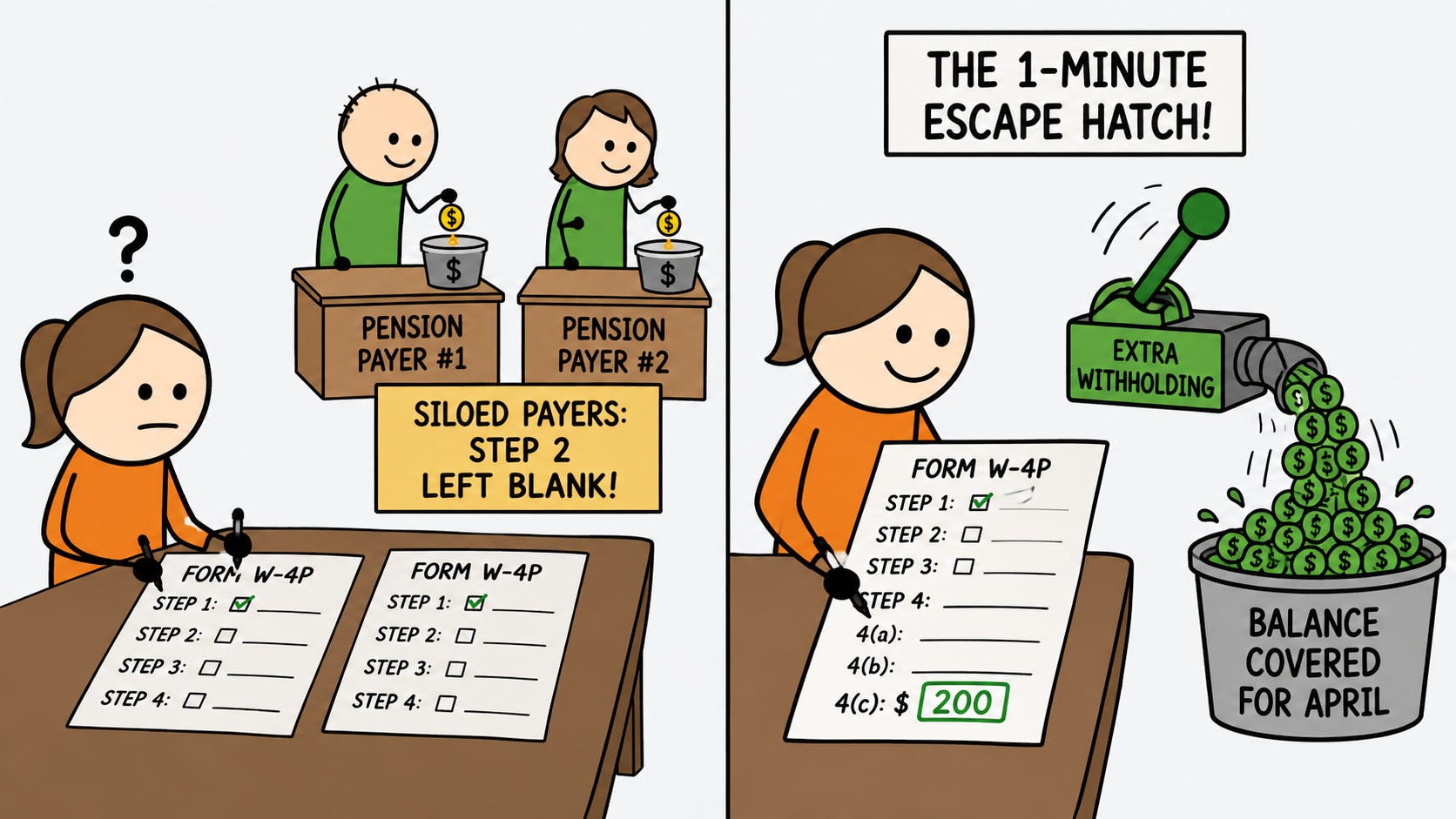
Now consider a different failure. A woman retires with two pensions and a spouse who is still working. She fills in Step 1 on both W-4P forms, selects married filing jointly, signs them, and sends them in.
Both payers now withhold as though married filing jointly with no other recurring income. The first pension is calculated as if it were the household’s only income. The second pension is calculated the same way. Neither knows about the other, and neither knows about her husband’s salary. Step 2 on either form was the mechanism for telling them, and it is blank on both.
She did not make a mistake in any ordinary sense. She completed the form she was given, correctly, and the result is a household that is underwithheld across three income streams. The available corrections on her side are the Step 2 worksheet or a dollar amount on line 4(c), and the second one takes about a minute.
The useful frame is that W-4P is not paperwork, it is the only standing instruction set a payer has. Whatever sits on that form is what the payer does, every payment, indefinitely, until something replaces it.
That also explains why the form fails so consistently. It is presented at retirement, which is the moment a person has the least accurate picture of what the coming year’s income will look like, and it is never presented again, which means the version filed during that moment of maximum uncertainty is the version that keeps running.
Anyone building a picture of what a full year of retirement income will look like across brackets can map it with the RMD and Roth conversion planner, and anyone sorting out when estimated payments and filing deadlines fall relative to a withholding change can work through the retirement account deadlines guide.
Where you stand depends on what is on file. For most people, the honest answer is that they do not know, and the payer will not ask.
I write one of these every day, one retirement rule, explained in plain language and verified against the source. The daily email is free: subscribe here.
Full archive, worksheets, and search live at RetirementNewsRundown.com.
Disclaimer
This article is for educational and informational purposes only. It is not tax, legal, or financial advice and does not create an advisor–client relationship. Always consult appropriate professionals regarding your specific situation.