Two people call their financial institution on the same morning. One wants to set up monthly payments from an annuity. The other wants to pull a lump sum out of an IRA. Same firm, same phone number, same money in the broadest sense. They are handed different withholding forms with different defaults, and one of them is about to run into a rule the other never encounters.
The dividing line is not the account type, which is what most people assume. It is the shape of the payment, and then a second question underneath it that decides whether you have any choice in the matter at all.
Form W-4P governs periodic payments, meaning a stream of payments made at regular intervals. Form W-4R governs the other two categories: nonperiodic payments and eligible rollover distributions.
A one-time IRA withdrawal is generally nonperiodic. A lump sum from an employer plan also uses Form W-4R, but it may fall into the separate eligible rollover distribution category, where a different withholding rule applies. A required minimum distribution taken as a single payment is generally nonperiodic and is specifically excluded from the mandatory 20% rollover withholding rule.
For nonperiodic payments the default is 10%. If you submit nothing, the payer withholds 10% of the taxable amount and sends you the rest. You are free to change that. Form W-4R lets you enter any whole number rate from 0 to 100, which means you can elect out of withholding entirely or elect a rate far above what you would ever owe. There is one limit worth knowing: you generally cannot elect a rate below 10%, including zero, on payments to be delivered outside the United States and its territories.
That is the permissive regime. Now the other one.
An eligible rollover distribution is a distribution from an employer-sponsored retirement plan that is eligible to be rolled over and is paid to you rather than sent in a direct rollover. The taxable portion paid to you is generally subject to mandatory 20% federal withholding. You may not choose a rate lower than 20%. You may choose higher, and in fact the only reason to submit a Form W-4R for one of these is to ask for more than 20%. The 20% happens on its own, with no form, no election, and no opportunity to decline.
This is the rule that catches people, and it catches them at the worst possible moment, because it fires precisely when someone is trying to move retirement money from one place to another.
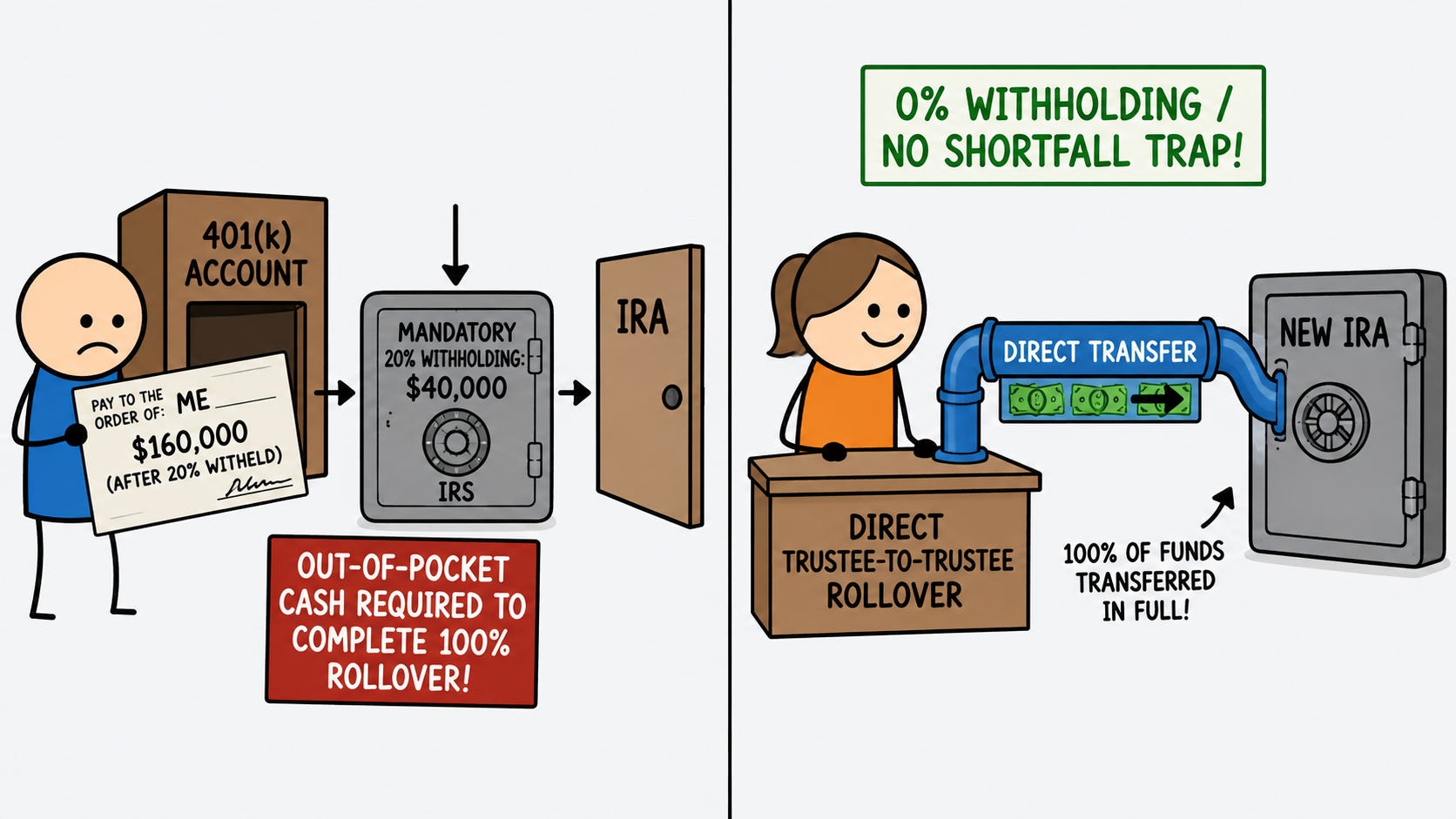
There is an exception, and it is the whole game. Mandatory withholding does not apply to a direct rollover, where the payer sends the distribution directly to another eligible retirement plan or IRA. Nothing is withheld because nothing is paid to you. The same movement of the same dollars, routed differently, produces either full withholding or none.
If the money does come to you and 20% is withheld, you can still complete a rollover within 60 days. But to defer tax on the entire taxable portion, you have to add funds from other sources equal to the amount withheld. The withheld 20% went to the Treasury, not into your hands, and the receiving account has no way to know that unless you replace it out of pocket.
IRA distributions sit outside the mandatory 20% eligible rollover distribution rule. A nonperiodic IRA distribution paid to you generally carries 10% withholding by default, and Form W-4R lets you choose another rate, including zero when permitted. Periodic IRA payments instead follow the W-4P rules. That distinction is the honest answer to why the same conceptual move behaves so differently depending on where the money starts.
Consider someone leaving a job with $200,000 in a 401(k), planning to move it to an IRA.
Done as a direct rollover, the plan sends the money to the IRA custodian. Nothing is withheld. The full $200,000 arrives, and the transaction produces no taxable income.
Done the other way, the plan cuts him a check. Twenty percent, or $40,000, is withheld as mandatory withholding. He receives $160,000. If he deposits that $160,000 into an IRA within 60 days, he has rolled over $160,000 and taken a $40,000 distribution, which is taxable income for the year. He gets credit for the $40,000 that was withheld when he files, but he is now taxed on money he never intended to remove, and if he is under 59.5 the 10% additional tax may apply to it as well.
To avoid that outcome he has to come up with $40,000 from savings within the 60 days and deposit $200,000 into the IRA, recovering the withheld amount later through his return. Someone who had $40,000 sitting available probably would not have been asking about the check in the first place.
Now the same person, a few years later, moving $200,000 from one traditional IRA to another. There is no mandatory 20% here, because an IRA distribution is not an eligible rollover distribution for this purpose. The default would be 10%, and he can elect out of it. Better still, a trustee-to-trustee transfer between IRAs avoids the distribution question altogether.
Identical dollar amount, identical destination, three very different withholding outcomes, decided by which account it left and how the paperwork routed it.
The useful frame is that two questions determine everything, and they run in order. Is this payment periodic or not, which decides the form. Then, if it is not periodic, is it an eligible rollover distribution from an employer plan paid to you, which decides whether you have any say over the rate.
Answer those two and the rest follows. Periodic goes to W-4P and the elections available there. Nonperiodic and not an eligible rollover distribution means 10% by default and anything from 0 to 100 by election. An eligible rollover distribution paid to you means 20% minimum with no way down.
That also explains why the direct rollover instruction matters more than any form. The choice between having the money sent to you and having it sent to the receiving institution is made before withholding is ever calculated, and it is the only point in the sequence where the 20% can be avoided rather than reclaimed.
Anyone working out how the 60 day window, the once per year rule, and the other rollover deadlines fit together can work through the retirement account deadlines guide, and anyone estimating what a large distribution would do to their bracket for the year can map it with the RMD and Roth conversion planner.
Where you stand depends on a routing decision most people treat as clerical. Once an eligible rollover distribution is paid to you, the mandatory withholding has already happened. The rollover itself can still be completed by replacing the withheld amount within the applicable window, but avoiding that withholding in the first place required choosing the direct rollover route before the payment was made.
I write one of these every day, one retirement rule, explained in plain language and verified against the source. The daily email is free: subscribe here.
Full archive, worksheets, and search live at RetirementNewsRundown.com.
Disclaimer
This article is for educational and informational purposes only. It is not tax, legal, or financial advice and does not create an advisor–client relationship. Always consult appropriate professionals regarding your specific situation.