The federal tax system is pay as you go. Tax on income is due during the year the income arrives, not in April when the return is filed. For most of a working life that requirement is invisible, because an employer satisfies it every two weeks without asking anyone.
Retirement removes the employer and keeps the requirement. Nobody sends a notice explaining that the job of paying tax during the year has transferred to you. The first indication most people get is a line on their return the following spring, at which point the year in question is over and the arithmetic is fixed.
Estimated tax payments are generally required if two things are true. You expect to owe at least $1,000 in tax after subtracting your withholding and refundable credits, and you expect your withholding and credits to come to less than the smaller of two figures: 90% of the tax on this year’s return, or 100% of the tax shown on last year’s return.
That second figure changes for higher incomes. If your adjusted gross income on the prior year’s return was more than $150,000, or more than $75,000 if you file married filing separately, the prior year test becomes 110% rather than 100%.
There is a clean exception. No estimated tax is required at all if you had no tax liability for the prior year, you were a U.S. citizen or resident for the whole year, and that prior tax year covered twelve months.
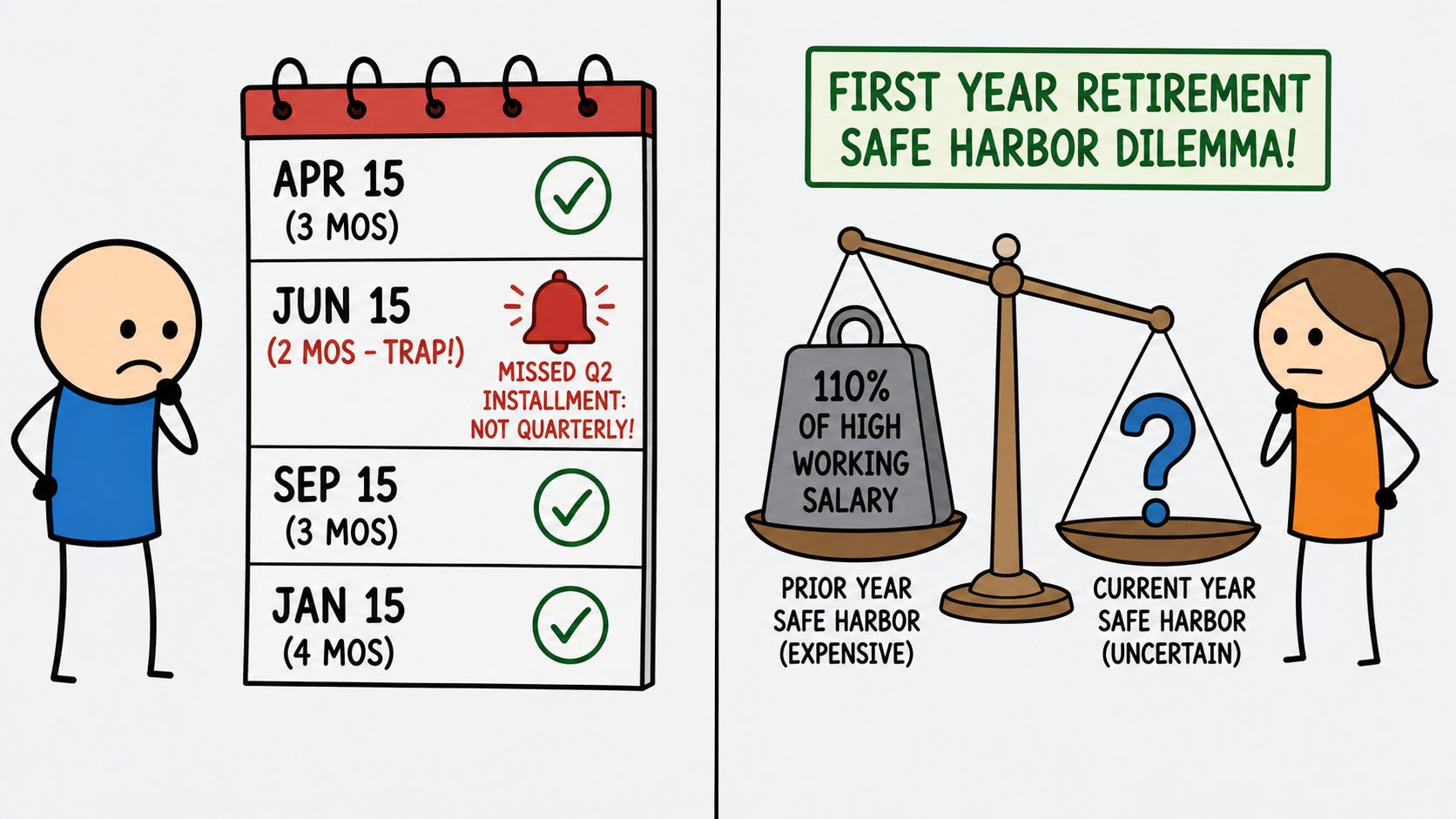
The dates are where people go wrong, because the payments are universally described as quarterly and the periods are not quarters. The first payment is due April 15 and covers January through March, three months. The second is due June 15 and covers April and May, two months. The third is due September 15 and covers June through August, three months. The fourth is due January 15 of the following year and covers September through December, four months. Each date shifts when it falls on a weekend or holiday.
Anyone who mentally spaces these out at three month intervals misses the June payment, which arrives two months after the first rather than three. That is the single most commonly missed installment, and it is missed for a reason that has nothing to do with the money.
What makes this a retirement problem specifically is how much retirement income arrives with no withholding attached to it. Social Security withholds nothing unless you file a Form W-4V electing it. A nonperiodic IRA distribution generally carries a 10% withholding default, but the account owner can elect another permitted rate, including zero, so an IRA can easily become another income source with little or no tax withheld. A pension withholds according to whatever W-4P election is on file, which may be an election filed decades ago. Dividends, interest, capital gains, rental income, and part-time self-employment income carry no withholding at all.
The result is that a retiree can have substantial income and almost no tax being paid against it during the year, without anything visibly going wrong until the return is prepared.
One useful escape exists at the end of the year. You do not have to make the January installment if you file your return and pay the entire balance due by the end of January, with that date shifting when it lands on a weekend. For someone who can file early, that converts a fourth payment into a slightly earlier filing.
Consider someone in his first full year of retirement. His pension pays $30,000 with modest withholding based on an old election. Social Security pays $28,000 with nothing withheld, because he never filed a W-4V. He takes $25,000 from an IRA with the withholding rate set to zero. Dividends and interest add $8,000.
Roughly $91,000 of income, and the only tax being paid during the year is whatever that pension election happens to produce.
Now look at his safe harbor options. His prior year was his last full working year, so the tax shown on that return may be substantially higher than the tax he expects to owe in retirement. If so, using 100% of that prior year tax, or 110% when the higher income rule applies, could require paying much more during the year than the 90% current year test would require.
The 90% test is the cheaper one in that situation, and it is also the harder one, because it requires estimating a year he has never lived before. That is the trade the first retirement year presents. The safe harbor that requires no forecasting can be expensive, and the one that costs less requires a forecast he has no basis for.
In later retirement years, the prior year test becomes easier to use because there is now a full retirement year return to reference. Whether it is cheaper than the 90% current year test still depends on how this year’s income compares with last year’s.
Now the timing problem. Suppose he works this out in July and sends one large payment in September that covers his entire expected tax for the year. If his tax obligation existed throughout the year and he is using the regular installment method, the September payment does not reach backward and erase the April and June underpayments. Each period is tested separately, which is why a person can pay their full annual tax and still be treated as having underpaid.
If the income creating the tax arrived later in the year, however, the annualized income installment method can produce a different result. That matters for retirees more than most people, because retirement income is often lumpy. A Roth conversion in November, a large capital gain in October, or a required distribution taken in December all create tax that did not exist in April.
The useful frame is that withholding and estimated payments are two ways of satisfying the same obligation, and retirement shifts the burden from the first to the second without anyone changing the rules.
That also explains why the fix has two shapes. You can send payments on the four dates, which is the direct route. Or you can increase withholding somewhere, through a W-4P election with a pension payer, a W-4V election on Social Security, or a rate election on an IRA distribution, which routes the same money through a different mechanism. The two are not treated identically across the year, and that difference is worth understanding on its own.
Anyone mapping when each installment and filing deadline falls can work through the retirement account deadlines guide, and anyone working out how large a required distribution will be so they can plan for the tax on it can run the figure with the required minimum distribution calculator.
Where you stand depends on how much of your income has tax coming out of it before it reaches you. For most retirees the honest answer is less than they think, and for some of them it is none.
I write one of these every day, one retirement rule, explained in plain language and verified against the source. The daily email is free: subscribe here.
Full archive, worksheets, and search live at RetirementNewsRundown.com.
Disclaimer
This article is for educational and informational purposes only. It is not tax, legal, or financial advice and does not create an advisor–client relationship. Always consult appropriate professionals regarding your specific situation.