The word penalty suggests a fine, a fixed charge imposed for breaking a rule. That framing is what makes this one confusing. This charge works differently. It is computed like interest on money the government takes the position it should have received earlier in the year, which is why it can appear on a return filed on time by someone who paid every dollar they owed.
Retirees run into it more than almost anyone, for reasons that have nothing to do with carelessness. Income arrives without withholding, the obligation to pay during the year transfers to them without notice, and the shortfall is only visible once the year is closed. There is also a relief provision written specifically for this situation that most people never hear about.
The addition to tax for underpaying estimated tax is built from three inputs: the amount of the underpayment, the period during which it was due and underpaid, and the published quarterly interest rates for underpayments. Those rates move, so this is not a number you can memorize. The charge itself is calculated using the federal underpayment rate over the period the tax was underpaid. If you let the IRS compute the penalty and pay the resulting bill by its stated due date, the IRS says it will not charge interest on that penalty.
The important structural feature is that it is figured separately for each required payment due date. Four periods, four independent calculations. An underpayment in the first period begins accruing in April and keeps accruing until it is made up or until the return due date arrives, whichever comes first. Nothing that happens in September reaches back and repairs it.
That is the mechanic behind the outcome people find hardest to accept. A person can owe nothing at filing, having paid their full annual tax before the deadline, and still carry this charge, because the calculation asks when the money arrived rather than whether it arrived.
The exits are the ones covered by the safe harbor rules. If your withholding and credits meet 90% of the current year’s tax or 100% of the prior year’s tax, or 110% of the prior year’s when the higher income rule applies, the penalty does not apply. Neither does it apply if the tax shown on your return minus your withholding and refundable credits comes to less than $1,000.
Form 2210 is where all of this is computed, and there is a detail worth knowing before anyone sits down with it. In most situations you do not have to complete it at all. If you are not requesting a waiver and not using the annualized income method, you can leave the penalty line on your return blank, and the IRS will figure the amount and send a bill. Doing the arithmetic yourself is optional in a way that very little else on a tax return is.
Two situations change that, and both require the form.
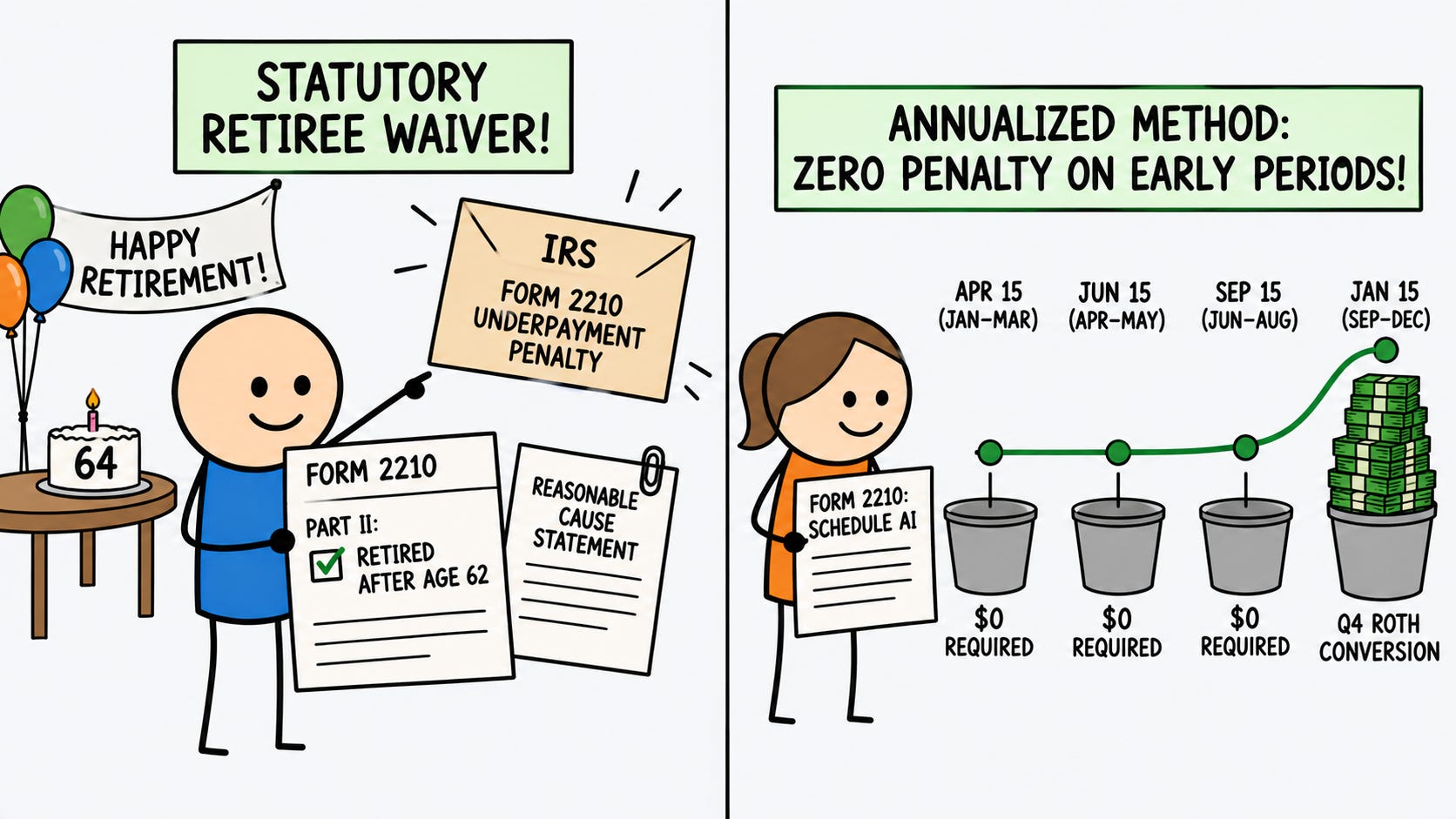
The first is the annualized income installment method, worked on Schedule AI. The regular method generally starts from equal required installments, while Schedule AI adjusts those installments when income actually arrived unevenly. For anyone whose income is lumpy, that can reduce or eliminate underpayments in earlier periods, because those periods genuinely had less income in them.
The second is the waiver, and this is the part written for retirees. The IRS will waive all or part of the addition to tax if, in the tax year for which the payments were required or in the preceding tax year, you retired after reaching age 62 or became disabled, and the underpayment was due to reasonable cause and not willful neglect.
A separate relief path exists for casualties, disasters, or other unusual circumstances when imposing the penalty would be inequitable. Federally declared disasters can also trigger IRS postponements of estimated tax payment deadlines for affected taxpayers, so the applicable disaster relief is worth checking before calculating an underpayment.
The waiver is not automatic. To request it with the return, you file Form 2210, check the applicable waiver box, and attach the required explanation and documentation, which for the retirement ground means showing the retirement date and your age. A taxpayer who does not request the waiver on the return may still be able to seek relief after the IRS assesses the penalty, but that requires a separate request rather than happening automatically.
Note the reach of that provision. It covers the tax year in question or the one before it, which means the second year of retirement can qualify on the strength of a retirement that happened in the first.
Consider someone who retires in May at 64 after a long career. His wages stop, his pension starts, Social Security begins in the fall with nothing withheld, and he makes no estimated payments because it does not occur to him that he is now responsible for them. The following spring his return shows an underpayment across all four periods.
He retired after reaching 62, in the tax year for which the payments were required. If his underpayment was due to reasonable cause rather than willful neglect, he can request the waiver by checking the box in Part II and attaching a statement explaining the circumstances. Nothing about that request is exotic. The provision exists because the year someone stops working is structurally different from every year before it.
If he left the penalty line blank, the IRS could compute the charge and send him a bill. He could still request relief afterward if he qualified, but filing Form 2210 with the return lets him make that case before simply accepting the assessment.
Now a different situation. A retiree converts a large amount to a Roth in November. Her annual tax is far higher than the prior year’s, and under the regular method she appears underpaid for April, June, and September, because the equal installment approach treats the year’s obligation as spread across periods that had no such income in them.
Schedule AI recomputes those periods using income actually received through each date. Through March she had ordinary retirement income and nothing else. Same through May, same through August. The conversion income belongs to the fourth period, and the required installments for the earlier ones shrink accordingly.
That is a different argument from asking for forgiveness. She is showing that the assumption underneath the standard calculation does not describe her year.
The useful frame is that there are two very different reliefs here and they solve different problems. The waiver is about circumstance: something happened to you, specifically retirement after 62 or disability, and the shortfall followed from it. The annualized method is about timing: the income that created the tax genuinely was not there yet when the earlier installments came due.
Neither substitutes for the other. Someone who retired mid-year with evenly spread income wants the waiver. Someone with a December conversion and no change in circumstances wants Schedule AI. A person with both may need both boxes.
Anyone mapping when each installment falls relative to a planned distribution or conversion can work through the retirement account deadlines guide, and anyone projecting what a conversion will do to a single year’s tax before committing to it can model it with the RMD and Roth conversion planner.
Where you stand depends on why you came up short. The system distinguishes between money that arrived late and money that was never there, and it offers a different remedy for each.
I write one of these every day, one retirement rule, explained in plain language and verified against the source. The daily email is free: subscribe here.
Full archive, worksheets, and search live at RetirementNewsRundown.com.
Disclaimer
This article is for educational and informational purposes only. It is not tax, legal, or financial advice and does not create an advisor–client relationship. Always consult appropriate professionals regarding your specific situation.