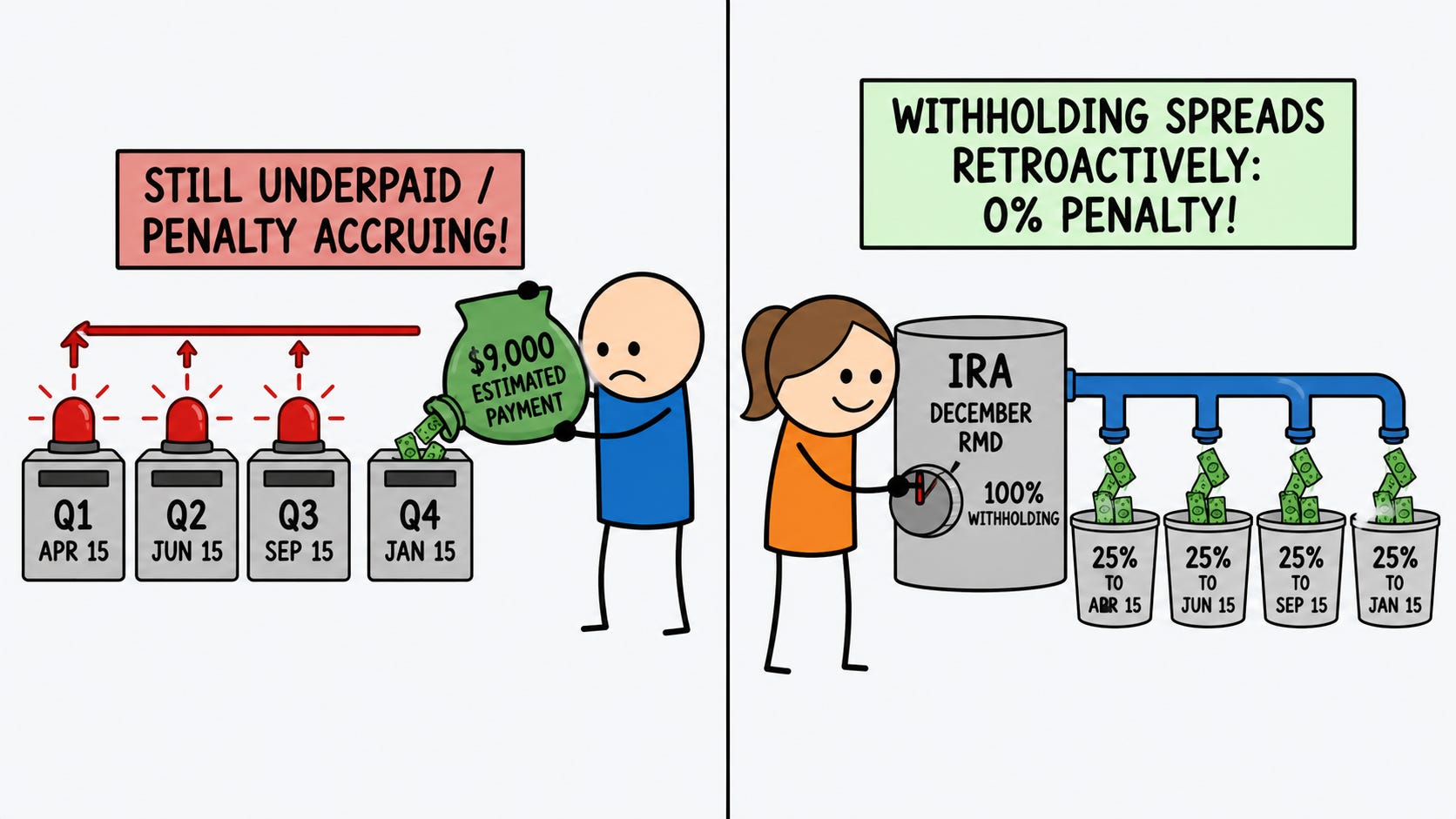
Someone works out in November that they have underpaid all year. The instinct is to send money to the IRS immediately, which is the right instinct but the wrong reason. An estimated payment made in November is credited in November, and the periods that closed in April, June, and September stay underpaid.
There is a second rule that acts differently, and the difference is written into the rules rather than being a matter of interpretation. Money that arrives as withholding is treated as having been paid across the whole year, no matter when it actually came out.
The rule is stated plainly in the instructions for the form where this is computed. For withheld federal income tax, you are considered to have paid one fourth of the amount on each payment due date, unless you can show otherwise.
Read that against the treatment of estimated payments, which are credited on the date they are made, and the asymmetry becomes the entire subject. A dollar withheld on December 28 is treated exactly like a dollar withheld on January 15. A dollar sent as an estimated payment on December 28 is treated as arriving on December 28, which is after three of the four installment dates have already passed.
This applies to any federal income tax withholding, not to one kind of account. Wage withholding, pension withholding under a W-4P election, Social Security withholding under a W-4V election, and withholding on an IRA distribution under a W-4R election all receive the same ratable treatment.
What makes an IRA the flexible instrument is the range of the dial. A nonperiodic IRA distribution can carry any whole number withholding rate from 0 to 100. Nothing else in a retiree’s finances offers that. A pension election changes future payments and takes effect on the payer’s schedule. Social Security offers four fixed percentages and nothing between them. An IRA distribution can be requested in December at whatever rate the owner elects.
Now the limit, because this mechanic is widely described in ways that overstate it. The distribution is taxable income. Withholding does not reduce tax owed, it moves when the tax is treated as having been paid. Taking $20,000 from an IRA and withholding all of it means $20,000 more income on the return and $20,000 sent to the Treasury, with nothing arriving in your bank account. The maneuver addresses the timing charge for underpayment. It does not address the tax itself, and for someone who did not otherwise need or want that distribution, it creates tax while solving a smaller problem.
The rule also runs in the other direction, and there is an election for that. If withholding was concentrated early in the year, spreading it evenly across four dates can understate what was actually paid in the first periods. A taxpayer can choose to treat withholding as paid on the dates it was actually withheld, which requires checking box D in Part II and completing and attaching Form 2210 to the return. The default is the even split. The actual dates are available if you ask for them and show the work.
One situation makes all of this considerably less academic. A person who has a required minimum distribution to take anyway has both the timing and the rate under their own control. The distribution is happening either way, and the income it creates was already going to be in the year’s return.
Consider someone who works out in October that her withholding for the year is roughly $9,000 short of where it needs to be.
If she sends a $9,000 estimated payment when the fourth installment comes due in January, it is credited then. The April, June, and September periods were each underpaid, and the addition to tax on each accrues from that period’s due date forward. Paying in January does not reach back to any of them.
If instead she takes an IRA distribution in December and elects $9,000 of withholding, the default rule treats that $9,000 as $2,250 paid on each of the four due dates. Every period is treated as having received its share, including the three that closed months before the distribution existed.
Same $9,000, same calendar year, same Treasury. Two entirely different results, decided by which instrument carried the money.
The part that gets left out of most descriptions is what the distribution cost her. If the $9,000 withheld came from a $9,000 distribution, she now has $9,000 of additional income on her return, which generates its own tax. If that distribution was her required minimum distribution, which she had to take before December 31 regardless, then the income was already coming and only the withholding rate was ever a choice. Those are two different situations wearing the same arithmetic.
Now the reverse case. Someone retires at the end of June after six months of wages with substantial withholding, and takes nothing from retirement accounts for the rest of the year. Under the default rule, that heavily front-loaded withholding is spread evenly across all four due dates, which treats a quarter of it as arriving in January, after the money was actually paid in the first half of the year.
For a person in that situation the actual date election can produce a better result, because the withholding genuinely was concentrated in the periods where the income was. Making that election means checking box D and filing Form 2210 rather than letting the default apply.
The useful frame is that there are two ways to move money to the Treasury during the year and the rules time them differently. Estimated payments are dated. Withholding is spread. Neither is better in the abstract, and which one helps depends entirely on where in the year the shortfall sits.
That also explains why the calendar matters so much more for one than the other. An estimated payment made late is late. Withholding made late is not, unless someone elects to have it treated that way. It is one of the few places in the tax code where the default assumption works in the taxpayer’s favor, and it works hardest for the person who noticed the problem last.
Anyone deciding when in the year to take a required distribution, and needing the amount before setting a withholding rate on it, can run the figure with the required minimum distribution calculator, and anyone mapping how the four installment dates line up against a planned distribution can work through the retirement account deadlines guide.
Where you stand depends on which instrument the money travels through. The amount can be identical and the treatment is not.
I write one of these every day, one retirement rule, explained in plain language and verified against the source. The daily email is free: subscribe here.
Full archive, worksheets, and search live at RetirementNewsRundown.com.
Disclaimer
This article is for educational and informational purposes only. It is not tax, legal, or financial advice and does not create an advisor–client relationship. Always consult appropriate professionals regarding your specific situation.