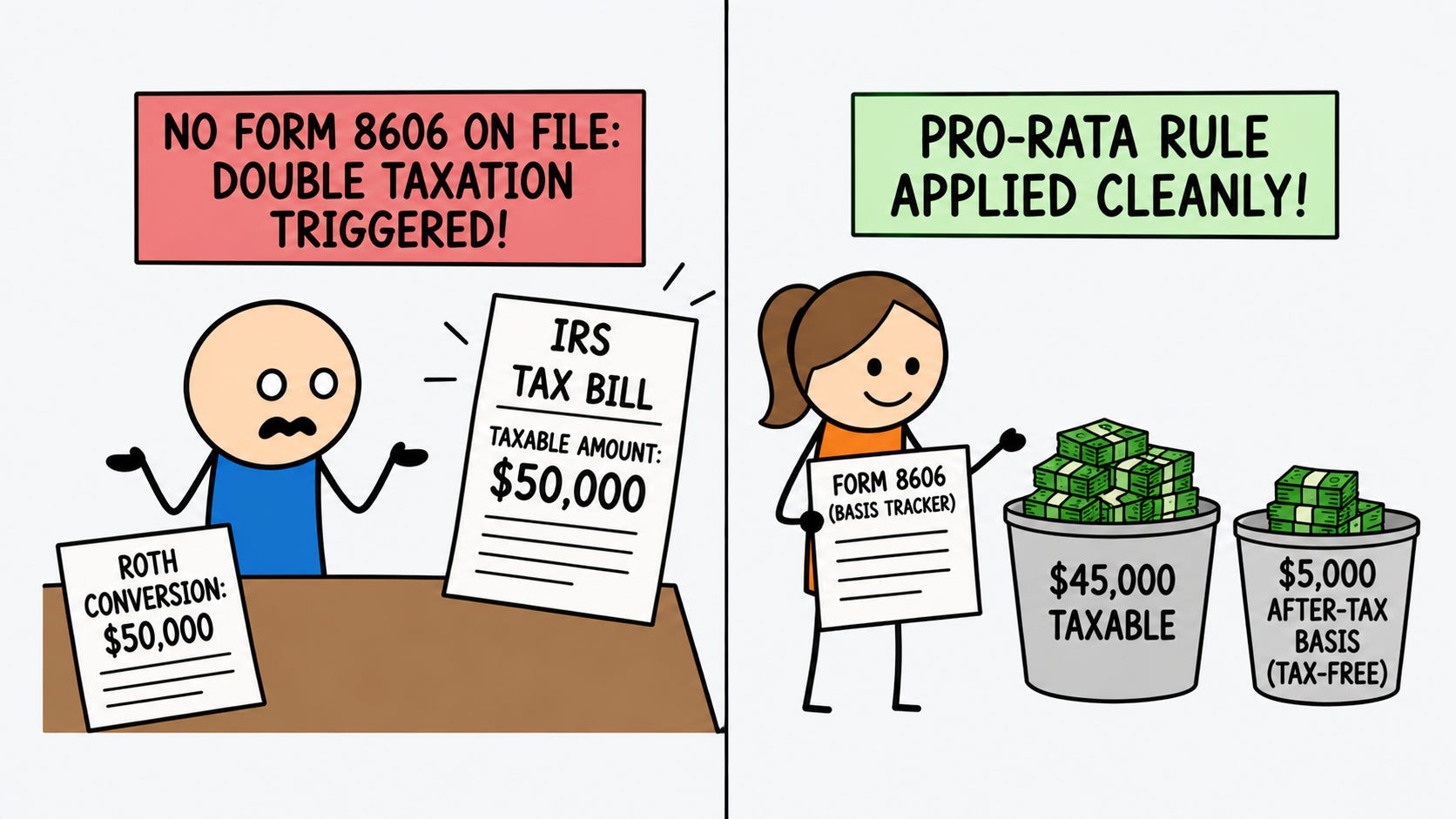
A married couple files jointly. One spouse is covered by a workplace retirement plan, their income sits above the deduction phase-out range, and they contribute to a traditional IRA anyway. The contribution is permitted. The deduction is not. The tax software asks whether any part of the contribution was nondeductible, the answer is yes, and a form is generated somewhere in the return that nobody reads. Six years later the account gets converted to a Roth. The Form 1099-R reports the full amount in box 1, box 2a either matches it or is left as taxable amount not determined, and the return picks up the entire conversion as income. Money that was already taxed the year it was earned gets taxed a second time on the way out. The mechanism that was supposed to prevent that was a single form, and the reason it failed is that the form stopped being filed at some point and nobody noticed.
Form 8606 is the tax system’s running record of after-tax basis inside traditional IRAs. If nondeductible contributions were never reported, distributions are generally treated as taxable unless the taxpayer can substantiate those contributions with satisfactory evidence. The form is what normally establishes that basis and carries it forward year after year.
The instructions list several situations that create a filing obligation. The main ones are making nondeductible traditional IRA contributions, taking distributions from a traditional, SEP, or SIMPLE IRA in a year when basis exists, converting traditional IRA money to a Roth, taking certain Roth IRA distributions, transferring IRA basis between spouses incident to divorce, and receiving distributions from an inherited IRA that carries basis or from an inherited Roth IRA where the distribution is not qualified. Rollovers, recharacterizations, and returns of contributions are outside the Roth distribution category.
The form is divided into three Parts. Part I handles nondeductible contributions to traditional IRAs and distributions from traditional, SEP, and SIMPLE IRAs when basis exists. Part II handles conversions to Roth IRAs. Part III handles distributions from Roth IRAs. Most people who file it use one Part. People running conversions with existing basis use two.
Part I is where the aggregation rule appears, and it is the section that surprises people. Line 6 asks for the total value of all your traditional, SEP, and SIMPLE IRAs as of December 31, plus any outstanding rollovers. Every one of those accounts, at every institution, gets added together. The lines that follow then combine that year-end figure with the conversions and distributions taken during the year to produce the denominator the calculation runs against. Basis is spread across that combined total rather than sitting inside the account that received the nondeductible contribution. This is the pro-rata rule, and it is why a large rollover IRA sitting alongside a small nondeductible contribution changes the math on a conversion so dramatically. Our IRA Pro-Rata Calculator runs that allocation.
The form carries small statutory penalties of its own. Failing to file Form 8606 when required to report a nondeductible traditional IRA contribution can trigger a $50 penalty unless reasonable cause applies. Overstating nondeductible contributions can trigger a $100 penalty, also subject to reasonable cause. Both figures are fixed in statute rather than indexed, which is why they have stayed small while the amounts they govern have not. The exposure that matters sits elsewhere. A taxpayer with $60,000 of basis who cannot substantiate it pays ordinary income tax on $60,000 that was already taxed once.
One more mechanical point. Form 8606 does not always need a tax return underneath it. When you are not required to file an income tax return but a filing event occurred, the form is filed by itself. You enter your address on page 1, sign and date page 2, and send it to the same place and by the same deadline that a Form 1040 would go.
Consider a taxpayer with $34,000 of accumulated basis from years of nondeductible contributions, each reported on a timely Form 8606. She also holds a rollover IRA from a former employer that is entirely pretax. Immediately before a $50,000 Roth conversion, her traditional, SEP, and SIMPLE IRA value totals $340,000. Assume no other distributions, contributions, rollovers, or investment changes during the year.
After the $50,000 conversion, $290,000 remains in the IRAs at year end. For the pro-rata calculation, that $290,000 year-end balance and the $50,000 conversion are combined, producing a $340,000 denominator. The $34,000 of basis is 10 percent of that total. Ten percent of the conversion, or $5,000, comes out nontaxable. The taxable portion is $45,000. The remaining $29,000 of basis carries forward to be used against future distributions.
Now assume she had never filed a single Form 8606. She still made those contributions, and she still deducted nothing for them. But nothing in the return reports the basis. The $50,000 conversion lands as $50,000 of ordinary income. At a 24 percent marginal rate, the missing form costs her $1,200 on this conversion alone, with the remaining $29,000 of basis still unrecorded and still exposed on every future distribution.
I write one of these every day, one retirement rule, explained in plain language and verified against the source. The daily email is free: subscribe here.
Missed years can often be reconstructed and corrected, though the IRS does not publish a single step-by-step procedure covering every late Form 8606 situation.
Reconstruction starts with Form 5498, which custodians file with the IRS every year a contribution is made and which shows the contribution amount and type. Your IRS account transcript and wage and income transcripts will list those 5498 filings going back several years. Old tax returns supply the other half of the answer, because a contribution that produced no IRA deduction on the return is the contribution that created basis. Custodian statements and confirmations fill remaining gaps.
Once the years and amounts are identified, the applicable prior-year form gets rebuilt using the records for that year, since line numbering and carryforward figures differ by year. Where correcting the basis also changes income, deductions, or tax reported on a return you already filed, Form 1040-X is generally the vehicle for that change and the corrected Form 8606 accompanies it. Where the missing form only establishes basis and changes nothing about the tax previously reported, practitioners commonly submit the prior-year Form 8606 separately with an explanation. The instructions do not spell out that second path in detail, which is worth knowing before you rely on it.
The refund clock and the basis record are two different things. A refund claim for an old overpayment can expire under the normal limitation period. Legitimate IRA basis can continue to affect the taxation of future distributions if you can substantiate it. That is why the IRS tells taxpayers to retain Forms 8606, Forms 5498, the relevant pages of prior tax returns, year-end IRA values, and distribution forms until all distributions have been made. A year too old to produce a refund can still produce basis that reduces tax on a distribution you take next year.
Our full Form 8606 guide walks through the line-by-line mechanics and the reconstruction sequence in more detail.
Full archive, worksheets, and search live at RetirementNewsRundown.com.
Disclaimer: This content is for educational purposes only and does not constitute tax, legal, or investment advice. Rules change and individual circumstances vary. Consult a qualified professional before acting.