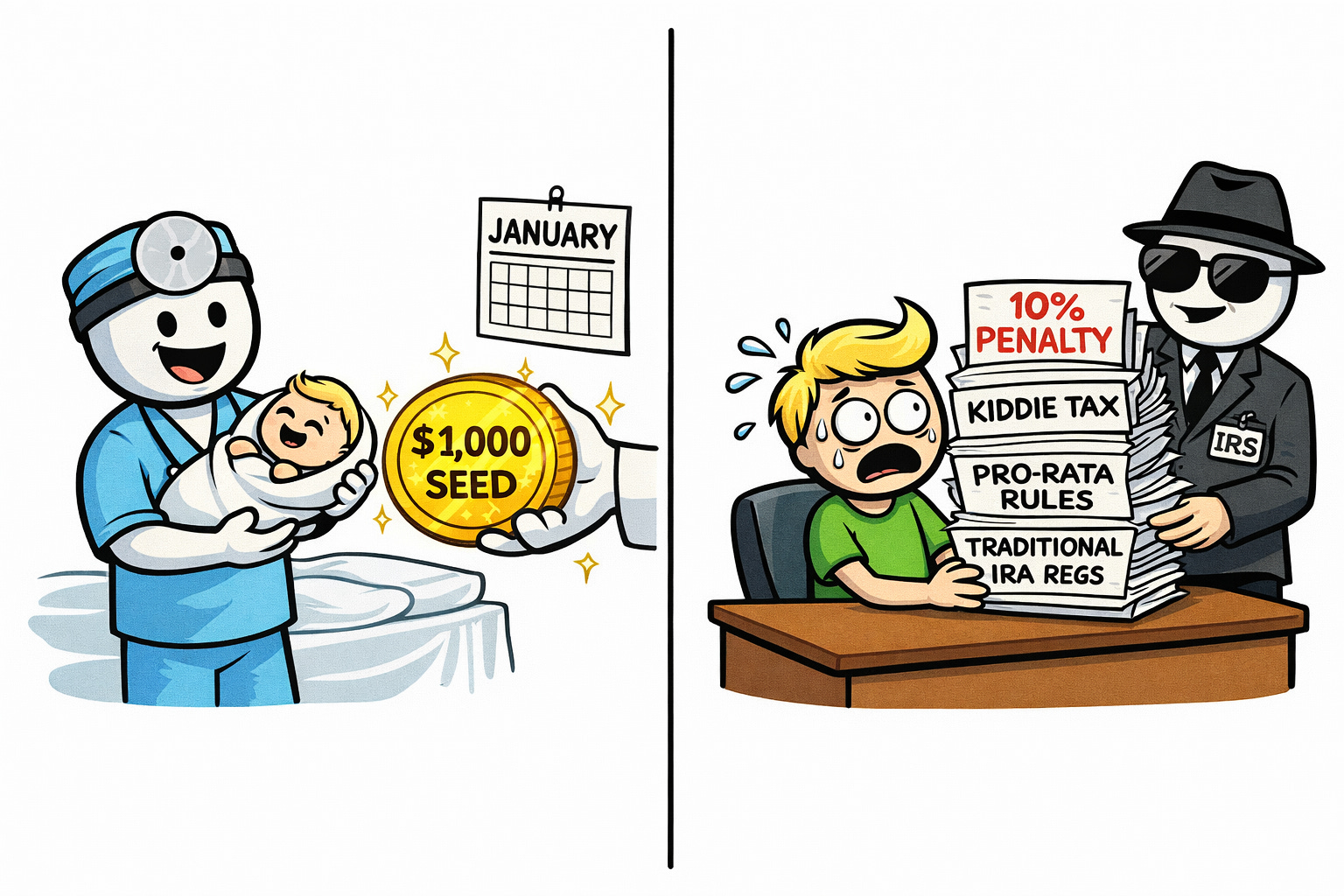
The marketing worked. A new savings account for kids. A thousand dollars from the government. Up to $5,000 a year in contributions. Tax-deferred growth. Every financial headline in the country ran it.
And almost every one of them stopped at the surface.
Trump Accounts were created under the One Big Beautiful Bill Act in 2025. They became available July 2026. Children under 18 with a Social Security number are eligible. Kids born between 2025 and 2028 get a $1,000 seed contribution from the Treasury. Parents, guardians, relatives, and even employers can contribute up to $5,000 a year. The money goes into low-cost index funds with expense ratios capped at 0.10%. No earned income required.
That all sounds simple. It is simple. For now.
The account has two lives. The first life is the growth period. Birth through the end of the year before the child turns 18. During this phase, the rules are tight. Investments are restricted to qualified U.S. stock index funds. No withdrawals. No conversions. No rollovers to outside accounts. The money is locked. The parent manages it. The child owns it but can’t touch it.
Then January 1 of the year the child turns 18 arrives.
The growth period ends. The Trump Account becomes subject to traditional IRA rules. The parent’s custodial role disappears. The investment restrictions lift. The child has full legal control of the account.
This is the moment most people are not prepared for.
Once the growth period ends, everything changes. Contribution limits shift. If the child wants to keep contributing, they now need earned income, just like any other traditional IRA. Tax deductibility depends on their income and whether they have access to an employer plan. Withdrawals before age 59 1/2 are subject to a 10% early withdrawal penalty unless an exception applies. Education expenses eliminate the penalty but not the income tax. First-time home purchases up to $10,000 eliminate the penalty but not the income tax.
The account that felt like a simple savings vehicle for 17 years is now a full-blown IRA with every rule that comes with it.
Here is where the real planning starts.
The Trump Account contains two types of money. After-tax basis from the contributions you made as a parent. And pre-tax money from the $1,000 government seed, any employer contributions, and all the investment growth over 17 years.
When the child turns 18, a Roth conversion becomes available. Convert the account to a Roth, pay tax on the pre-tax portion, and the money grows tax-free for the rest of their life. If the account started at birth with the $1,000 seed and $5,000 annual contributions earning a reasonable return, that balance could be well into six figures by age 18. Converting that to a Roth at 18 sounds like the obvious play. The child is young. Low income. Low tax bracket. Convert it all for almost nothing.
Except it might not work that way.
If the child is under 19, or under 24 and a full-time student, the kiddie tax applies. Roth conversion income is unearned income. The IRS does not tax it at the child’s rate. It gets taxed at the parent’s rate. If the parents are in the 24% bracket, the conversion gets taxed at 24%. If they are in the 32% bracket, the conversion gets taxed at 32%.
The “convert while they’re young and in a low bracket” strategy that every article recommends only works cleanly if the child is not a full-time student and is fully self-supporting. For most 18-year-olds heading to college, that is not the case.
The better window might be after graduation. Age 23 or 24. First job. Low income year. No longer subject to the kiddie tax. That is when the Roth conversion math actually favors them.
One more thing most coverage skips entirely.
Trump Account basis is tracked separately from other IRAs. This is not how traditional IRAs normally work. If your child opens a traditional IRA later in life and also has the old Trump Account, the pro-rata rule does not lump them together for distribution tax calculations. The Trump Account gets its own basis tracking.
This is a carve-out that no other IRA type gets. It creates real flexibility when deciding which account to convert or withdraw from down the road. But only if someone actually knows it exists.
The $1,000 seed contribution is a nice headline. The $5,000 annual limit is a solid savings vehicle. But the decisions that actually determine whether this account helps or hurts your child happen at 18 and beyond.
Which money is pre-tax. Which is after-tax. When to convert. Whether the kiddie tax applies. How the basis interacts with other retirement accounts over a 60-year time horizon.
That is where the planning starts. Not at birth. At 18.
I write one of these every day, one retirement rule, explained in plain language and verified against the source. The daily email is free: subscribe here.
Full archive, worksheets, and search live at RetirementNewsRundown.com
Disclaimer This article is for educational and informational purposes only. It is not tax, legal, or financial advice and does not create an advisor-client relationship. Always consult appropriate professionals regarding your specific situation.