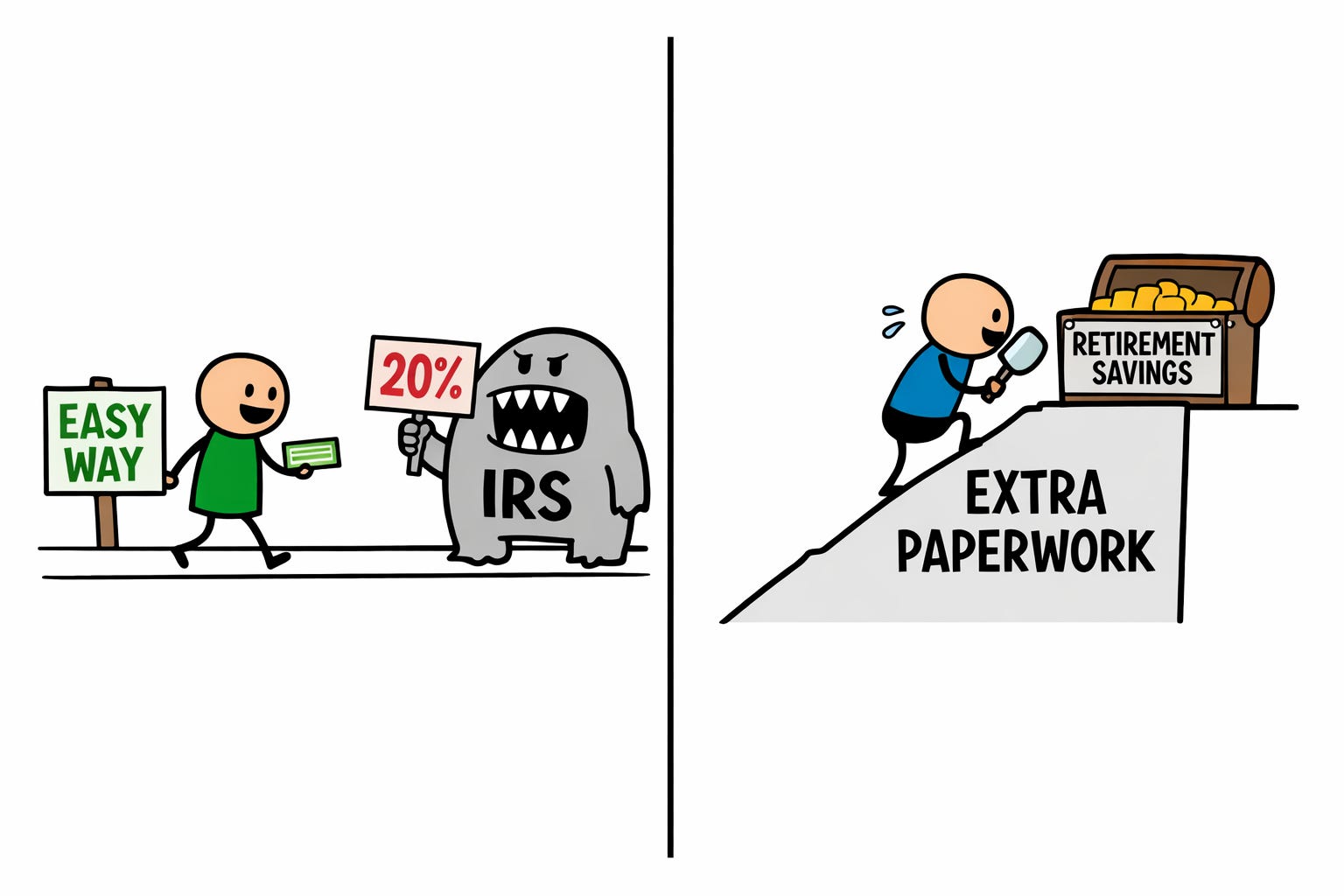
There is a version of every retirement decision that feels easy. Roll everything into one account. Take the default distribution. Let the custodian pick the withholding. Sign where they tell you to sign. Move on with your day.
Nobody warns you that convenience has a price tag. It just doesn’t show up until later.
A client calls and wants to move a 401(k) from a former employer. The fastest option is an indirect rollover. The custodian cuts a check. The client deposits it into an IRA. Simple.
Except the custodian withholds 20% for federal taxes. On a $100,000 balance, the client receives $80,000. They have 60 days to deposit the full $100,000 into the IRA. Not $80,000. The full amount. That missing $20,000 has to come out of their own pocket. If they can’t replace it in time, the IRS treats it as a distribution. Income tax plus a 10% early withdrawal penalty if they are under 59 1/2.
A direct rollover avoids all of that. The money moves custodian to custodian. No withholding. No 60-day clock. No scrambling to find $20,000 on short notice.
But the direct rollover takes a few more days of paperwork. So people pick the check.
The same pattern shows up with Roth conversions. Someone decides in December to convert part of a traditional IRA. Good strategy. Except they let the custodian withhold taxes from the conversion itself.
On a $50,000 conversion with 22% federal withholding, only $39,000 goes into the Roth. The other $11,000 goes to the IRS as a tax payment. That $11,000 is treated as a distribution. If the person is under 59 1/2, it gets hit with the 10% early withdrawal penalty. And it never enters the Roth, so it never grows tax-free.
The alternative is to pay the tax bill from a separate bank account. Keep the full $50,000 in the Roth. But that requires planning. It requires having cash set aside. It is less convenient.
RMDs follow the same logic. A retiree with IRAs at three custodians takes the RMD from each account individually because that is what each custodian calculates. Easy.
But IRA RMDs can be aggregated. You calculate the total required distribution across all traditional IRAs, then take the entire amount from whichever account makes the most tax sense. Maybe one account has lower-performing holdings you want to liquidate. Maybe pulling from a specific account keeps your income below an IRMAA threshold. The aggregation rule gives you that flexibility.
Most people never use it because it requires a step that the custodians do not do for you. Each one calculates their number. None of them look at the full picture.
Convenience works against you when it hides the decision you did not realize you were making. Every default option in the retirement system was designed to be easy for the institution, not optimal for you.
The withholding default on a rollover exists because the IRS wants its money now. The custodian’s RMD letter exists because they are required to send it, not because it is the best strategy. The checkbox that says “withhold taxes from this conversion” exists because it simplifies their accounting.
None of it is wrong. All of it is expensive if you do not understand what you are choosing.
The cheapest retirement decisions are rarely the fastest ones. The ones that save the most money usually require an extra form, an extra phone call, or an extra week of processing time. The system does not reward speed. It rewards precision.
If someone is offering you the easy version of a retirement decision, ask what the hard version looks like. That is usually where the money is.
I write one of these every day, one retirement rule, explained in plain language and verified against the source. The daily email is free: subscribe here.
Full archive, worksheets, and search live at RetirementNewsRundown.com
Disclaimer This article is for educational and informational purposes only. It is not tax, legal, or financial advice and does not create an advisor-client relationship. Always consult appropriate professionals regarding your specific situation.