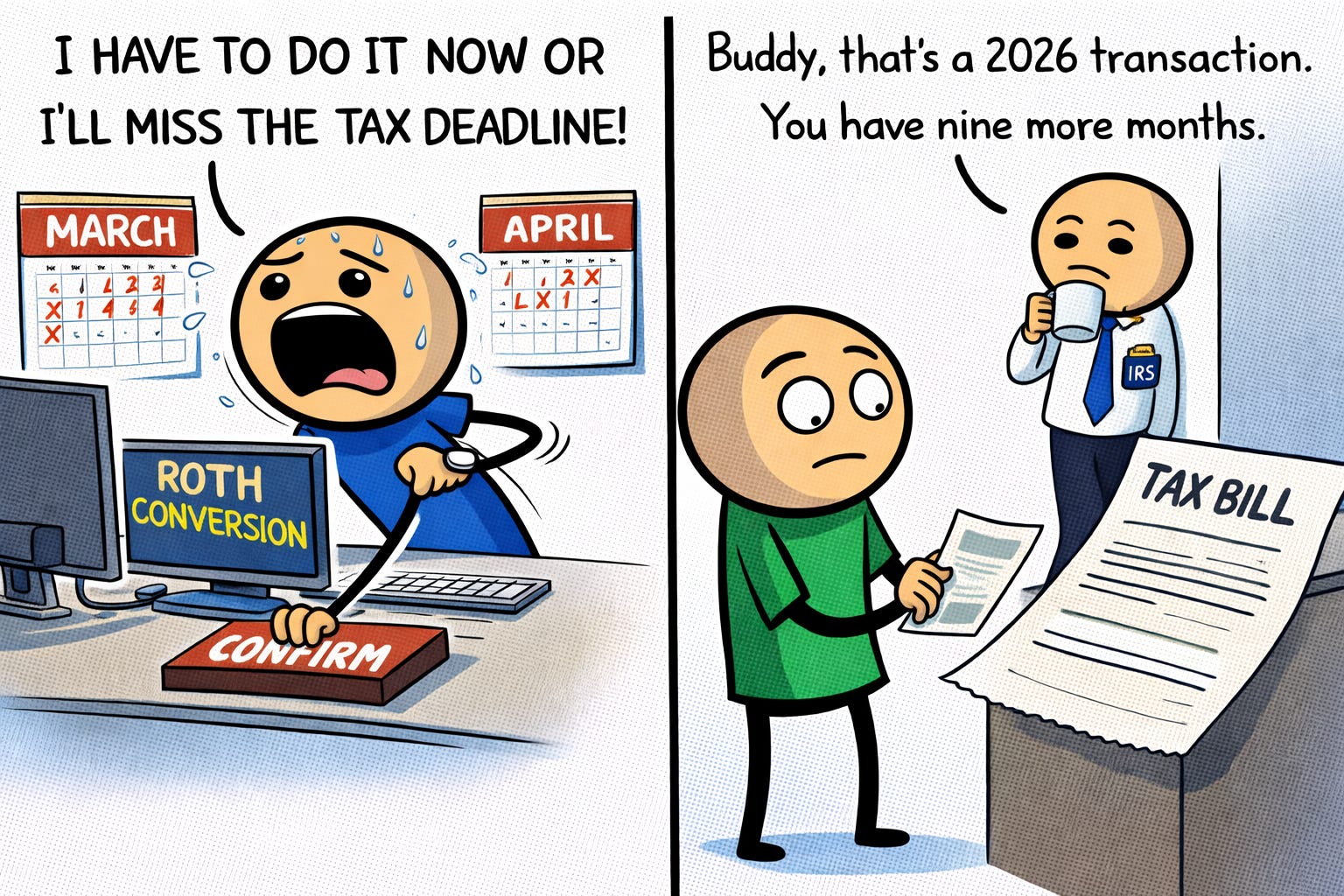
March is when the retirement system asks you to make permanent decisions on a temporary timeline. Tax season creates urgency. Deadlines create pressure. And the combination produces choices that feel time-sensitive even when the consequences stretch across decades.
The IRA contribution deadline is approaching. The excess contribution correction window is closing. The recharacterization clock is ticking. First-quarter estimated tax payments are due. And somewhere in the middle of all that, people are making Roth conversion decisions, rollover decisions, and beneficiary changes based on last year’s tax return, which they’re only now seeing clearly for the first time. We cover contribution limits and deductibility rules in our Traditional IRA Guide
Most of these decisions are fine. Some of them are not. The ones that aren’t tend to share a common trait: they were made in March because March felt like the deadline, not because March was actually the deadline.
The IRA contribution deadline for the prior tax year is the tax filing deadline, typically April 15. For 2025 contributions, that means April 15, 2026. This deadline does not move if you file an extension. Extensions give you more time to file your return. They do not give you more time to fund your IRA.
This creates a narrow window in March where people realize they haven’t made their prior-year contribution and rush to fund it. The rush itself isn’t the problem. The problem is that people sometimes fund the wrong account type or contribute the wrong amount because they’re working from incomplete information.
A common scenario: someone contributes $7,500 to a Roth IRA in March 2026 for the 2025 tax year, then finishes their tax return in April and discovers their modified adjusted gross income exceeded the Roth IRA income limit. The contribution was not eligible. Now they have an excess contribution that needs to be corrected.
The correction window for this is the tax filing deadline, including extensions. If you file an extension to October 15, 2026, you have until October 15 to withdraw the excess contribution (plus any earnings attributable to it) without penalty. If you miss that deadline, the excess stays in the account and is subject to a 6% penalty for every year it remains. For help with excess contributions, see out Excess Contribution Correction Tool.
The alternative to withdrawing is recharacterizing the Roth contribution as a Traditional IRA contribution. Recharacterization must also be completed by the tax filing deadline, including extensions. Once recharacterized, the contribution is treated as if it was always made to the Traditional IRA. The math resets. The excess goes away.
If someone had waited two weeks to finish their tax return before funding the IRA, they would have known their MAGI and contributed to the right account from the start. The March rush created a problem that didn’t need to exist.
Roth conversions are calendar-year transactions. A conversion done on March 15, 2026, counts as 2026 income. It cannot be applied to 2025. And unlike contributions, there is no recharacterization for conversions. The Tax Cuts and Jobs Act eliminated the ability to undo Roth conversions starting in 2018. Once you convert, the tax bill is locked in.
March is when people see their prior-year tax return and realize they had room in their bracket for a Roth conversion they didn’t make. That realization comes too late for last year but creates motivation for this year. The impulse is to convert immediately, while the idea is fresh.
The risk is converting too much in the current year without knowing what the current year’s income will look like. Someone who converts $80,000 in March based on their projected 2026 income might discover in November that a year-end bonus, capital gain distribution, or side income pushed them two brackets higher than expected. That $80,000 conversion is now taxed at 32% or 35% instead of the 22% or 24% they planned for.
Since the conversion can’t be reversed, the excess tax is permanent. The March conversion didn’t cause the problem by itself. The timing did. A conversion made in November or December, when full-year income is nearly finalized, would have been sized correctly.
There’s no deadline that forces a Roth conversion to happen in March. Conversions can be done any day the markets are open, any month of the year. The April 15 contribution deadline doesn’t apply to conversions. The only relevant deadline is December 31 of the year you want the conversion to count for. That gives you nine more months of income data to work with. For the full breakdown on conversions and the 5-year rules, see our Roth IRA Guide
Estimated tax payments catch people in March because the first quarterly payment for the current tax year is due April 15. If you made a large Roth conversion, took a big IRA distribution, or realized significant capital gains, your withholding may not cover the tax bill. The IRS expects you to pay as you go, and underpayment penalties apply if you owe more than $1,000 at filing and didn’t pay at least 90% of the current year’s tax or 100% of the prior year’s tax (110% if your AGI exceeds $150,000) through withholding or estimated payments.
The March decision that echoes here is the one where someone does a Roth conversion, doesn’t adjust their estimated payments, and gets hit with an underpayment penalty the following April. The penalty isn’t catastrophic. It’s calculated as interest on the underpaid amount. But it’s avoidable, and it adds insult to a tax bill that was already larger than expected.
The alternative is to increase federal tax withholding from other income sources (like Social Security or pension payments) or to make estimated payments throughout the year. Withholding is applied evenly across the year regardless of when it’s actually withheld, which makes a December withholding increase a surprisingly effective tool for covering a March conversion. Estimated payments, by contrast, must be made on a quarterly schedule: April 15, June 15, September 15, and January 15.
The first RMD deadline catches new retirees in March every year. If you turned 73 in 2025, your first Required Minimum Distribution is due by April 1, 2026. That’s the one-time extension for your very first RMD. Every RMD after that is due by December 31.
March is when people who turned 73 last year realize they haven’t taken their first RMD yet and start scrambling. The scramble itself is fine. The problem is what happens next. They take their first RMD in March 2026, which counts as 2026 income. Then they owe a second RMD for 2026, due by December 31, 2026. Two RMDs in the same calendar year. Both taxable. The combined income can push them into a higher bracket, trigger IRMAA surcharges on Medicare premiums two years later, and increase the taxable portion of their Social Security benefits.
If they had taken the first RMD in December 2025 instead of waiting until March 2026, the income would have been split across two tax years. One RMD in 2025, one in 2026. Lower bracket impact in both years.
The April 1 deadline for the first RMD is a trap disguised as a favor. It feels like extra time. It is extra time. But using it almost always results in a worse tax outcome than taking the distribution in the prior calendar year.
March is not inherently dangerous. These deadlines exist for a reason, and millions of people navigate them correctly every year. The ones who don’t share something in common: they treated March like the decision point instead of the execution point. The decision should have been made weeks or months earlier, with better information and less time pressure.
The contribution deadline is April 15, but the decision about which account to fund should happen after you know your income. The Roth conversion can happen any time before December 31, not just when tax season reminds you it exists. The first RMD is due by April 1, but the smarter move is usually December 31 of the prior year.
March creates the illusion of urgency. The calendar says otherwise.
I write one of these every day, one retirement rule, explained in plain language and verified against the source. The daily email is free: subscribe here.
Full archive, worksheets, and search live at RetirementNewsRundown.com
Disclaimer This article is for educational and informational purposes only. It is not tax, legal, or financial advice and does not create an advisor-client relationship. Always consult appropriate professionals regarding your specific situation.