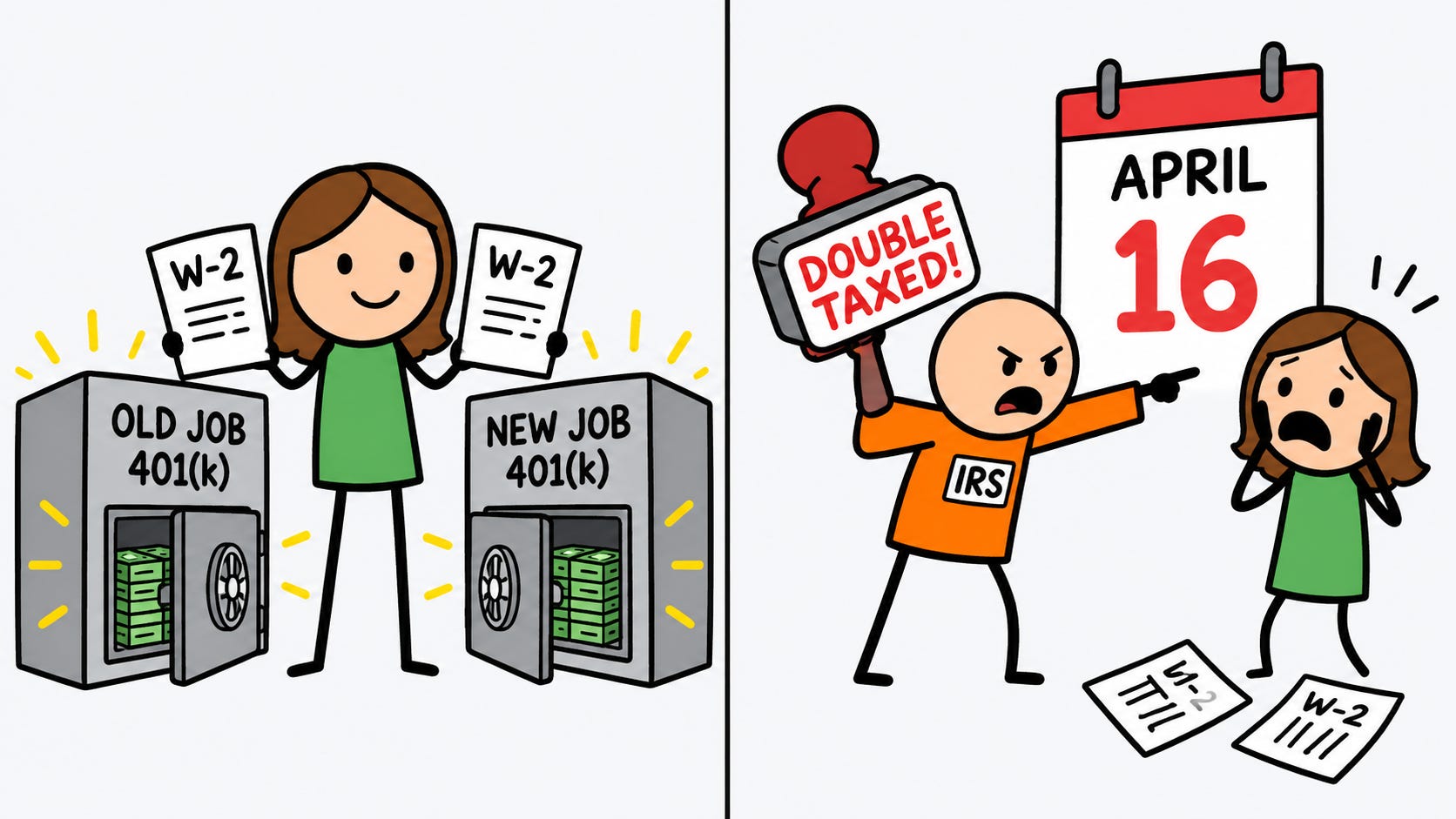
Every 401(k) plan watches its own payroll. When an employee’s deferrals hit the annual limit, the plan stops taking money out of the paycheck, and the system works smoothly for anyone who spends the whole year at one job.
The limit, though, belongs to the person. Someone who changes jobs mid-year starts fresh at a new plan that has no idea what went into the old one, and the new payroll system will happily keep deferring until its own count hits the limit. By December the employee can be well over the annual cap with two plans that each did everything right.
The annual elective deferral limit covers everything a person defers into 401(k) plans, 403(b) plans and similar arrangements for the calendar year, pretax and Roth deferrals combined. The IRS is explicit that the participant has to add up deferrals across every plan they were in. Anything over the limit that cannot be treated as a catch-up contribution is an excess deferral. People 50 and older get a higher ceiling when their plans offer catch-up contributions, which can absorb some or all of the overage.
The limit runs on the calendar year. Deferrals count in the year they come out of the paycheck, so the total is settled when the last December payroll runs.
The fix has a hard deadline. The employee notifies a plan that permits excess-deferral corrections and asks it to pay out the excess plus its earnings. Plans are allowed to offer this but are not required to. The distribution has to be completed by April 15 of the following year to avoid double taxation, and the plan can set an earlier date for receiving the request. Filing an extension on the tax return does not move April 15.
When the excess comes out on time, the tax result is clean. The excess is taxable in the year it was deferred, so the employee adds it to that year’s income, because the W-2 already left it out of taxable wages. The earnings are taxable in the year they are distributed. The corrective payment carries no 10% additional tax and no withholding or Social Security and Medicare tax.
What happens if April 15 passes? The excess is still taxable in the year it was deferred. It also stays in the plan, where it gets no basis, so it is taxed a second time whenever it eventually comes out. And it generally cannot be pulled out later just because the employee asks. It stays put until the plan’s ordinary rules allow a distribution, such as leaving the employer or reaching an eligible age, unless a distribution is needed to protect the plan’s qualified status. The IRS also notes that certain uncorrected excesses can threaten a plan’s qualified status.
So the clocks line up this way. The limit is a calendar-year limit, measured on deferrals through December 31. The correction deadline is April 15 of the next year, a date tied to the deferral year with no extension available, and the plan may set an earlier notice date. Missing it turns a single tax into a double one.
Priya is 38. She defers $15,000 into her employer’s 401(k) through June, then leaves for a new job. Her new employer’s plan lets her start in August, and she sets her deferral at $3,000 a month. Using a $24,500 annual limit for illustration, she has deferred $30,000 by December, $5,500 over, and neither plan flagged a thing.
In January her two W-2s arrive, each showing its own deferrals in box 12, and the total jumps out. Her new plan permits excess-deferral corrections, so she contacts it in February and requests a corrective distribution. In March the plan pays her $5,500 plus $180 of earnings.
The $5,500 goes on her return for the year she deferred it, added to her wages. The $180 is income for the year the plan paid it. There is no 10% additional tax. Her total tax cost is roughly what she would have paid had she taken that $5,500 as regular pay in the first place.
In the other version, Priya does not add up the two W-2s and files with only what they show. The excess surfaces the following summer. April 15 has passed, so the $5,500 is still taxable for the year she deferred it, and she amends that return to include it. The $5,500 stays in the new plan with no basis, and when she eventually withdraws it in retirement, it is taxed again.
Had Priya been 52 and her new plan offered catch-up contributions, the catch-up room could have absorbed the overage, and there would have been no excess at all.
An excess deferral is a counting problem that payroll systems are not built to catch, and the fix is a request and a distribution, as long as one of the plans permits it and it happens by April 15.
What matters is adding up every plan’s deferrals for the year once the last paycheck posts, and knowing that April 15 is the date that decides whether the excess gets taxed once or twice. For how the deferral limit, catch-up contributions and plan rules fit together, our 401(k) guide lays out the full picture.
I write one of these every day, one retirement rule, explained in plain language and verified against the source. The daily email is free: subscribe here.
Full archive, worksheets, and search live at RetirementNewsRundown.com.
Disclaimer
This article is for educational and informational purposes only. It is not tax, legal, or financial advice and does not create an advisor-client relationship. Always consult appropriate professionals regarding your specific situation.