An HSA holder approaching their sixty-fifth birthday tends to think of Medicare as the main event of the year. The HSA, having sat in the background for years, feels like a separate matter that does not need much attention. Whatever changes about Medicare will get worked out. Whatever the HSA is doing will keep doing it.
The HSA changes several things at sixty-five, and not all of them are obvious. The interaction between the HSA and Medicare is the most consequential of these changes, because Medicare enrollment ends HSA contribution eligibility, and the timing of that enrollment has consequences for contributions already made. Sixty-five is also the age at which the structure of the account itself shifts, in a way that makes the HSA more flexible than it has ever been. Knowing what changes when is the difference between using the new flexibility and tripping over the new restrictions.
The first change at sixty-five is the disappearance of the twenty percent additional tax. Before sixty-five, non-qualified distributions from the HSA are subject to both ordinary income tax and a twenty percent additional tax. At sixty-five, the additional tax goes away. Non-qualified distributions still get taxed as ordinary income, similar to a traditional IRA distribution.
Qualified medical distributions remain tax-free at any age. That treatment does not change. The combination makes the HSA function as a tax-free medical account and a traditional-IRA-style account for everything else, with no penalty layered on top.
The second change is the relationship between Medicare enrollment and HSA contributions. Medicare enrollment ends HSA contribution eligibility for any month the participant is enrolled. The disqualification is monthly. Once Medicare enrollment begins, contributions stop, regardless of what the HDHP coverage looks like.
For participants who want to keep contributing past sixty-five, the path requires two delays. Medicare Part A enrollment is automatic for anyone drawing Social Security benefits. Delaying Social Security delays automatic Part A enrollment. The participant also has to refrain from voluntarily Medicare enrollment. The combination keeps contribution eligibility alive past sixty-five, as long as the participant retains HDHP coverage.
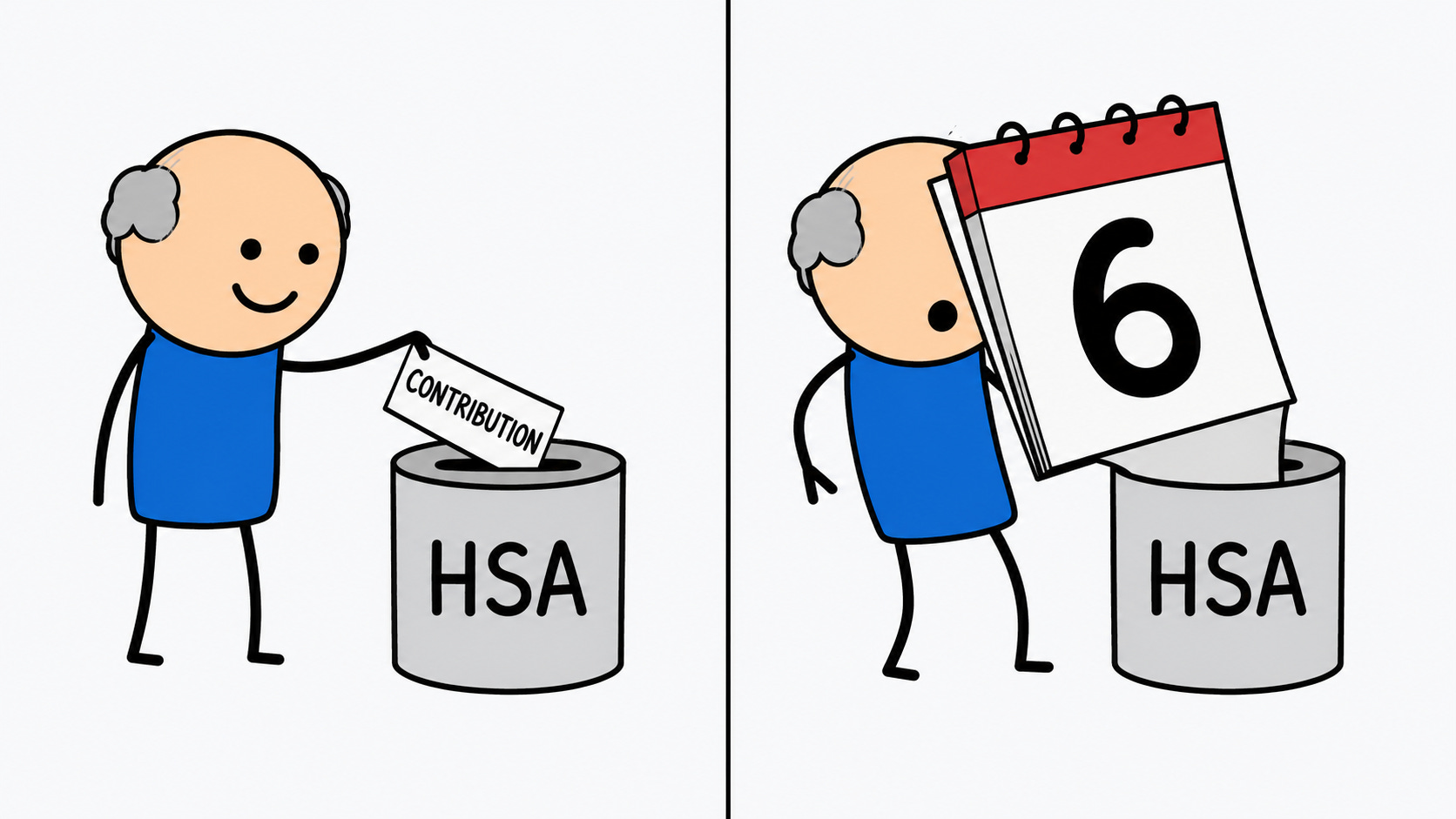
There is a trap in delayed Medicare enrollment. When a participant eventually enrolls in premium-free Part A after sixty-five, coverage generally starts up to six months back from the month they apply, but not earlier than the first month they were eligible for Medicare. HSA contributions made during those retroactive months become excess contributions, since the participant is treated as having been enrolled in Medicare during that period. A participant who timed their contributions to stop the month they enrolled may discover the actual disqualification window started six months earlier.
The third change is what becomes a qualified medical expense. Once the HSA owner is age sixty-five or older, Medicare premiums for Part B, Part D, and Medicare Advantage generally qualify as medical expenses that can be paid or reimbursed from the HSA tax-free. Medigap supplemental insurance premiums generally do not qualify, even though they look like Medicare premiums. Qualified long-term care insurance premiums can qualify, subject to age-based limits. Medigap supplemental insurance premiums generally do not qualify, even though they look like Medicare premiums. Long-term care insurance premiums qualify, subject to age-based limits.
The fourth change is the absence of required minimum distributions. Unlike a traditional IRA, the HSA carries no RMDs at any age. The balance can sit in the account indefinitely, available for qualified medical expenses tax-free or for non-medical use at ordinary income rates.
What happens if you do this later instead. Contributions made during Medicare-disqualified months are excess contributions, subject to the six percent excise tax for every year they remain in the account uncorrected. A participant who realizes the retroactive Part A rule created an excess can fix it through the standard excess contribution correction by the tax filing deadline including extensions. After that window, the six percent applies until the excess is removed.
Someone turns sixty-five in March and delays Medicare and Social Security to keep contributing to their HSA. They keep HDHP coverage, contribute the family limit, and continue at the same pace through the following year.
At sixty-six and a half, they enroll in Medicare Part A. The coverage is retroactive six months from the enrollment date. The six months of HSA contributions made during that retroactive window are treated as having been made while Medicare-enrolled, which makes them excess contributions for the year they occurred.
The participant corrects the excess by withdrawing it plus earnings before the tax filing deadline, including extensions, for the contribution year. The earnings are taxable in the year they are withdrawn. The six percent excise tax does not apply, because the correction was timely. The delayed enrollment saved the months before the retroactive look-back reached. The six months inside that look-back window stayed disqualified.
The HSA earns its most flexible structure at sixty-five. The triple tax advantage on qualified medical use remains intact. The penalty on non-qualified use disappears. The account never carries required minimum distributions. The combination is unique among tax-favored accounts.
There is a trap in delayed Medicare enrollment. When a participant eventually enrolls in premium-free Part A after sixty-five, coverage generally starts up to six months back from the month they apply, but not earlier than the first month they were eligible for Medicare. HSA contributions made during those retroactive months become excess contributions, since the participant is treated as having been enrolled in Medicare during that period. A participant who timed their contributions to stop the month they enrolled may discover the actual disqualification window started six months earlier.
For participants who do not want to keep contributing past sixty-five, the path is straightforward. Enroll in Medicare when eligible, stop contributions, use the existing balance for qualified medical expenses including the Medicare premiums that now qualify. For participants who want to keep contributing, the path requires delaying Social Security to avoid automatic Part A enrollment, with the understanding that eventual enrollment carries the six-month retroactive trap.
The deadlines run on familiar tracks. Contributions follow the April 15 deadline. Excess corrections follow the tax filing deadline including extensions.
I write one of these every day, one retirement rule, explained in plain language and verified against the source. The daily email is free: subscribe here.
Full archive, worksheets, and search live at RetirementNewsRundown.com.
Disclaimer This article is for educational and informational purposes only. It is not tax, legal, or financial advice and does not create an advisor–client relationship. Always consult appropriate professionals regarding your specific situation.