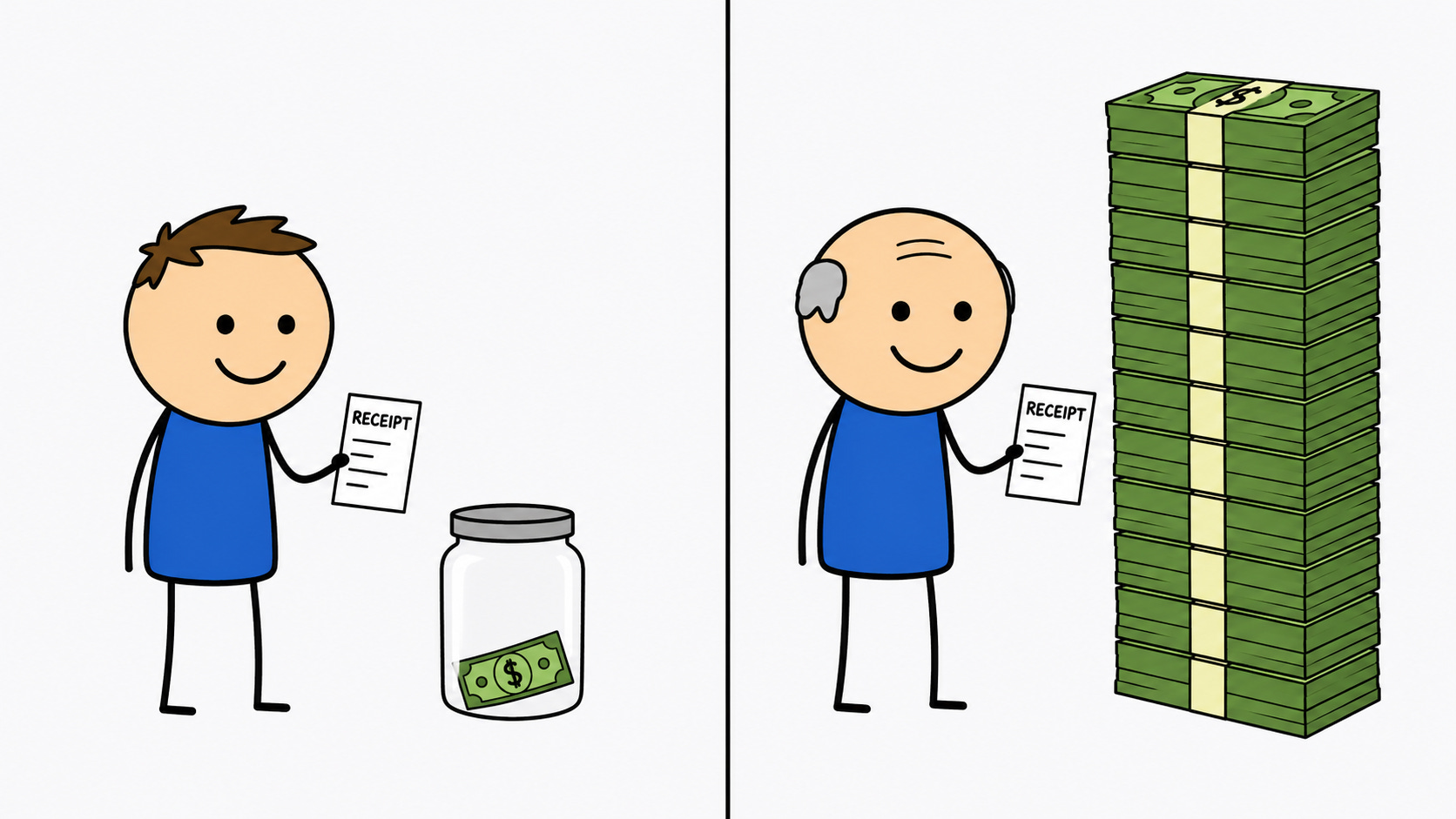
The Health Savings Account gets sold as a current medical spending account. The benefits packet describes it that way. The custodian’s website describes it that way. Most participants treat it that way, contributing only enough each year to cover expected medical expenses, then spending the balance down on those expenses as they come up. The cycle restarts the next year. The account never accumulates much because it was never asked to.
The HSA has a different mode that does not get described in the benefits packet. If the balance is left alone, invested, and not spent on current medical expenses, it grows tax-free indefinitely. At age sixty-five, the rules change in a way that turns the account into one of the most flexible tax-advantaged vehicles available. The HSA earned the nickname stealth retirement account by functioning very differently than most participants realize.
The triple tax advantage is the foundation. Contributions to the HSA are deductible going in, or pre-tax through payroll. The balance grows tax-free for as long as it sits in the account. Withdrawals for qualified medical expenses come out tax-free, with no time limit. No other tax-advantaged account matches all three.
The investment piece is what most participants never use. An HSA custodian may offer investment options once the cash balance crosses a threshold, often a few thousand dollars. The balance above that threshold can be invested in mutual funds, ETFs, or similar vehicles. The growth inside the account can come out tax-free when used for qualified medical expenses, which is the part that makes the HSA so unusual. If the custodian’s investment options are limited, the balance can generally be moved to a different HSA custodian without losing the tax treatment.
The account carries forward indefinitely. Unlike a flexible spending account, there is no use-it-or-lose-it rule. A balance contributed in one year can sit in the account for thirty years, growing the entire time, and still be available for qualified medical expenses with no time limit.
The receipt strategy is the part that turns the HSA into a retirement vehicle. A qualified medical expense incurred at any point after the HSA was established can be reimbursed at any later date, as long as the account holder kept proof of the expense. The expense and the reimbursement do not have to happen in the same year. A medical bill paid out of pocket in one decade can be reimbursed from the HSA in another decade, tax-free, while the balance grew in the meantime.
At age sixty-five, the structure of the account shifts in a meaningful way. The twenty percent additional tax that normally applies to non-qualified HSA distributions stops applying. Non-qualified distributions become taxable as ordinary income, the same treatment a traditional IRA distribution receives, but with no penalty layered on top. Qualified medical expenses remain tax-free out of the account. The HSA effectively works as a tax-free medical account and a traditional-IRA-style account for everything else.
Once the HSA owner is age sixty-five or older, Medicare premiums, including Part B, Part D, and Medicare Advantage, generally qualify for tax-free HSA reimbursement. Medigap supplemental premiums generally do not. Qualified long-term care insurance premiums can qualify, subject to age-based limits. The pool of expenses available for tax-free reimbursement at retirement is broader than many participants realize.
What happens if you do this later instead. An HSA that is spent down on current medical expenses each year gives the participant tax-free medical spending, but does not accumulate as a retirement asset. The receipt strategy only works for medical expenses incurred after the HSA was established, so older receipts cannot be reimbursed from a newly opened account. Once Medicare enrollment begins, contributions stop, but the existing balance retains its tax treatment.
Someone in their early thirties opens an HSA through their employer’s HDHP. They contribute the family limit each year, invest the balance once it crosses the custodian’s cash threshold, and pay all current medical expenses out of pocket. They keep digital copies of every medical receipt.
Over three decades, the balance grows through contributions and investment returns. By retirement, the HSA holds a balance large enough to function as a meaningful retirement asset, and the receipts from those three decades represent a separate pool of qualified expenses that could be reimbursed tax-free.
In retirement, they reimburse themselves from the HSA for old medical expenses as needed for cash flow. They cover Medicare Part B and Part D premiums from the HSA directly. The portion they do not need for medical or premium reimbursements stays in the account, available for non-medical use at ordinary income rates with no additional tax.
The participant gets three different uses out of the same account, none of which required unusual planning beyond keeping receipts and not spending the balance on current expenses.
The stealth retirement account label describes what the HSA actually does when the account is funded, invested, and not spent on current expenses. The triple tax advantage, the indefinite carry-forward, the receipt strategy, and the shift in treatment at sixty-five all exist in the rules.
What truly matters is recognizing the structure before deciding how to use the account. An HSA spent down on current medical expenses delivers a tax benefit on current spending. An HSA left to grow delivers something larger and more flexible. The choice between those two uses is a cash flow decision more than a tax decision.
The deadlines fit the pattern. Contributions follow the April 15 deadline for the contribution year. Reimbursements have no deadline at all. A receipt from decades ago is still valid as long as the expense was incurred after the HSA was opened. The combination of indefinite carry-forward and indefinite reimbursement gives the account its unique flexibility.
The HSA behaves this way when left alone. Recognizing that the account can be used this way is what separates a participant who treats the HSA as a current medical account from one who treats it as a tax-advantaged retirement vehicle.
I write one of these every day, one retirement rule, explained in plain language and verified against the source. The daily email is free: subscribe here.
Full archive, worksheets, and search live at RetirementNewsRundown.com.
Disclaimer This article is for educational and informational purposes only. It is not tax, legal, or financial advice and does not create an advisor–client relationship. Always consult appropriate professionals regarding your specific situation.