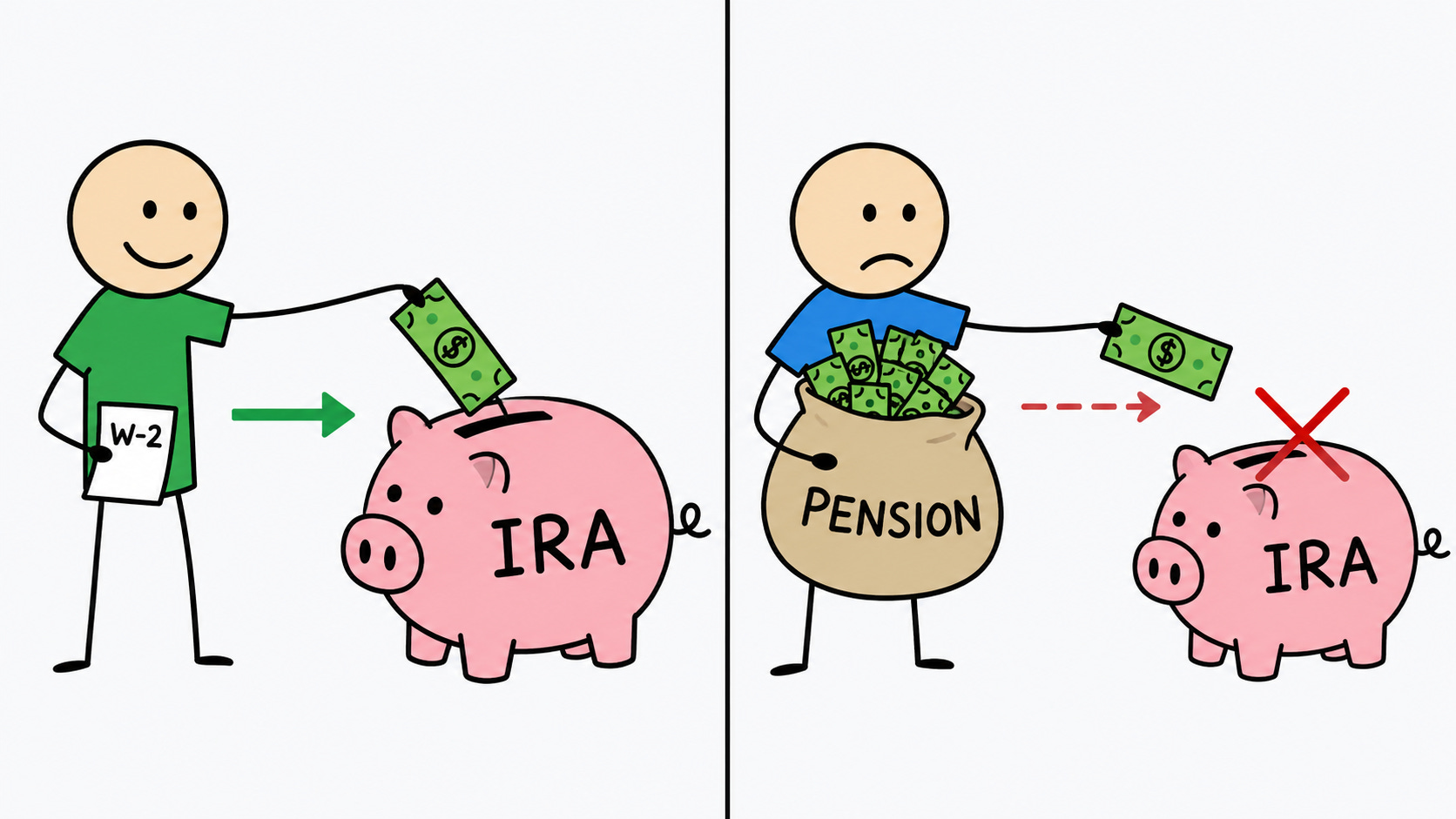
Funding an IRA depends on a single qualification, which is compensation. Compensation is the money a person receives in exchange for work performed during the year, and the rules allow an IRA contribution only up to the amount of compensation a person has. The size of a bank account, the performance of an investment portfolio, and the total of all income in a year are separate questions, and none of them on its own permits an IRA contribution.
This surprises people who have plenty of money and assume that settles the question. A retiree living on a pension, Social Security, and an investment portfolio has income arriving every month and might reasonably assume an IRA contribution is allowed. The test is the source of the money, and in this case the source is something other than work.
Someone sits down to fund a Roth IRA, confident the contribution is allowed because the cash is there. Whether it is actually permitted depends on a question they may not have asked, which is whether any of that money was earned by working.
To contribute to a Traditional or Roth IRA, a person must have compensation for the year at least equal to the amount contributed. Compensation is the tax term for earned income in this context, and the rules define it specifically.
Compensation includes wages, salaries, tips, bonuses, and commissions, generally the amount reported in the wage box of a W-2. It includes net earnings from self-employment, the profit from a business after the relevant deductions. It includes taxable fellowship and stipend payments, a category that matters for graduate students and postdoctoral researchers. Nontaxable combat pay counts even though it is not otherwise taxed, a deliberate exception written into the rules. Taxable alimony under qualifying divorce agreements counts as well.
Compensation does not include income that arrives without work attached. Interest and dividends do not count. Capital gains do not count. Rental income does not count for most owners. Pension and annuity income does not count. Social Security does not count. Unemployment compensation does not count. Deferred compensation from a former employer does not count. The common thread is that these represent returns on money or benefits tied to past work, rather than pay for work performed during the year.
The maximum a person can contribute is the lesser of the annual contribution limit or total compensation for the year. For a Roth IRA, that is only the first gate, because modified adjusted gross income can independently reduce or eliminate the allowed Roth contribution. Someone with compensation above the limit can contribute the full limit. Someone with compensation below the limit can contribute only up to their compensation. Someone with zero compensation can contribute zero, with one exception.
That exception is the spousal IRA. A married person with little or no compensation can contribute based on the working spouse’s compensation, provided the couple files a joint return. The combined IRA contributions for both spouses cannot exceed the couple’s combined compensation, but this rule allows a non-earning spouse to fund an IRA on the strength of the household’s earned income.
The deadline to make a contribution for a given tax year is the tax-filing deadline for that year, which falls in the spring of the following year. This is a tax-filing deadline, and it does not move. Filing for an extension extends the time to file the return, but it does not extend the time to make an IRA contribution. Once that date passes, the contribution opportunity for that tax year is closed.
What happens if someone contributes without enough compensation to support it? The portion that exceeds compensation is an excess contribution, subject to a 6% excise tax for each year it remains in the account. The correction window generally allows the excess, plus any earnings it generated, to be removed by the tax return due date, including extensions, which avoids the 6% tax. The withdrawn earnings are themselves taxable for the contribution year, so the fix clears the 6% tax but not the tax on the growth. Waiting past that window means the 6% applies and keeps applying every year until the excess is corrected.
Renata retired and lives on a pension and Social Security, with a brokerage account producing dividends and capital gains. In March she decides to fund a Roth IRA for the prior tax year, since the money is available and the deadline has not passed.
The deadline part is correct. The compensation part is the problem. None of those income sources is compensation. Renata had income all year, but none of it came from work, so her compensation for IRA purposes is zero, and her allowed contribution is zero. Contributing anyway creates an excess contribution exposed to the 6% excise tax.
Now change one fact. Renata takes a part-time job and earns four thousand dollars in wages. That four thousand is compensation. Her allowed contribution becomes the lesser of the annual limit or that four thousand. The pension and investment income still do not count, but the part-time wages opened the door.
Every IRA contribution comes down to one question: was the money earned by working? Wages and self-employment profit are the two categories that cover most people. Combat pay, qualifying fellowship and stipend income, and qualifying alimony round out the list. Investment income, retirement income, and benefits do not count, no matter how large they are.
A person unsure of where they stand can check the source of each stream of income. Money received for work done during the year supports an IRA contribution. Money received for anything else does not.
For married couples, the spousal IRA keeps a non-earning spouse in the game as long as the household has earned income and the couple files jointly. And for anyone who contributes more than their compensation allows, the correction window through the tax-filing deadline is the release valve that removes the excess before the 6% excise tax takes hold.
I write one of these every day, one retirement rule, explained in plain language and verified against the source. The daily email is free: subscribe here.
Full archive, worksheets, and search live at RetirementNewsRundown.com.
Disclaimer This article is for educational and informational purposes only. It is not tax, legal, or financial advice and does not create an advisor–client relationship. Always consult appropriate professionals regarding your specific situation.