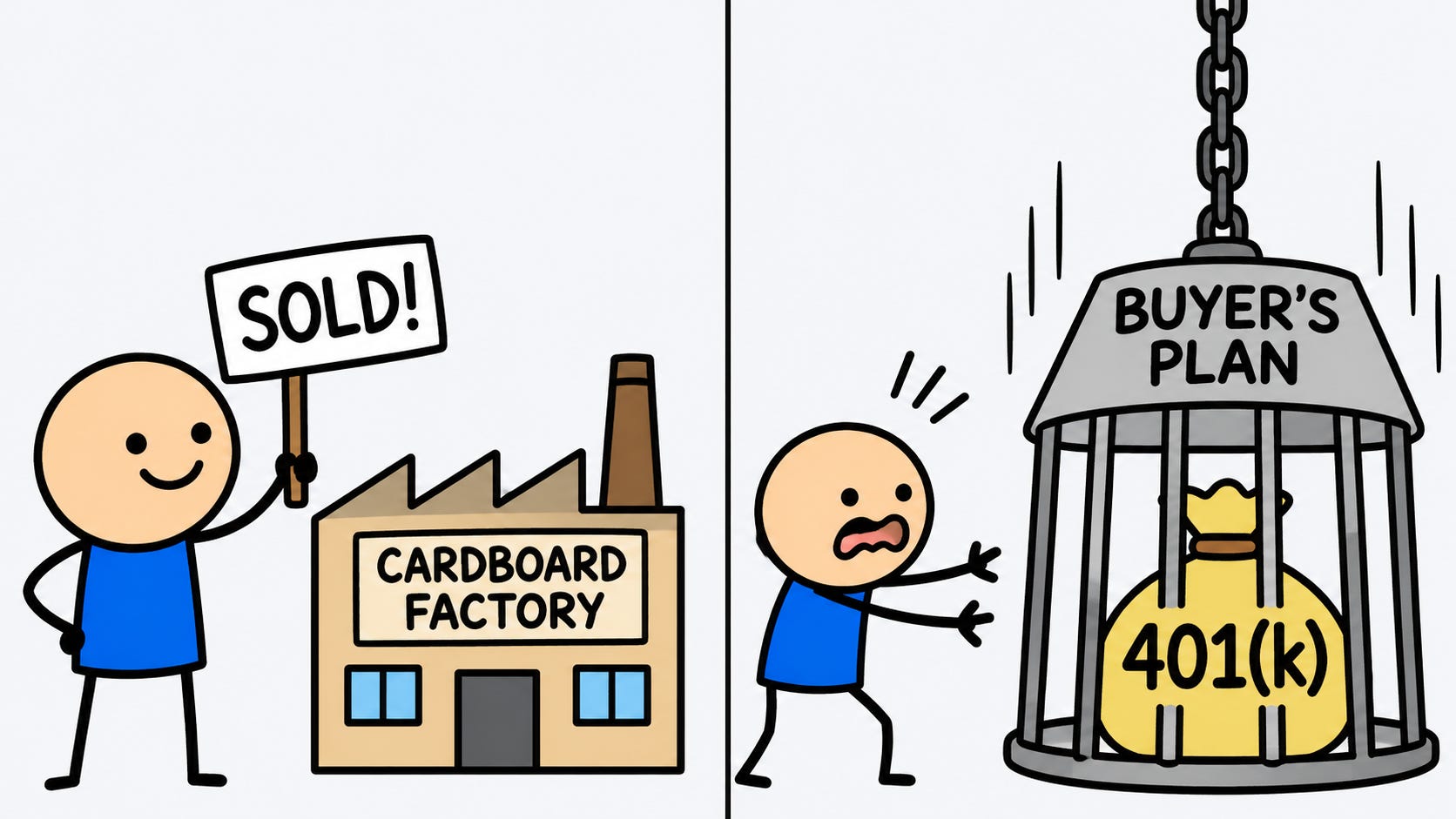
A small business 401(k) belongs to the company that sponsors it, so when the company changes hands, so does the plan’s future. Whether the owner’s own balance, often the largest one in the plan, can be rolled out right away depends on how the deal is structured and on a few plan decisions made before closing.
Sale negotiations cover the price, the earn-out, the lease and the noncompete in great detail. The retirement plan tends to get a line in the closing checklist, which is a modest amount of attention for an account that can be worth more than the down payment.
The first question is what the buyer is purchasing.
In a stock sale, the buyer acquires the company itself, and the plan comes with it. The company is still the employer, so employees who keep working there have not left their employer, and that alone does not let them take money out. Once the deal closes, the buyer controls the plan. A buyer that already has its own 401(k) usually merges the two plans or terminates the acquired one, and either path runs on the buyer’s timeline. A merger has to preserve the benefits participants already have.
That is why the seller’s decision before closing matters. A seller who wants the plan to end can have the company adopt a formal resolution terminating it with a date before the sale closes. Terminating a plan makes every participant 100% vested in their account, including employer matching and profit-sharing money, and the assets are generally distributed as soon as administratively feasible, usually within a year. Waiting until after closing hands the decision to the buyer. If the buyer then terminates the old plan while keeping its own 401(k), the successor plan rule generally keeps employees’ deferrals from being paid out because of the termination. A termination before closing avoids that problem.
In an asset sale, the buyer purchases the business’s equipment, customers and contracts, and the seller’s company keeps its plan. Employees the buyer hires have left the seller’s employment, which is generally a distribution event for their 401(k) balances. The seller’s company can keep the plan or terminate it, often after the business winds down. If a large share of participants leave because of the sale, usually 20% or more, the IRS can treat it as a partial termination, and the affected participants become fully vested too.
The owner’s own balance follows the same rules as everyone else’s. Leaving employment with the company that sponsors the plan opens it up for distribution, along with plan termination, death, disability, and reaching 59.5 if the plan allows in-service withdrawals. Owners who sell stock and then stay on as employees for a transition period, which some buyers ask for, have not left their employer yet. Their balances stay in the plan until they do, or until it terminates.
What happens if the plan question is settled later? A plan that was not terminated before a stock sale closes is the buyer’s to merge, keep or end, and the owner’s control over the timing is gone. A plan that stays with the seller after an asset sale still has to be run, with annual returns and contributions handled properly, until it is wound down. The money stays the participants’ throughout, and the timing of when it can move belongs to whoever sponsors the plan.
Mike owns all of an S corporation that runs an HVAC company with 12 employees and a 401(k). His own account holds $600,000. A larger competitor with its own 401(k) offers to buy the business, and the closing is set for June 30.
If the deal is a stock sale and Mike’s company adopts a resolution terminating the plan effective June 29, every participant becomes fully vested. The plan distributes its assets over the following months, and the employees and Mike can roll their balances to IRAs or, if it accepts them, to the buyer’s 401(k).
If nobody acts before closing, the plan belongs to the buyer on July 1. Mike agrees to stay on as an employee for a year to help with the transition. His $600,000 stays under the plan’s distribution rules, in a plan he no longer controls, while he keeps working there. Unless another distribution event applies, such as reaching 59.5 in a plan that allows in-service withdrawals, it cannot roll out until he leaves the following summer.
If the deal is an asset sale instead, Mike’s S corporation keeps the plan. The 12 employees the buyer hires have left the corporation, so their balances become available to roll over. Mike winds down the corporation over the next few months and terminates the plan, which brings its own timeline and filings.
None of these paths puts the money at risk. Vested balances stay the participants’ property whoever sponsors the plan. What the structure of the sale decides is who controls the timing: whether the owner’s balance becomes available through a termination the owner started, which still takes some months to process, or stays under the buyer’s plan rules for another year.
What matters is reading the purchase agreement for whether the deal is a stock or asset sale, settling whether the plan ends before closing, and knowing whether a transition role keeps the owner employed. For where the owner’s balance goes once it is free to move, our rollover IRA guide walks through the options.
I write one of these every day, one retirement rule, explained in plain language and verified against the source. The daily email is free: subscribe here.
Full archive, worksheets, and search live at RetirementNewsRundown.com.
Disclaimer
This article is for educational and informational purposes only. It is not tax, legal, or financial advice and does not create an advisor-client relationship. Always consult appropriate professionals regarding your specific situation.