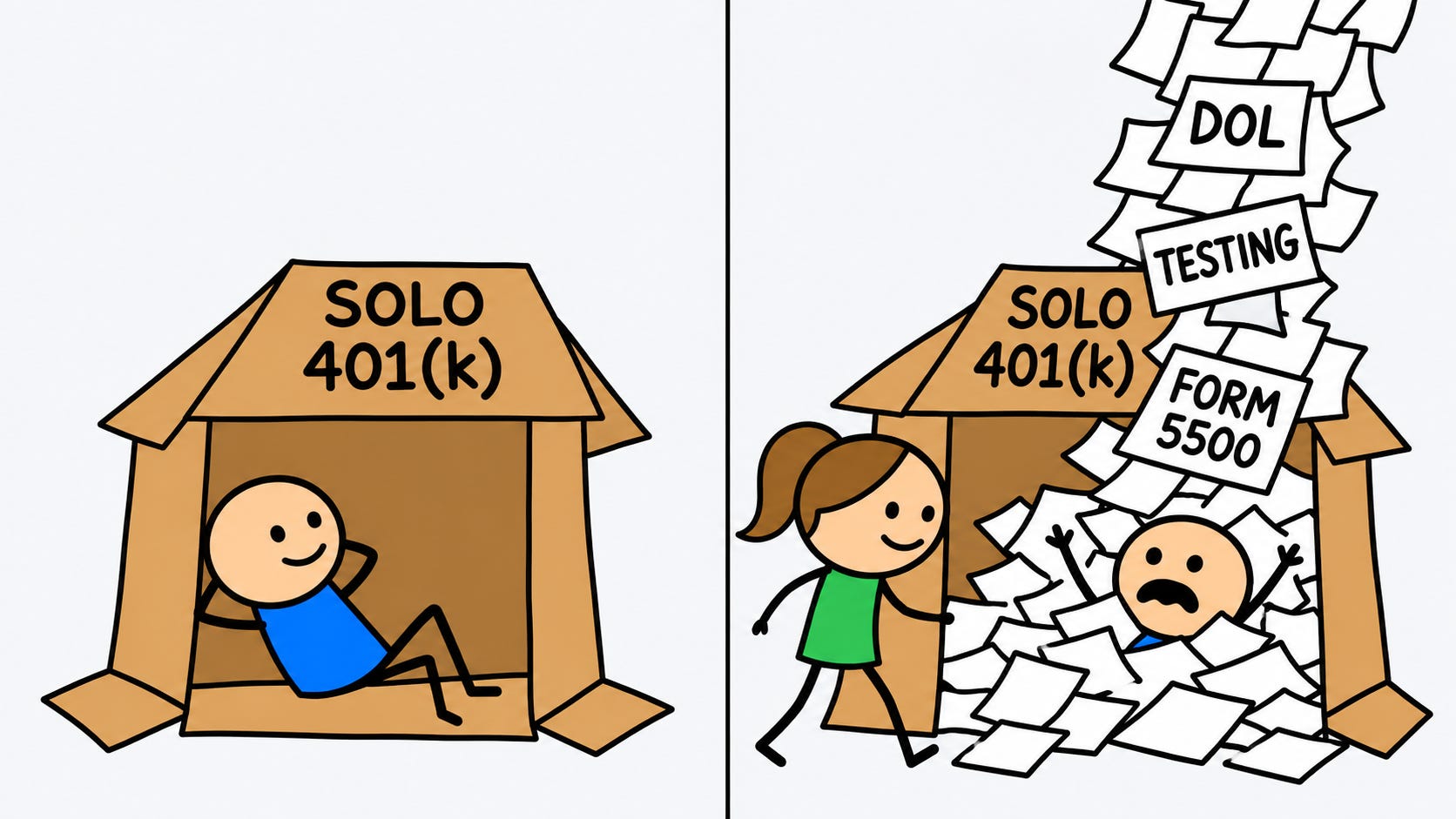
A solo 401(k) is a regular 401(k) plan with one feature that makes it easy: it covers only the business owner, or the owner and spouse. With nobody else in the plan, there is no nondiscrimination testing, no Labor Department oversight, and no annual return until the assets pass $250,000. The owner sets it up, funds it, and mostly forgets the rules exist.
The plan document does not forget. The day the business hires someone who could become eligible, the clock on that person starts running under the plan’s own terms. It is easy to keep treating the plan as solo after that, and the fix grows with every year it waits.
The IRS states the rule directly: if the business hires employees and they meet the plan’s eligibility requirements, they must be included. A spouse working in the business does not change anything, since the plan was always allowed to cover the owner and spouse. Anyone else does.
The plan can make employees wait, within limits. It can require that an employee reach age 21 and complete a year of service, which generally means a 12-month period with at least 1,000 hours. For 401(k) deferrals, part-timers get their own route in: a plan cannot make an employee wait beyond two consecutive 12-month periods with at least 500 hours each. The plan cannot exclude anyone for being too old. Whatever the plan’s own document says controls within those limits, and many solo 401(k) documents already spell out an age and service requirement that nobody has looked at since signing.
Once an employee meets the requirements and reaches the plan’s entry date, three things change. The right to defer starts that day, and the testing and reporting changes follow the plan-year rules.
The plan has to let that employee defer pay. Employer contributions follow the plan’s terms, although employees who qualify only under the long-term part-time rule can be left out of matching and other employer contributions.
The employee’s deferrals become subject to nondiscrimination testing, which compares what owners and other highly paid people save with what everyone else saves. A safe harbor design, which promises a set employer contribution, avoids that testing.
The plan stops being a one-participant plan. It moves under the Labor Department’s rules for employee plans, including deadlines for depositing deferrals withheld from pay, and the annual return shifts from Form 5500-EZ to the Form 5500 series, filed electronically. The $250,000 exemption belongs only to one-participant plans, so it no longer applies.
What happens if the employee is left out anyway? Excluding an eligible employee is an operational failure in the plan, and the IRS has a published correction path for it. The fix generally involves the employer making a corrective contribution to the employee’s account to make up for the deferral opportunity that was missed, plus any employer contributions the plan would have made, with earnings. Catching it early is cheaper. The correction programs give lower-cost options for mistakes found and fixed quickly, and the bill grows with each year the employee stays out.
The plan does not have to cover anyone before they are eligible. An owner who hires in March and sees the employee become eligible the following spring has that year to decide whether to keep the 401(k) with employees in it, change its design, or replace it with a different plan before the employee’s entry date arrives.
Kevin runs a design studio as a sole proprietor and has a solo 401(k) whose document requires age 21 and one year of service with 1,000 hours, with entry on the first day of the next quarter. In March he hires Ana, 30, full time, and Ben, 24, for about 600 hours a year.
Ana completes 1,000 hours during her first 12-month eligibility period, measured from her March hire date. She meets the service requirement the following March and enters the plan on April 1. From that date she can defer, the plan is subject to the Labor Department’s rules, and the next annual return comes from the Form 5500 series, the 5500-SF if the plan meets that form’s conditions, filed electronically whatever the balance. Kevin’s own deferrals will be tested against hers unless he adopts a safe harbor design.
Ben never reaches 1,000 hours in a year. After his second consecutive 12-month period with at least 500 hours, he becomes eligible to defer under the long-term part-time rule, entering on the plan’s next entry date. The plan can leave him out of employer contributions.
Suppose Kevin keeps running the plan as solo and his accountant notices two years after Ana’s entry date. Correcting the failure now means corrective contributions for two years of missed deferral opportunity, the employer contributions the plan’s terms called for, earnings on both, and the late annual returns.
Hiring an employee starts the eligibility clock. Once that employee enters the plan, the solo arrangement becomes an ordinary small business 401(k), and the plan document’s eligibility terms set the timeline for when that happens.
What matters is the date each employee meets the plan’s age and service terms, and the entry date that follows, because that date sets off the changes: who can defer, the testing, the Labor Department rules and the annual return. For owners weighing what kind of plan fits a business with employees, our retirement plan selector compares the options side by side.
I write one of these every day, one retirement rule, explained in plain language and verified against the source. The daily email is free: subscribe here.
Full archive, worksheets, and search live at RetirementNewsRundown.com.
Disclaimer
This article is for educational and informational purposes only. It is not tax, legal, or financial advice and does not create an advisor-client relationship. Always consult appropriate professionals regarding your specific situation.