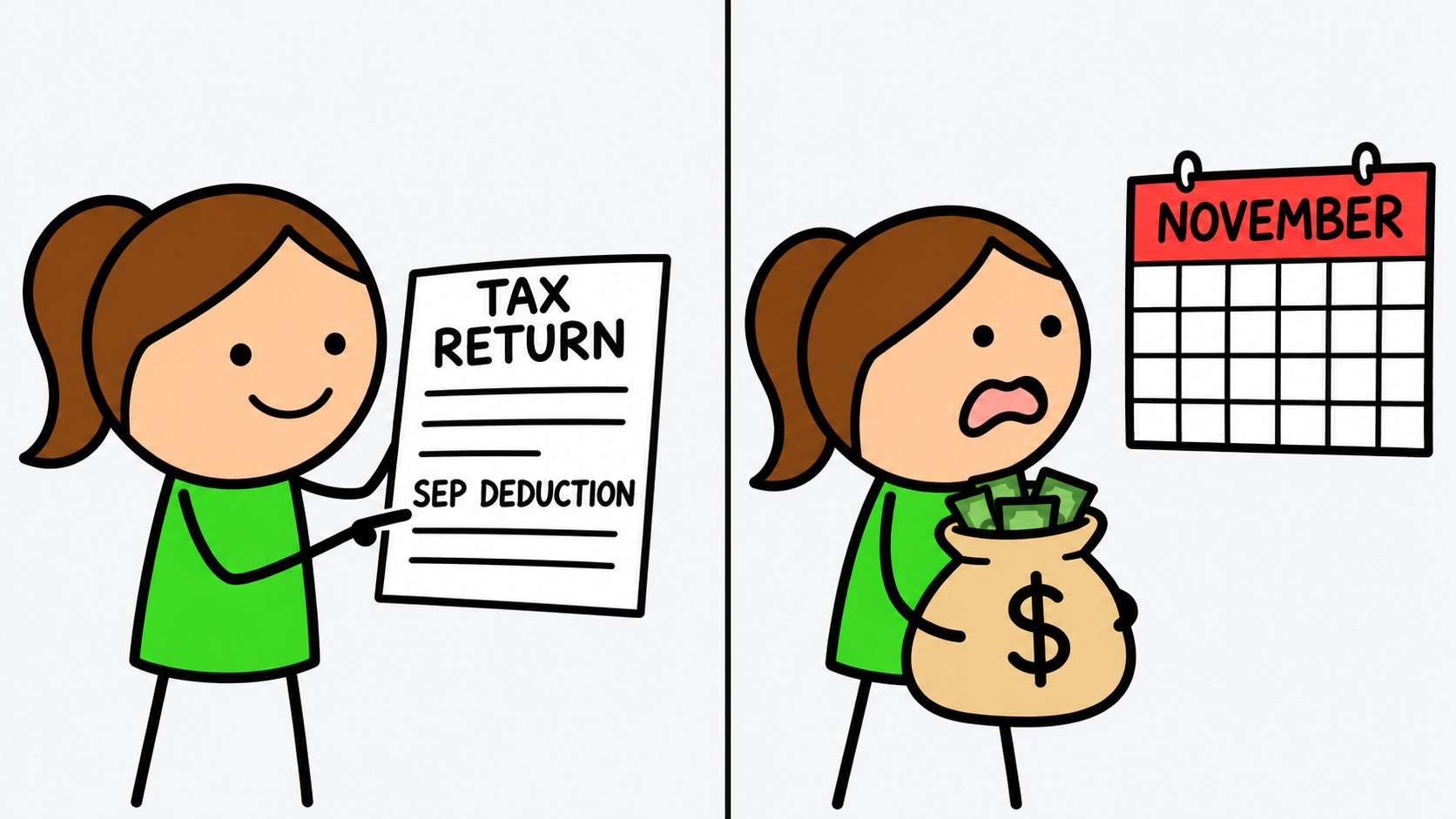
A SEP IRA lets a business owner decide how much to put in for a year long after the year ends. The contribution can go in as late as the due date of the business’s tax return, extensions included, and still count for the year before. For a sole proprietor on extension, that can mean funding a prior year’s SEP in October.
That flexibility produces a specific mistake. The owner files the return in late summer, claims the SEP deduction, and plans to move the money before the extended deadline. Then October 15 passes, and the money is still in the checking account. The deduction is already on a filed return, and the custodian has no idea which year anyone meant.
The rule for the deduction is short. To deduct a SEP contribution for a year, the contribution has to be made by the due date of the employer’s return for that year, including extensions. For a sole proprietor, that is the individual return: April 15, or October 15 with a valid extension. For a partnership or S corporation, it follows the business return’s own due date. The deadline to set up a SEP for a year runs to the same date.
The deduction depends on the money actually reaching the SEP IRA by that date, whatever the return says. A return that claims a SEP deduction for money that never arrived in time is overstating the deduction.
The custodian’s paperwork stays out of the question. Form 5498 reports SEP contributions by the calendar year the money arrives, including contributions made early in a year for the year before, and the instructions say custodians are not responsible for reporting which year a SEP contribution is for. That call belongs to the business owner, on the return.
What happens if the money goes in after the deadline? It cannot count for the prior year, and nothing extends the deadline once it has passed. The prior-year return that claimed the deduction needs an amended return to remove it, along with the tax and interest that follow.
The late deposit still counts for something. It is a SEP contribution for the year it was actually made, deductible on that year’s return and subject to that year’s limit: 25% of each employee’s pay, with the owner’s own share figured from net earnings using the reduced rate for the self-employed. If the owner has eligible employees, contributing for the current year means contributing for them too, at the same percentage, under the plan’s allocation formula.
If the late money is more than the current year’s SEP rules allow, the extra is an excess contribution, and it needs its own correction. The usual fix is removing the excess along with the earnings on it. Left in place, it can bring a 10% excise tax on the employer for the nondeductible amount and a 6% excise tax each year on the account owner’s IRA. The IRS does let some amounts above the deduction limit carry forward to later years. An amount above the contribution limit itself goes through the correction.
The other option is to leave the money where it is. SEP contributions are discretionary, so skipping a year is allowed, and there is no penalty for a year with no contribution. The cost is the lost deduction and the lost tax-deferred growth.
Dana is a sole proprietor with no employees. For one year, her net profit supports a SEP contribution of about $20,000. She files Form 4868 in April, which extends her return to October 15, and files the return itself in September with a $20,000 SEP deduction on it. She means to make the transfer the following week.
She forgets until November 3. The deadline for that year passed on October 15.
Her filed return claims a deduction for a contribution that was never made in time, so it needs an amended return, Form 1040-X for a sole proprietor, removing the $20,000 deduction. The extra income from losing that deduction brings additional tax, plus interest from the original due date.
The $20,000 she deposits on November 3 becomes a SEP contribution for the current year. It is deductible on next spring’s return as long as her current-year net earnings support at least $20,000. If business slowed and her current-year limit comes to $15,000, the other $5,000 is more than she was allowed to contribute. That $5,000 needs a separate correction, usually removing it with its earnings, and left alone it can bring both the 6% IRA excise tax and the 10% employer excise tax.
Had she remembered on October 14, a deposit that day would have matched the return exactly.
A missed SEP deadline costs a year of deduction, and nothing turns the clock back for that year. Both the deduction and the plan setup are tied to the return due date with extensions, and the custodian cannot fix it because the custodian never knew the intended year.
What matters is making the prior-year return match what actually happened, and then counting the late money against the current year’s limit and any employees’ share. For owners whose late deposit ends up larger than the current year allows, our small business excess contribution fix walks through how that excess is handled.
I write one of these every day, one retirement rule, explained in plain language and verified against the source. The daily email is free: subscribe here.
Full archive, worksheets, and search live at RetirementNewsRundown.com.
Disclaimer
This article is for educational and informational purposes only. It is not tax, legal, or financial advice and does not create an advisor-client relationship. Always consult appropriate professionals regarding your specific situation.