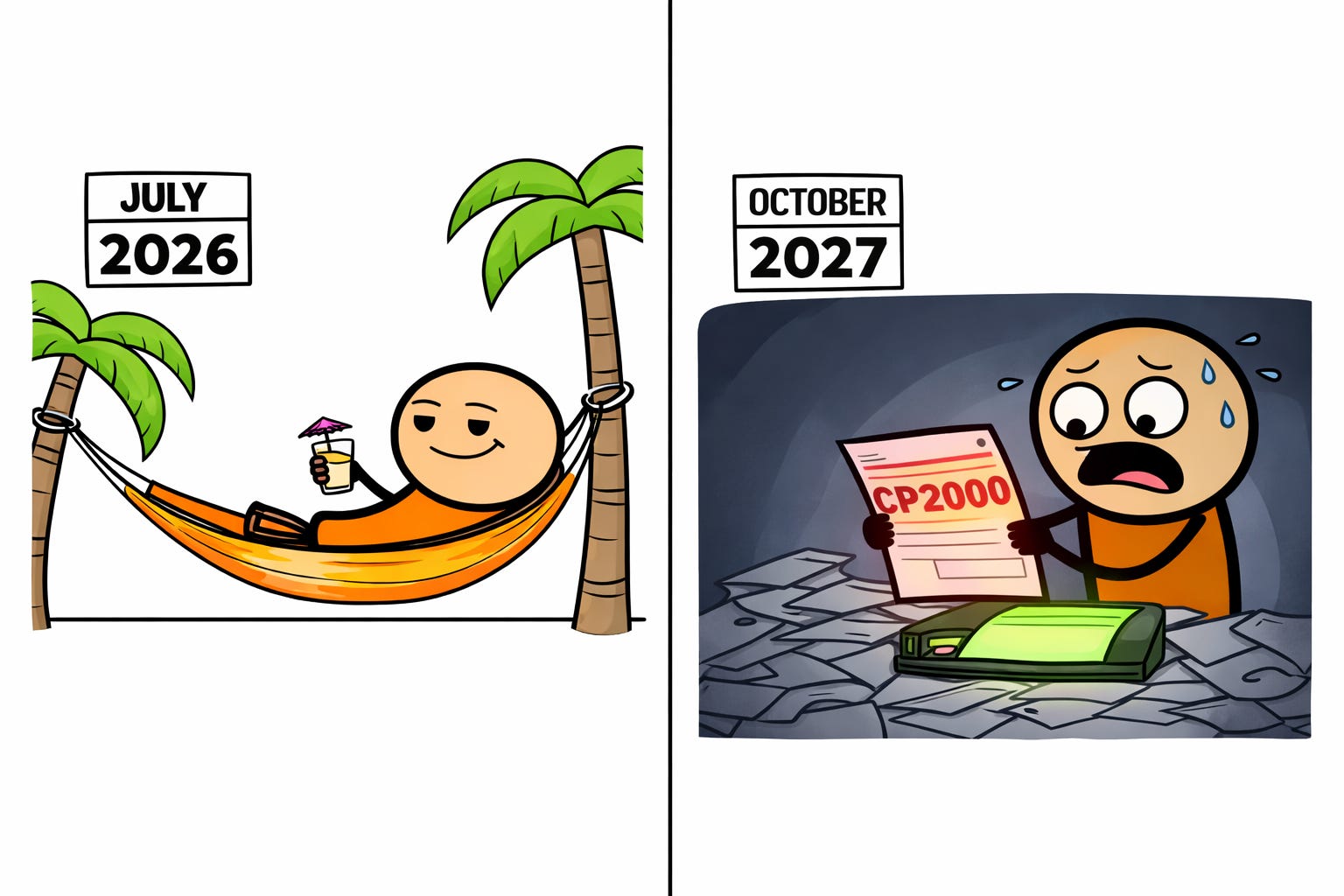
You file your tax return in February and report a $50,000 IRA distribution and wait for a response from the IRS. Nothing happens. March passes. April passes. May passes. You assume the IRS reviewed your return, verified the distribution against the 1099-R, and approved everything.
Then in August of the following year, you get a CP2000 notice saying the IRS found a discrepancy between what you reported and what your custodian filed. The notice references a tax return you filed eighteen months ago. You barely remember the details.
The IRS didn’t verify your return in real time. They didn’t cross-check the 1099-R in March or April or May. They ran their automated matching program over a year later. That’s when the discrepancy surfaced. That’s when the notice got generated. The silence you interpreted as approval was just the IRS not having gotten to your file yet.
The IRS does not match retirement forms when you file your return. They match them twelve to eighteen months after the filing deadline. The entire process runs on a massive batch system that compares millions of tax returns against millions of information returns submitted by custodians, employers, and financial institutions. Your individual return sits in the queue waiting for the matching program to run. When it finally does, any discrepancies trigger automated notices.
Here’s how the timeline actually works. You file your 2025 tax return in February 2026. The IRS processes the return. They check for basic errors. They verify your math. They issue your refund if you’re owed one. But they don’t verify the retirement distribution you reported against the 1099-R your custodian filed. They can’t. The custodian hasn’t filed the 1099-R yet.
Custodians file 1099-Rs with the IRS by March 31st, 2026. The IRS receives the data and loads it into their master information returns database. That process takes weeks or months. By summer 2026, the IRS has a complete database of all the 1099-Rs filed by all the custodians in the country. But they still haven’t matched those forms against individual tax returns. They just have the data sitting there.
The actual matching happens later. Much later. The IRS runs the Automated Underreporter Program, which systematically compares every tax return filed against every information return received. That program doesn’t run in real time. It runs in cycles. For returns filed in early 2026, the matching typically happens in mid to late 2027. Twelve to eighteen months after you filed.
When the program finds a discrepancy, it generates a CP2000 notice. That’s a proposed adjustment, not a bill. The IRS is telling you they found a mismatch and asking you to either agree with their correction or provide documentation showing your return was correct. The notice gets mailed to the taxpayer. By the time you receive it, it’s been a year and a half since you filed the return. You’ve moved on. You don’t remember the details. You have to dig out the paperwork and figure out what the IRS is questioning.
At Charles Schwab, I took calls from people who got CP2000 notices in July 2027 about distributions they reported on their 2025 return filed in February 2026. They were confused. They thought the IRS had already reviewed and approved their return because they got their refund and never heard anything for over a year. They assumed no news was good news.
No news just meant the matching program hadn’t run yet. The refund was issued based on what the taxpayer reported. The IRS trusted the numbers initially. The verification came later when the automated system compared the return against the custodian’s 1099-R. If the numbers matched, nothing happened. If they didn’t, a notice got generated a year and a half after filing.
Here’s a specific example. A client files their 2025 tax return on February 15th, 2026. They report a $60,000 traditional IRA distribution as taxable income. The IRS processes the return in March 2026. They issue the refund in April 2026. The client assumes everything is fine.
The custodian files the 1099-R on March 28th, 2026, showing a $60,000 distribution. The IRS receives the data in early April and loads it into their database over the next several weeks. By June 2026, the IRS has both the tax return and the 1099-R in their system. But they haven’t compared them yet.
In September 2027, the IRS Automated Underreporter Program runs its matching cycle for 2025 tax returns. The program compares the $60,000 the client reported against the $60,000 the custodian filed. The numbers match. No discrepancy. No notice. The file closes without the taxpayer ever knowing the verification happened.
Now change one detail. The custodian originally filed a 1099-R showing $60,000 in March 2026. Then in May 2026, they realized they made an error and filed a corrected 1099-R showing $65,000. The IRS received the correction and updated their database. When the matching program ran in September 2027, it compared the $60,000 the client reported against the corrected $65,000 the custodian filed. Mismatch. The system generated a CP2000 notice in October 2027. The client received it in November 2027. Twenty-one months after they filed the return.
The IRS does not tell you when they run the matching program. You don’t get a notice saying your return has been verified and approved. You only get a notice if there’s a discrepancy. If your return matches the information returns on file, you never hear anything. The lack of communication doesn’t mean the IRS hasn’t checked. It means they checked and everything matched.
This is why people assume filing early and getting a refund means the IRS approved their return. The refund is issued based on what you reported. The verification happens over a year later. If the verification finds a problem, the IRS can assess additional tax even though they already issued the refund. The CP2000 notice will show the proposed adjustment, the additional tax owed, and the deadline to respond. It’s a proposal. You have the right to dispute it. But many people pay it immediately out of fear, even when the IRS is wrong.
The timeline is the same for other retirement forms. If you claim an IRA deduction on your 2025 return, the IRS doesn’t verify it against Form 5498 when you file in February 2026. They verify it when the matching program runs in 2027. Form 5498 isn’t filed by custodians until June 1st, 2026. The IRS loads that data into their system over the summer. The comparison against your tax return happens a year later.
If you claimed a $7,000 IRA deduction and the custodian’s Form 5498 shows a $7,000 contribution, the numbers match. No problem. If the Form 5498 shows $5,000, there’s a $2,000 discrepancy. The system flags it and generates a notice in 2027 asking you to explain why you deducted $7,000 when the custodian only reported a $5,000 contribution.
The three-year statute of limitations for IRS assessments starts from the date you file your return or the due date, whichever is later. If you file your 2025 return on February 15th, 2026, the statute starts on April 15th, 2026, because that’s the due date. The IRS has until April 15th, 2029, to assess additional tax. That’s three years from the due date.
If you omit more than 25% of your gross income, that three-year window extends to six years. This is rare for retirement distributions unless someone failed to report a massive Roth conversion or forgot an entire IRA rollover. But it’s another reason why keeping accurate records matters. The IRS has a longer window to come after you if the underreporting is substantial.
The matching program typically runs twelve to eighteen months after filing, which is well within the three-year window. If the IRS finds a discrepancy in September 2027, they still have until April 2029 to issue the assessment. The CP2000 notice is a proposal, not an assessment. The taxpayer has the right to respond, provide documentation, and dispute the proposed adjustment. If the IRS ultimately assesses additional tax, that assessment has to happen before the statute expires.
This is why keeping retirement account records for at least three years after filing is critical. You might not need them for a year and a half. But when the CP2000 notice arrives in 2027 asking about a 2025 distribution, you need documentation showing what you reported was correct. The custodian’s 1099-R. Your basis calculations. Your rollover confirmations. Whatever proves the numbers you used.
The IRS matching system is automated, mechanical, and slow. It doesn’t review your return when you file. It reviews your return over a year later when the batch matching program runs. If everything aligns, you never hear anything. If something doesn’t match, you get a notice asking for an explanation eighteen months after you’ve forgotten the details.
The silence after filing and receiving a refund is not approval. It’s just the IRS not having run the matching program yet. When they do run it, any discrepancy will surface. The notice will arrive long after you assumed everything was settled. The time gap between filing and verification is built into the system. It’s not a bug. It’s how the IRS processes over a hundred million tax returns every year.
If the numbers you report match the numbers your custodian files, the time gap doesn’t matter. The verification happens quietly in the background and you never know it occurred. If the numbers don’t match, you’ll find out when the CP2000 notice shows up a year and a half later. But by then, it’s too late to fix the underlying issue. You can only respond to the notice and provide documentation supporting what you reported.
I write one of these every day, one retirement rule, explained in plain language and verified against the source. The daily email is free: subscribe here.
Full archive, worksheets, and search live at RetirementNewsRundown.com.
Disclaimer
This article is for educational and informational purposes only. It is not tax, legal, or financial advice and does not create an advisor–client relationship. Always consult appropriate professionals regarding your specific situation.