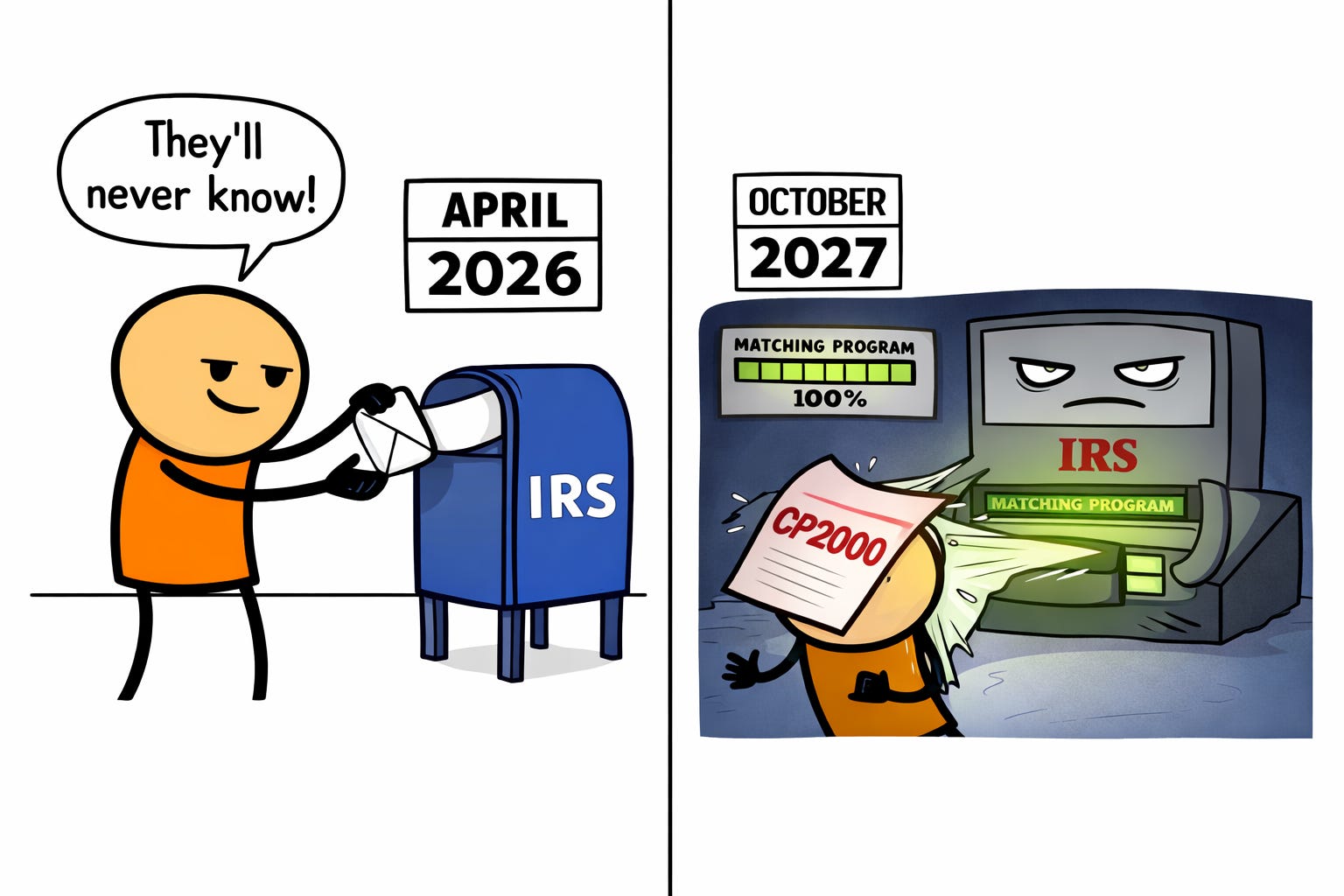
The IRS receives your tax return in February showing a $75,000 IRA distribution. They also receive a 1099-R from your custodian in April showing the same $75,000. You assume the IRS computer instantly compares the two numbers, confirms they match, and closes your file. The entire process happens automatically within days of the custodian filing the form.
That’s not how it works. The IRS doesn’t match your return against the 1099-R in April. They don’t even try. The matching happens over a year later when the IRS runs a massive batch program that compares every single tax return filed in 2026 against every single information return received from every custodian, employer, and financial institution in the country. Your individual return sits in a database waiting for its turn. When the program finally gets to your file, it executes the comparison in milliseconds. But that happens twelve to eighteen months after you filed.
The IRS Information Returns Processing system operates in three distinct stages. Collection, storage, and matching. Each stage happens at a different time with different systems handling different parts of the process. Understanding this structure explains why the IRS doesn’t catch discrepancies immediately and why notices arrive so long after you’ve forgotten the details.
Stage one is collection. Custodians, employers, and financial institutions file information returns with the IRS throughout the year. 1099-Rs get filed by March 31st. W-2s get filed by January 31st. Form 5498s get filed by June 1st. Almost all of these forms are filed electronically. The IRS lowered the electronic filing threshold significantly in 2026. Anyone filing ten or more forms must file electronically. That covers virtually every custodian. Paper filing is essentially extinct for retirement forms. Everything comes in electronically by March 31st.
The IRS receives these forms in massive batch files containing thousands or millions of records. Each file gets ingested into the Information Returns Master File, known internally as the IRMF. The data sits there waiting for the next stage.
Stage two is storage and indexing. The IRS loads the information returns into the IRMF organized by taxpayer identification number. Every 1099-R, every W-2, every Form 5498 gets indexed by Social Security number or employer identification number. The database accumulates data from every filing entity in the country. By the end of summer, the IRS has a complete repository of all the information returns filed for the prior tax year. But they still haven’t done anything with that data. They’ve just collected and organized it.
Stage three is matching. This is where the Automated Underreporter Program runs. The program takes every tax return filed for the year from the Individual Master File, known as the IMF, and compares it against every information return associated with that taxpayer’s Social Security number in the IRMF. It checks whether the income reported on the return matches the income reported by third parties. If everything aligns, the file passes. If there’s a discrepancy, the system generates a CP2000 notice proposing an adjustment.
The matching program doesn’t run continuously. It runs in scheduled cycles. For tax year 2025, the matching cycle for most returns begins in mid to late 2027. The IRS needs time to collect all the information returns, load them into the IRMF, and prepare the data for comparison. Once the cycle starts, it processes millions of returns in sequence. Your return gets matched when the program reaches your Social Security number in the queue. That could be early in the cycle or late in the cycle depending on where you fall in the processing order.
At Charles Schwab, I explained this to clients who assumed their return had been verified within weeks of filing because they got their refund and never heard anything. The refund was issued based on what they reported. The IRS didn’t verify it against third-party data at that point. They couldn’t. The custodian hadn’t filed the 1099-R yet. Even after the custodian filed, the IRS didn’t immediately cross-check. They stored the data in the IRMF and waited for the matching program to run over a year later.
Here’s how the system processes a specific return. A taxpayer files their 2025 return on February 20th, 2026, reporting a $50,000 traditional IRA distribution as taxable income. The IRS receives the return, runs it through error checking, verifies the math, and processes the refund in March 2026. The return gets stored in the Individual Master File. At this point, the return has been accepted and the refund issued. But the return has not been verified against the custodian’s 1099-R.
The custodian files the 1099-R electronically on March 30th, 2026, showing a $50,000 distribution. The IRS receives the electronic file, extracts the data, and loads it into the Information Returns Master File in April 2026. The 1099-R is now in the IRMF indexed under the taxpayer’s Social Security number. But it still hasn’t been compared to the tax return stored in the IMF. The two pieces of data exist in separate databases waiting for the matching program to connect them.
In August or September 2027, the IRS starts the Automated Underreporter matching cycle for tax year 2025. The program pulls the taxpayer’s 2025 return from the IMF. It pulls all the information returns filed under that taxpayer’s Social Security number from the IRMF. It compares the $50,000 distribution reported on the return against the $50,000 shown on the 1099-R. Match. No discrepancy. The system records the successful match and moves to the next return in the queue. The taxpayer never knows this verification happened.
Now change one variable. The taxpayer reported $50,000 on their return. The custodian filed a 1099-R showing $55,000. When the matching program runs in August or September 2027, it detects a $5,000 discrepancy. The system flags the return and generates a CP2000 notice. The notice calculates the tax on the $5,000 unreported income, adds the 10% early withdrawal penalty if applicable, and calculates interest retroactively from April 15th, 2026. That’s eighteen months of accumulated interest by the time the notice gets generated. The notice gets printed and mailed in October 2027. The taxpayer receives it in November 2027. Twenty-one months after they filed the return.
The matching program is entirely automated. No human reviews the returns unless a discrepancy triggers a notice and the taxpayer responds disputing the adjustment. The computer compares numbers. If they match, the file closes. If they don’t, the system calculates the tax on the unreported income, adds penalties and interest dating back to the original return due date, and generates a notice with the proposed adjustment.
The program doesn’t understand context. It doesn’t know that a distribution reported on the return might be correct even though the 1099-R shows a different number. It doesn’t know about basis adjustments, Roth conversions with withholding complications, or rollovers that were valid but coded incorrectly. The program sees two numbers. If they don’t match, it flags the return. The taxpayer has to provide the context by responding to the CP2000 notice with documentation showing why the numbers differ.
This is why the notice is called a proposed adjustment. The IRS is not asserting you owe additional tax. They’re saying their records show a discrepancy and proposing a correction based on what the third-party data indicates. You have the right to agree, disagree, or partially agree. If you disagree, you provide documentation supporting your position. The IRS reviews it and either accepts your explanation, rejects it, or negotiates a settlement.
Rollovers are one of the most common triggers for these notices because the matching is asymmetrical. The IRS receives the 1099-R from the distributing custodian showing the money left the account. Code G indicates it was a direct rollover. But the IRS doesn’t receive confirmation that the money landed safely in the receiving account until Form 5498 gets filed months later. The 1099-R is filed by March 31st. The Form 5498 from the receiving custodian isn’t filed until June 1st. The matching program runs in August or September. It sees the money left one account but might not have confirmation it arrived in another account because the forms are filed by different companies with different deadlines.
If the rollover was valid and both forms eventually get filed, the match succeeds. But the delay between the 1099-R deadline and the Form 5498 deadline creates a window where the data looks incomplete. The matching system has to wait for both pieces to arrive before it can confirm the rollover. That’s why rollovers are flagged more often than straightforward distributions. The system is waiting for two forms from two different custodians to prove the transaction was what the taxpayer claimed.
The IRS has three years from the filing due date to assess additional tax. For a 2025 return filed in February 2026, the statute runs until April 15th, 2029. The matching program runs in August or September 2027, well within that window. If the program finds a discrepancy, the IRS sends the CP2000 notice. The taxpayer has time to respond. If the IRS ultimately assesses additional tax, that assessment has to happen before April 15th, 2029. The matching program is designed to catch discrepancies early enough in the statute period to allow for notice, response, review, and assessment if necessary.
If the taxpayer omits more than 25% of their gross income, the statute extends to six years. This is rare but applies in cases where someone completely failed to report a massive distribution or forgot an entire account. The IRS has until April 15th, 2032, to assess additional tax in those situations. The matching program would still run in 2027, but the extended statute gives the IRS additional time to pursue the case if the taxpayer disputes the adjustment and the process drags on.
The system is built for scale. The IRS processes over a hundred million individual tax returns every year. They receive billions of information returns from millions of filing entities. Manually reviewing every return against every form would be impossible. The Automated Underreporter Program handles the comparison mechanically. It matches numbers stored in the Individual Master File against numbers stored in the Information Returns Master File. If they align, the return passes without human intervention. If they don’t, the system generates a notice and a human only gets involved if the taxpayer disputes the adjustment.
The matching system doesn’t operate in real time. It operates in cycles. Your return gets processed and stored in the IMF when you file. The information returns get processed and stored in the IRMF when custodians file. The comparison happens twelve to eighteen months later when the matching program runs. If the numbers you reported match the numbers third parties filed, the system confirms the match and closes your file silently. If the numbers don’t match, the system generates a notice asking you to explain the discrepancy.
The delay between filing and matching is not a flaw. It’s the designed workflow. The IRS needs time to collect all the information returns, organize the data in the IRMF, and prepare it for batch comparison against the IMF. Once the program runs, discrepancies surface quickly. But the program doesn’t run until over a year after you file. The silence between filing and receiving a notice doesn’t mean the IRS approved your return. It means the matching program hasn’t run yet. When it does, you’ll either hear nothing or you’ll get a CP2000 notice twenty months later asking about something you barely remember.
I write one of these every day, one retirement rule, explained in plain language and verified against the source. The daily email is free: subscribe here.
Full archive, worksheets, and search live at RetirementNewsRundown.com.
Disclaimer
This article is for educational and informational purposes only. It is not tax, legal, or financial advice and does not create an advisor–client relationship. Always consult appropriate professionals regarding your specific situation.