You take a distribution from your IRA on December 15th. The money hits your bank account on December 18th. You file your tax return on January 25th reporting the distribution. Then you call the IRS in February to confirm they received the information. The representative tells you they have no record of any retirement distribution for you.
You panic. Did the custodian fail to report it? Did the form get lost? Is your tax return going to be rejected?
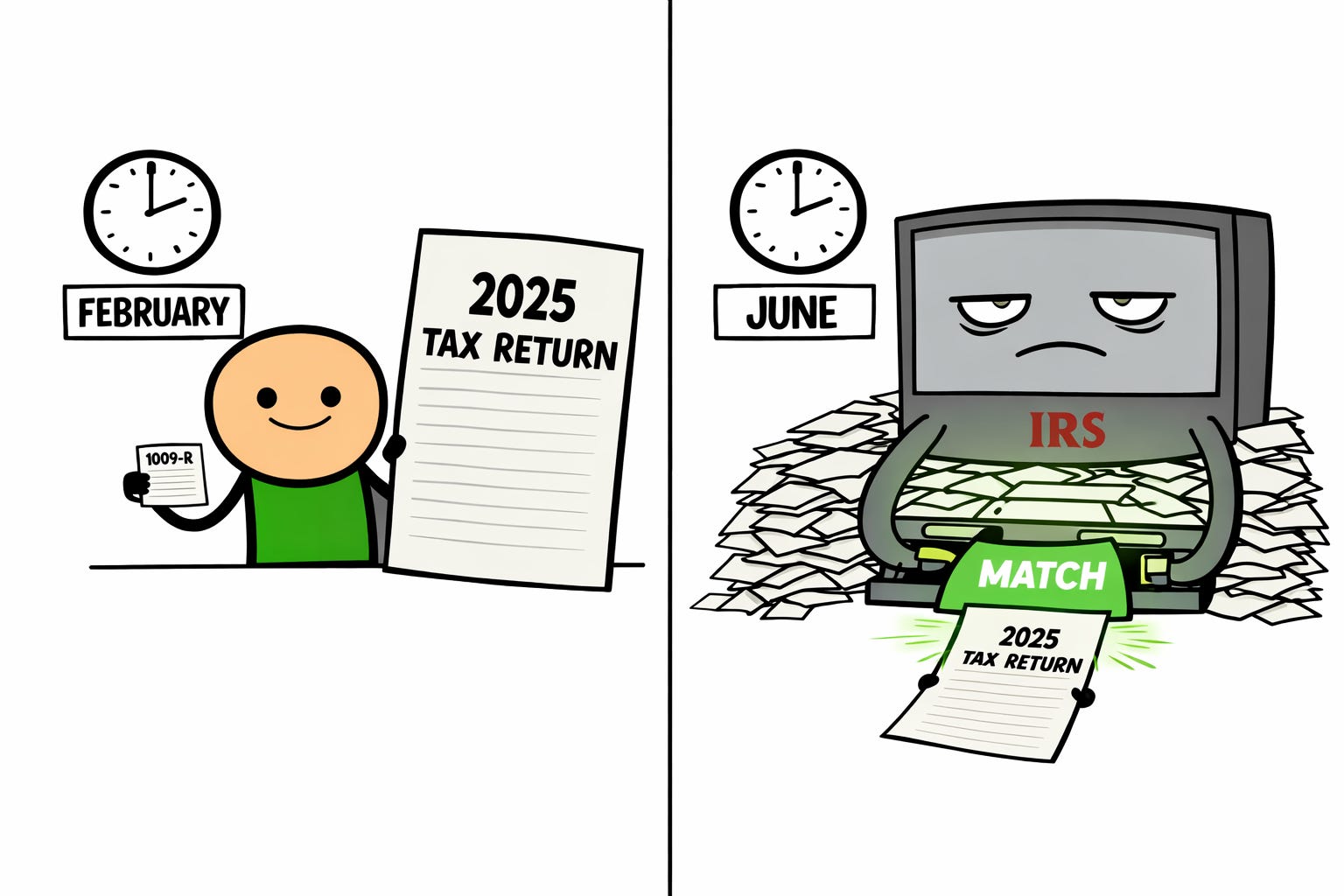
No. The IRS doesn’t have the information yet because the custodian hasn’t filed it yet. The transaction happened in December. The IRS won’t see it until April or May. The gap between when the money moved and when the IRS knows about it is four to six months. Sometimes longer.
When you take a retirement distribution, three separate timelines start running. The transaction date. The reporting date to you. The reporting date to the IRS. These dates are separated by weeks or months, and people constantly confuse them.
The transaction date is when the distribution actually happens. December 15th in this example. That’s the date the money leaves the retirement account and gets deposited into your bank account. That’s the date that determines which tax year the distribution belongs to. A December 15th, 2025 distribution is taxable in 2025. It doesn’t matter that you didn’t receive the 1099-R until February 2026. The distribution happened in 2025, so it goes on your 2025 tax return.
The reporting date to you is when the custodian sends you the 1099-R. For most retirement distributions, that’s February 2nd, 2026. The custodian has until that date to mail you the form. You might receive it earlier. You might receive it later if the mail is slow. But the custodian’s deadline to get it in the mail is early February.
The reporting date to the IRS is when the custodian files the 1099-R with the IRS. That deadline is March 31st, 2026 for electronic filing. The custodian doesn’t file your individual 1099-R on December 15th when the transaction happens. They don’t file it on February 2nd when they mail it to you. They batch all their 1099-Rs together and file them electronically with the IRS by the end of March.
So the transaction happens in December. You get the form in February. The IRS gets the form in late March or early April. Then the IRS has to process it, load it into their system, and make it available for cross-checking. That takes additional time. By the time the IRS actually has the distribution data in their matching system, it’s late spring or early summer. Four to six months after the transaction.
At Charles Schwab, I took calls from people who filed their tax return in late January and then called the IRS in February to verify the IRS had received their retirement distribution information. The IRS told them there was no record of any distribution. The caller would panic and assume Schwab had failed to report it.
Schwab hadn’t failed to report anything. Schwab just hadn’t filed it yet. The deadline to file with the IRS was March 31st. It was February. Schwab was still batching the forms. The IRS wouldn’t receive the data for another six weeks.
Even after Schwab filed the 1099-R on March 31st, the IRS didn’t load it into their system immediately. The IRS receives millions of 1099-Rs from thousands of custodians. They process them in batches. A form filed on March 31st might not show up in the IRS database until May. Or June. Or later.
This is why calling the IRS in February to ask about a December distribution gets you nowhere. The representative searches the IRS system. The system has nothing. Not because the form wasn’t filed, but because it hasn’t been filed yet. The transaction happened. The form was issued to you. But the custodian hasn’t transmitted the data to the IRS yet, and even if they had, the IRS hasn’t finished processing it.
Here’s a specific timeline. You take a $40,000 distribution from your traditional IRA on December 15th, 2025. The custodian processes the distribution that day. The money arrives in your bank account on December 18th. The distribution is taxable in 2025 because that’s when it occurred.
The custodian generates your 1099-R in January 2026. They mail it to you by February 2nd, 2026. You receive it on February 5th. You file your 2025 tax return on February 10th, 2026, reporting the $40,000 distribution as income.
The custodian doesn’t file the 1099-R with the IRS until March 28th, 2026. They submit it electronically along with all the other 1099-Rs they issued that year. The IRS receives the file on March 28th. They process it over the next several weeks. The data gets loaded into the IRS master file in late April or early May.
When you filed your return on February 10th, the IRS had no record of your $40,000 distribution. The custodian hadn’t filed the 1099-R yet. The IRS processed your return anyway. They didn’t reject it. They didn’t freeze your refund waiting for confirmation. They accepted what you reported and moved forward.
Months later, the IRS matching system runs its automated comparison. It compares the $40,000 you reported on your return against the $40,000 the custodian reported on the 1099-R. The numbers match. No problem. No notice. The gap between when you filed and when the IRS received the supporting data doesn’t create an issue as long as the numbers align.
The same time gap applies to IRA contributions. If you make a prior-year IRA contribution in March 2026 for tax year 2025, the custodian reports it on Form 5498. The deadline for custodians to file Form 5498 with the IRS is June 1st, 2026. That’s three months after you made the contribution. Four months after the tax year ended.
If you file your 2025 return in February 2026 claiming a $7,000 IRA deduction for a contribution you made in March 2026, the IRS has no record of that contribution when they process your return. The Form 5498 won’t be filed until June. The IRS won’t have the data until summer.
Does that mean the IRS will reject your deduction? No. The IRS processes the return. They accept the deduction. They issue the refund if you’re owed one. Months later, they verify the deduction against the Form 5498 data. If the custodian’s report matches your return, everything clears. If it doesn’t, you get a notice asking you to explain the discrepancy.
The time gap between the transaction and the IRS having data in their system is built into the reporting structure. Custodians don’t report in real time. They report in batches weeks or months after the transaction. The IRS doesn’t process in real time. They process in batches weeks or months after receiving the data. A December transaction might not show up in the IRS matching system until the following summer.
This is also why amended 1099-Rs create problems. If a custodian files a 1099-R on March 31st and then realizes they made an error and files a corrected 1099-R on May 15th, the IRS receives both. The corrected version overwrites the original in the system. But if you already filed your return based on the original 1099-R, your return now doesn’t match the IRS data. The mismatch triggers a notice twelve to eighteen months later asking you to explain the difference.
You filed in February based on the information you had. The custodian filed a correction in May. The IRS loaded the correction in June. When the IRS ran their matching program in 2027, they compared your February 2026 return against the corrected May 2026 1099-R. The numbers didn’t match. You get a notice even though you reported everything correctly based on the form you received.
The gap between when a retirement transaction happens and when the IRS actually has the data in their system is measured in months. A December distribution doesn’t show up in IRS records until the following spring or summer. A March contribution doesn’t show up until late summer. The transaction is immediate. The reporting is delayed. The IRS processing is delayed further. By the time the IRS cross-checks everything, six months or more have passed since the money moved.
If you file your return before the custodian files the supporting forms, the IRS doesn’t reject your return. They process it and verify it later. The time gap is irrelevant as long as the numbers you report match the numbers the custodian eventually files. If they don’t match, you’ll find out when the IRS sends a notice a year and a half later. But that’s not because you filed early. That’s because the numbers didn’t align.
I write one of these every day, one retirement rule, explained in plain language and verified against the source. The daily email is free: subscribe here.
Full archive, worksheets, and search live at RetirementNewsRundown.com.
Disclaimer
This article is for educational and informational purposes only. It is not tax, legal, or financial advice and does not create an advisor–client relationship. Always consult appropriate professionals regarding your specific situation.