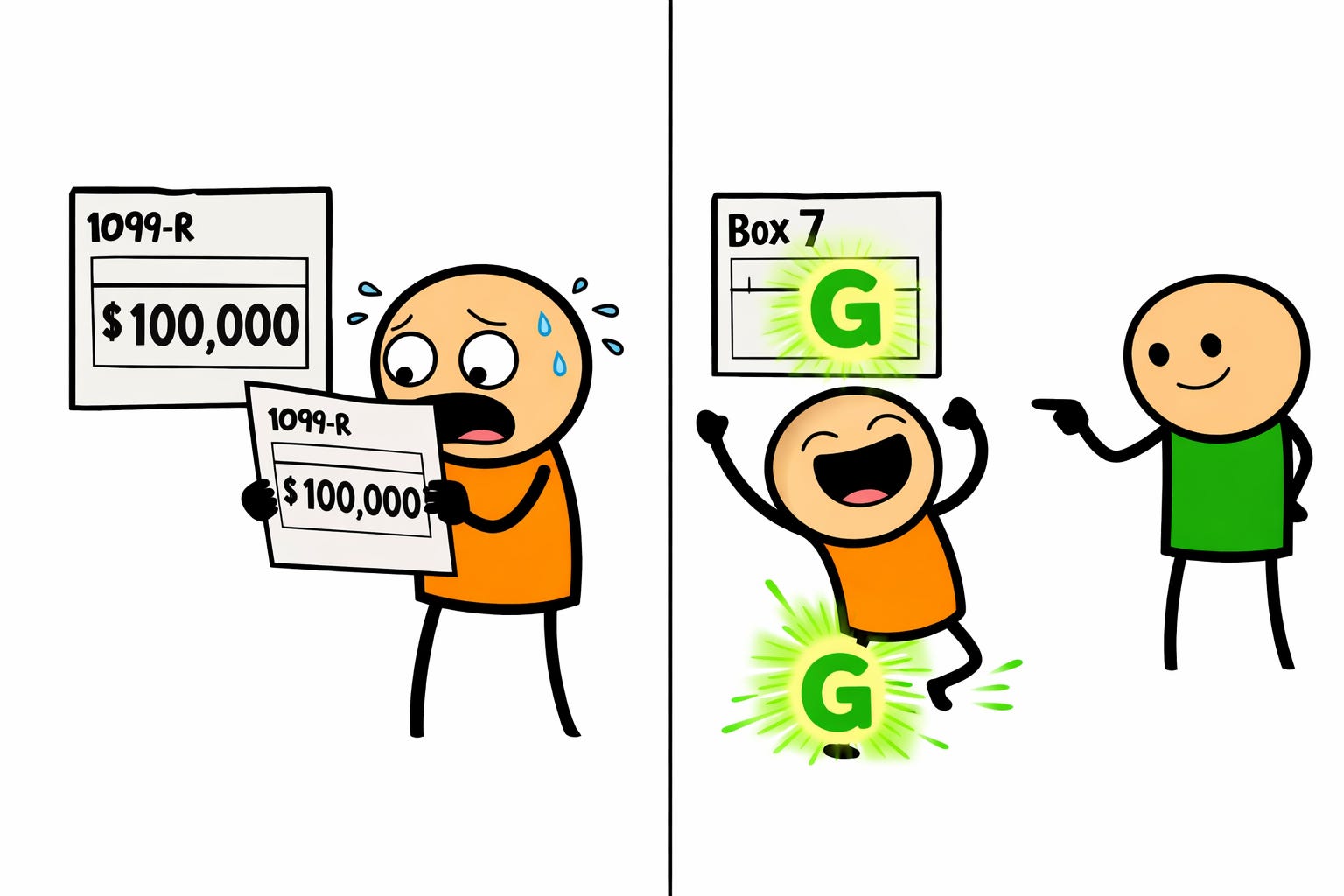
The 1099-R shows up in February showing $100,000 in box 1. You open it. You see six figures. You immediately assume you owe taxes on $100,000. You start calculating what 22% or 24% of that number looks like. You panic.
Then you look at box 2b. It says zero. Or it’s blank. Or it says “Taxable amount not determined.”
Now you’re confused. Does the IRS expect you to pay taxes on $100,000 or not? The form shows a massive distribution but no taxable amount. What are you supposed to report on your return?
The answer is in the distribution code. Box 7. That two-letter or single-digit code determines whether the $100,000 is taxable income or just a number the IRS needs to see reported.
Box 1 on the 1099-R shows the gross distribution. That’s the total amount that came out of the retirement account. It does not show the taxable amount. It shows the amount distributed. Those are two completely different things.
Box 2a shows the taxable amount. Sometimes. If the custodian knows what the taxable portion is, they’ll put it in box 2a. If they don’t know, box 2a will be blank or show zero. Then box 2b will have a checkmark next to “Taxable amount not determined.”
When box 2b says “Taxable amount not determined,” the custodian is telling you they reported the distribution to the IRS but they have no idea how much of it is taxable. They’re putting that responsibility on you. You have to figure out the taxable portion based on the type of distribution, your basis in the account, and the distribution code.
The distribution code is in box 7. That code tells you what kind of distribution this was. Code G means direct rollover. Code 1 means early distribution with no known exception. Code 7 means normal distribution after age 59½. Code 2 means early distribution with an exception that waives the penalty. Code J means a Roth distribution. Code P means you took a distribution to correct an excess contribution.
Each code changes the tax treatment entirely. A $100,000 distribution with code G is a rollover. You moved the money from one retirement account to another. Zero taxable. A $100,000 distribution with code 7 is a normal distribution. Fully taxable unless you have basis. A $100,000 distribution with code J is a Roth distribution. Potentially zero taxable if it’s a qualified distribution. Potentially fully taxable if it’s not.
At Charles Schwab, I took calls from people who got a 1099-R showing $80,000 in box 1, zero in box 2a, and “Taxable amount not determined” checked in box 2b. They wanted to know if they owed taxes on $80,000.
I’d ask what kind of distribution it was. “I rolled it over to Vanguard.”
Box 7 would show code G. Direct rollover. That meant zero taxable. The client moved $80,000 from their Schwab IRA to their Vanguard IRA. Schwab reported the distribution because money left the account. But it wasn’t taxable income because it went into another IRA. The 1099-R exists to document the movement, not to report taxable income.
The client would ask why Schwab didn’t just put zero in box 2a if the taxable amount was zero. Because Schwab doesn’t know for certain that the rollover was valid. The client could have already done an indirect rollover in the past twelve months. That would violate the one-per-year rule and make the entire distribution taxable. Schwab doesn’t track rollovers at other custodians. So Schwab reports the gross distribution, marks the box as “Taxable amount not determined,” enters code G to indicate it was a direct rollover, and leaves it to the taxpayer to confirm the rollover was valid.
If the rollover was valid, the taxable amount is zero. If it wasn’t, the taxable amount is the full $80,000. The 1099-R doesn’t make that determination. The taxpayer does.
Another scenario. A client gets a 1099-R showing $50,000 in box 1. Box 2a is blank. Box 2b says “Taxable amount not determined.” Box 7 shows code J. Roth IRA distribution.
Is the $50,000 taxable? Maybe. Maybe not. Depends on whether the distribution is qualified.
A qualified Roth distribution is tax-free. To be qualified, the Roth IRA has to have been open for at least five years and the distribution has to happen after age 59½, after death, after disability, or for a first-time home purchase up to $10,000. If both conditions are met, the entire $50,000 comes out tax-free.
If the distribution is not qualified, the ordering rules apply. Contributions come out first, tax-free. Then conversions come out in order, taxable if withdrawn within five years of the conversion. Then earnings come out last, fully taxable and subject to the 10% penalty if under 59½.
The custodian has no idea which bucket the $50,000 came from. They don’t track whether you’re 59½ yet. They don’t know if your Roth has been open for five years. They issued a 1099-R showing code J because it was a Roth distribution. They left box 2a blank because they can’t determine the taxable portion. The taxpayer has to figure that out and report it correctly on Form 8606 if any portion is taxable.
If the distribution was qualified, nothing gets reported on the tax return except the 1099-R itself. If it wasn’t qualified, the taxpayer calculates the taxable portion, reports it as income, and completes Form 8606 to show the breakdown between contributions, conversions, and earnings.
Here’s another one. A client gets a 1099-R showing $6,500 in box 1. Box 2a shows $6,500. Box 7 shows code P. The client is confused. They didn’t take a distribution. They just corrected an excess contribution.
Code P means the distribution was made to correct an excess IRA contribution. The $6,500 was an over-contribution that had to be removed before the tax filing deadline. The custodian processed the removal and reported it on a 1099-R because money left the IRA. But the $6,500 isn’t taxable as a distribution. It’s taxable as the reversal of a deduction that shouldn’t have been taken in the first place.
If the client took a $6,500 IRA deduction on their prior-year return and then removed the contribution as an excess, they report the $6,500 as income in the year the excess was removed. That offsets the deduction they claimed. But it’s not a retirement distribution subject to the 10% early withdrawal penalty. It’s just taxable income. Code P tells the IRS that’s what happened.
If the client never took a deduction for the contribution in the first place, the $6,500 removal is not taxable at all. The money went in after-tax, came back out after-tax, and no deduction was ever claimed. The 1099-R still gets issued because the custodian has to report the distribution. But the taxpayer doesn’t report it as taxable income. They just document the removal on Form 8606 to show the basis.
The 1099-R is not a bill. It’s a report. It tells the IRS that money moved out of a retirement account. It does not tell the IRS how much of that money is taxable. That’s determined by the distribution code, the type of account, your basis, your age, and whether the distribution qualifies for an exception.
A $100,000 distribution could be zero taxable if it’s a direct rollover. It could be $100,000 taxable if it’s an early withdrawal from a traditional IRA with no basis. It could be partially taxable if it’s a nonqualified Roth distribution. The form itself doesn’t answer that question. The taxpayer answers it by understanding the distribution code and applying the correct rules.
If box 2a shows a number, that’s the custodian’s best estimate of the taxable portion. If box 2a is blank and box 2b says “Taxable amount not determined,” the custodian is telling you to figure it out yourself. Look at the distribution code. Understand what kind of distribution it was. Calculate the taxable portion. Report it correctly.
The number in box 1 is just the starting point. The distribution code is what matters.
I write one of these every day, one retirement rule, explained in plain language and verified against the source. The daily email is free: subscribe here.
Full archive, worksheets, and search live at RetirementNewsRundown.com.
Disclaimer
This article is for educational and informational purposes only. It is not tax, legal, or financial advice and does not create an advisor–client relationship. Always consult appropriate professionals regarding your specific situation.