A contribution becomes excess in more than one way. The most familiar is contributing more than the annual limit, which is a single combined limit across all of a person’s Traditional and Roth IRAs. Funding a Traditional IRA with the full limit and a Roth IRA with the full limit in the same year does not double the allowance. Half of that is excess.
A contribution also becomes excess when it exceeds the person’s earned income for the year. The allowed contribution is capped at compensation, so a contribution larger than the year’s compensation produces an excess equal to the difference, even if the dollar limit was never approached.
For a Roth IRA, a contribution becomes excess when modified adjusted gross income rises above the allowed range. Roth eligibility phases out as income climbs, and a contribution made before the year’s income is known can turn out to exceed what that income level permits. The contribution was placed in good faith, but the rule grades it against an income figure that did not exist yet on the day it was made.
A failed rollover becomes an excess contribution as well. When a 60-day rollover misses its deadline or violates the once-per-year rule, the amount that landed in the IRA is not a valid rollover. It is treated as a regular contribution, and because rollover amounts are usually far larger than the annual limit, almost all of it becomes excess.
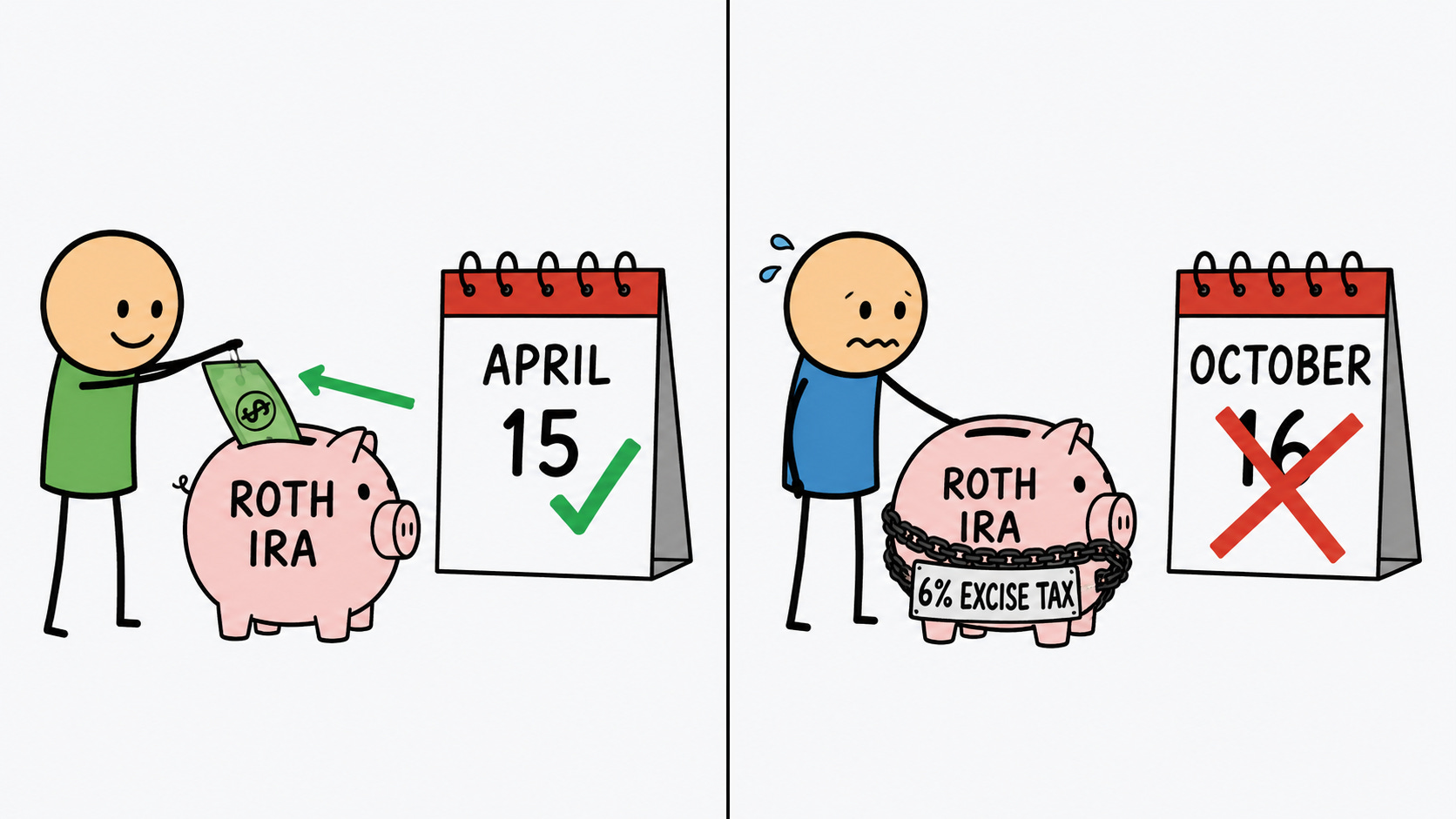
The consequence is the same regardless of the cause. An excess contribution is subject to a 6% excise tax, charged for each year the excess remains in the account. An excess left in place for several years is taxed at 6% several times over.
The correction window is the part that matters most. An excess removed, along with the earnings attributable to it, by the tax-filing deadline including extensions avoids the 6% entirely. A person who timely filed the return has a related path, the excess can generally be removed within six months of the original return due date, excluding extensions, with an amended return to report the result.
The earnings that come out are taxable as income for the year the contribution was made. A timely correction clears the 6% excise tax, and the earnings withdrawn alongside the excess are not subject to the 10% early withdrawal penalty.
What happens if the excess is removed later, after that window has closed? The 6% applies for that year, and for every year the excess stays in the account afterward. The excess can still be fixed two ways. It can be withdrawn, which stops the 6% from accruing in future years. Or it can be absorbed, applied as a contribution for a later year in which the person has unused contribution room. Absorption uses up the excess without a withdrawal, though the 6% still applies for each year until it happens.
Priya contributes the full amount to her Roth IRA in February. Her income the prior year was comfortably within the Roth range, and she has no reason to expect a different result this year.
The year turns out to be a strong one. A promotion and a bonus push her modified adjusted gross income above the Roth eligibility range. The contribution she made in February, valid on the day she made it, is now an excess contribution. Nothing about her action changed. Her income changed, and the income is what the rule measures.
Priya has options, and the cleanest one keeps her money in place. Before the tax-filing deadline, assuming she is otherwise eligible to make a Traditional IRA contribution, she can recharacterize the Roth contribution. The custodian treats it as a Traditional IRA contribution from the start, which removes the Roth excess without pulling the money out of a retirement account. She can also withdraw the contribution and its earnings by that deadline. Either timely fix clears the excess and avoids the 6%. If she does nothing and finds the problem two years later, she owes 6% for each of those years and still has to withdraw or absorb the excess to stop the charge from continuing.
An excess contribution is a common and fixable event, not a sign that something went badly wrong. It happens to careful people because several of the triggers, a rising income, a drop in earned income, a rollover that missed its window, are only visible after the fact.
The deadline is the part worth tracking. Catching an excess before the tax-filing deadline, including extensions and the six-month grace for a timely filed return, means the 6% never applies. Catching it later means the 6% applies for the years involved, but the excess can still be withdrawn or absorbed to stop it from continuing.
The label sounds severe, and the recurring 6% gives it teeth, but the situation is one of the more routine corrections in the retirement system. Knowing the cause and acting before the window closes is the entire difference between a quick fix and a recurring tax.
I write one of these every day, one retirement rule, explained in plain language and verified against the source. The daily email is free: subscribe here.
Full archive, worksheets, and search live at RetirementNewsRundown.com.
Disclaimer This article is for educational and informational purposes only. It is not tax, legal, or financial advice and does not create an advisor–client relationship. Always consult appropriate professionals regarding your specific situation.