A freelance designer files an extension in April, gets busy, and remembers the retirement account in early October. She has had a good year and wants to put away as much as the rules allow. She calls her custodian ready to fund a solo 401(k) she opened two years ago, and finds she can make about half the contribution she had in mind.
The employer half is available to her. The employee half is gone, and it went at the end of December, nine months before she thought about it.
Her extension bought her months on one of those halves and zero days on the other.
Two different deadlines live inside a solo 401(k), and an extension moves one of them.
The employer contribution, the profit sharing piece, is due by the due date of your business return including extensions. Same for a SEP, where the employer contribution is the only kind there is. If you extended, that money can go in months after year end and still count for the year that ended.
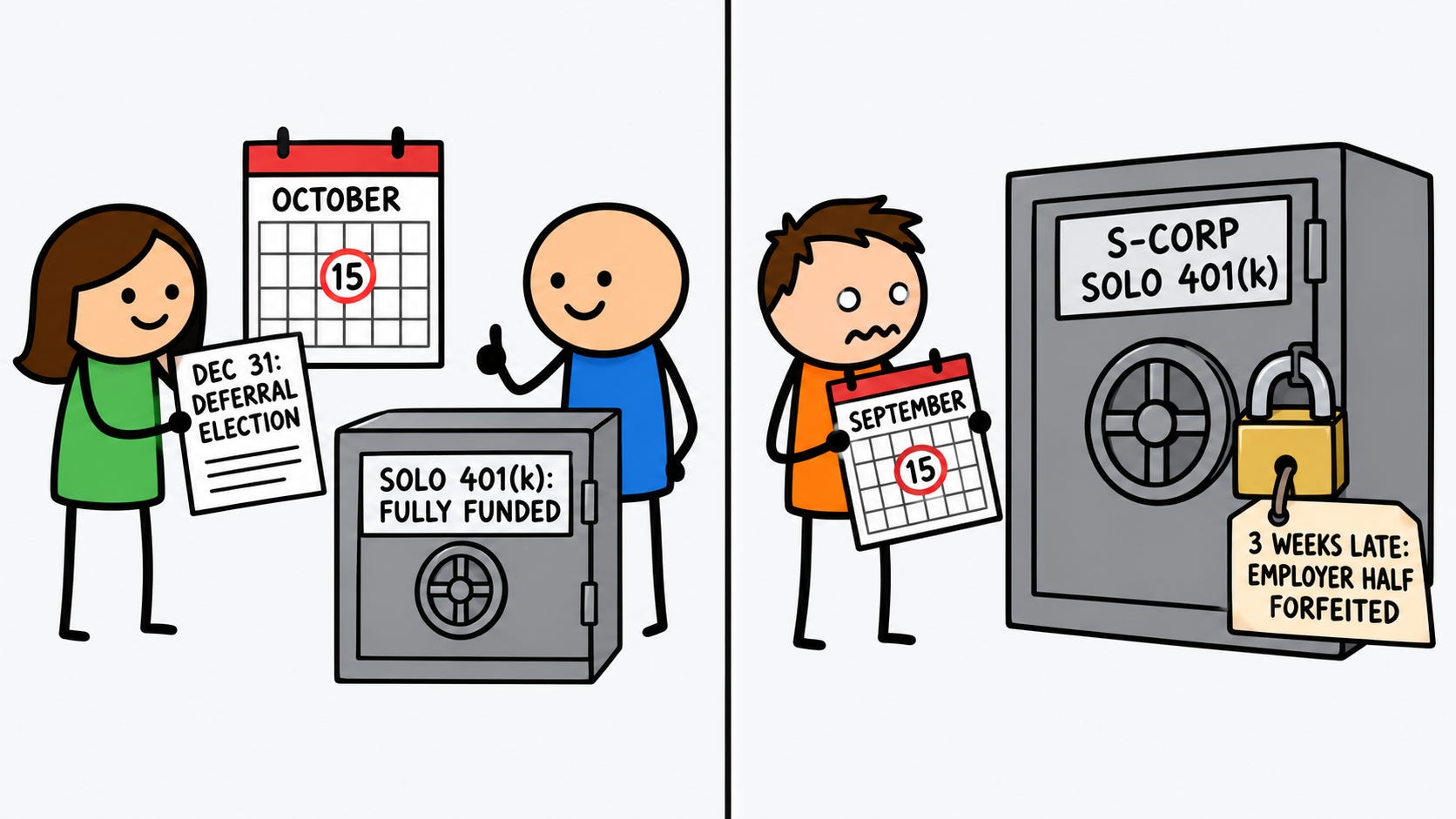
The employee deferral works differently. As an owner employee you have to elect the deferral by the end of the tax year, and only then can you fund it by the extended return due date. The election is the December 31 deadline. The funding is the extended one. An extension covers the funding, and the election belongs to the calendar year.
That distinction is the whole article, and it is why the designer lost half her contribution. She never made an election in December, so by October there was nothing to fund.
This pattern belongs to people whose income is self-employment income, meaning sole proprietors and partners, whose earnings are treated as available on the last day of the year. If you pay yourself W-2 wages from your own S corporation, your deferrals come out of those paychecks during the year the way any employee’s do, and there is nothing left to fund afterward.
For the self-employed, though, the reverse is worth knowing. Someone who made a timely election before year end has preserved the ability to fund it later, after final earned income is known, subject to the plan’s own election terms and the annual limits. The election itself costs nothing.
Now the second thing people get wrong, which is which date the extension actually reaches.
There is no single extended deadline. It depends on how your business files.
A partnership or an S corporation files its return by the fifteenth day of the third month after the year ends, so March 15 for a calendar year business. The automatic extension runs six months, which lands on September 15. If you run an S corp and you are reading this in October, your extended window closed a few weeks ago.
A sole proprietor reports on Schedule C with a personal return due April 15, and the extension runs to October 15. A C corporation on a calendar year lands in the same place. Those are the filers who still have room in early October.
So two businesses with the same profit, the same plan and the same extension can have deadlines a month apart, and the one who read a generic October 15 article and relaxed is the one who misses it entirely.
A SEP is simpler on every count, which is the reason to know about it in October.
Setup and funding both ride the extended return due date. You can establish a SEP for a year that has already ended, as late as the extended due date of that year’s return, and fund it in the same motion. No election, no December anything, no prior year paperwork.
That makes the SEP the simplest option for somebody who reaches October with no plan and wants a deduction for the year that ended. Other qualified plans can also be adopted retroactively by that same extended deadline and take a prior year employer contribution. What retroactive adoption generally cannot do is create a prior year employee deferral, so by October the employer piece is the piece on offer whichever plan you choose.
What an extension leaves alone is worth listing plainly. The IRA contribution deadline sits on the April filing date and stays there whether or not you extend. The deadline to pay tax was also April, with the extension covering the filing alone. And the deferral election stays on December 31.
Miss the deadline that applies to you and the contribution simply becomes a contribution for a different year. The deduction for the year that ended is gone, the money either applies to the current year or comes back out, and nothing carries backward.
Take two businesses, both with $120,000 of profit and both wanting the largest deduction they can get for last year.
The first is a single member LLC taxed as a sole proprietorship. She filed an extension in April, so her deadline is October 15. She made a deferral election last December. In early October she funds both halves of her solo 401(k), the employee deferral she elected and the employer profit sharing piece, and deducts the lot on the return she files that week.
The second is a partner in a two person partnership with the same profit and the same plan, who also made a December election. The partnership’s extended deadline was September 15. He is three weeks late. The deferral he elected cannot be funded for last year, the employer contribution cannot be deducted for last year, and both now apply to the current year instead. Same plan, same election, same intention, one month of calendar difference.
Change one fact and the picture improves. Suppose he had realized this in August instead. The employer contribution would still have been on the table, through the plan he already had or through a SEP opened that month. What decided his outcome was when he remembered, not which plan he was holding.
The useful thing here is that “I filed an extension” is an incomplete sentence for retirement purposes. It needs to be followed by which return, because the date changes by entity, and by which contribution, because the deferral and the employer piece behave differently.
Three questions settle it. What return does your business file, which fixes whether your date is the fifteenth of September or the fifteenth of October. Did you make a deferral election by December 31, which fixes whether the employee half exists at all. And are you self-employed or on your own payroll, which fixes whether that election was ever yours to make.
For somebody arriving at this late with nothing set up, the SEP is usually the answer, and it is the answer precisely because it has no December requirement hiding inside it. The SEP contribution deadline guide lays out the timing by entity type, and the plan selector compares what each plan would actually let you contribute at your income before you commit to one.
None of this is punitive. There is no penalty for missing these dates, no form to file, no correction window to hit. The money lands in a different tax year than you meant it to, which is an ordinary disappointment. The reason to know the dates is that for a self-employed person, the good version and the bad version are separated by a four minute phone call in December.
I write one of these every day, one retirement rule, explained in plain language and verified against the source. The daily email is free: subscribe here.
Full archive, worksheets, and search live at RetirementNewsRundown.com.
Disclaimer
This article is for educational and informational purposes only. It is not tax, legal, or financial advice and does not create an advisor-client relationship. Always consult appropriate professionals regarding your specific situation.