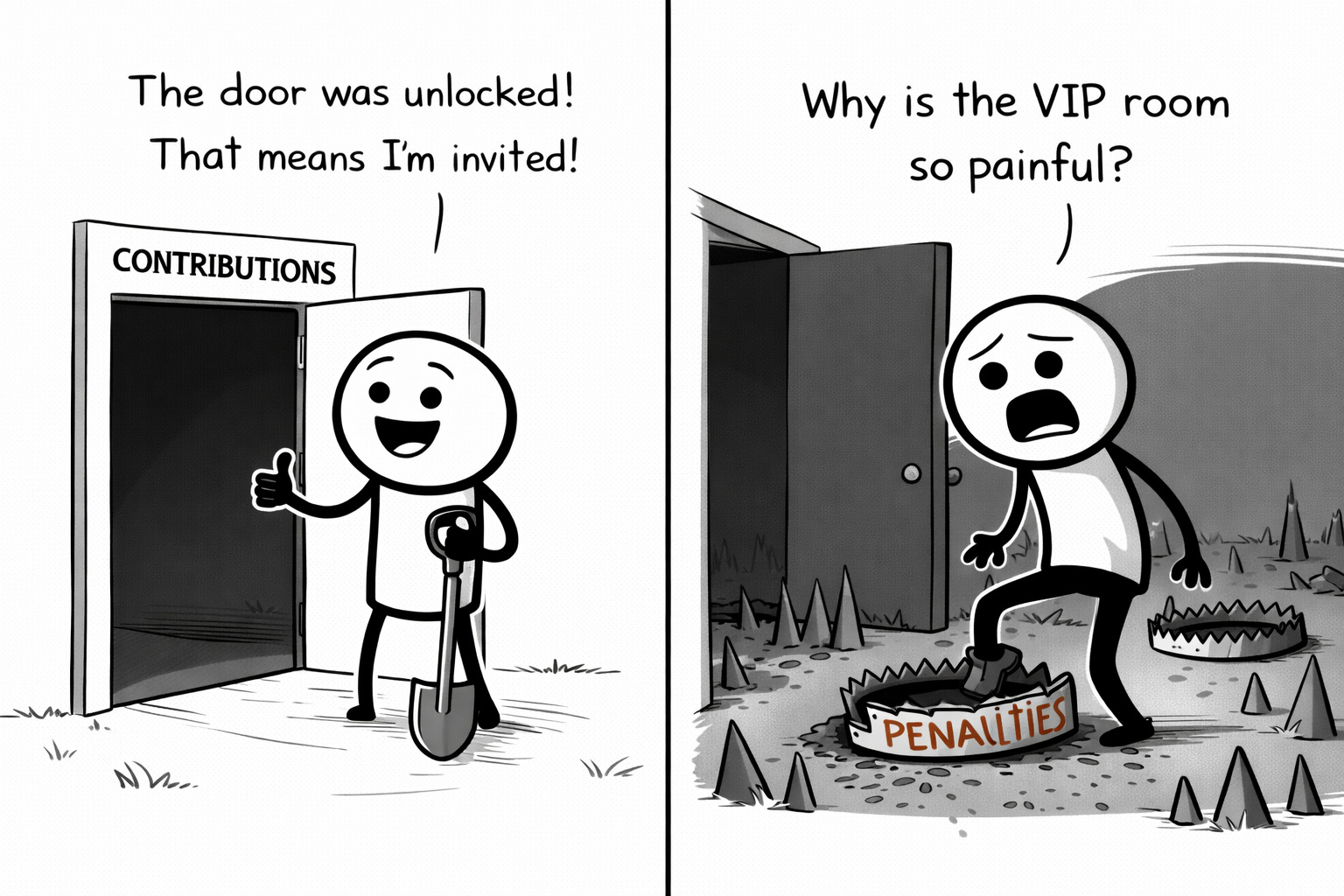
One of the most common phrases people use when talking about retirement accounts is also one of the most misleading.
“It was allowed.”
That sentence usually comes with confidence. The transaction went through. The account accepted it. No error message appeared. No one stopped it. The assumption is that if something was allowed, it must have been fine.
That assumption is doing a lot of work it was never hired to do.
Retirement rules are not built around whether something can happen. They are built around whether something holds up when it is later reviewed. The gap between those two ideas is where most surprises live.
Many retirement transactions are allowed to occur even when they create problems later. The system does not pre approve outcomes. It records actions and evaluates them when the rules say it is time.
Calendar year deadlines are usually where that evaluation begins. December 31 is when eligibility, limits, and classifications become fixed. Until that date passes, many transactions exist in a provisional state.
Tax filing deadlines come later. They exist to report what already happened. Filing does not change whether something was allowed or problematic. It documents the result.
Correction windows exist for certain situations. They allow some issues to be fixed after the calendar year ends without ongoing penalties. Once those windows close, the fact that something was allowed to occur does not protect it from consequences.
If something is done later instead, the system does not regrade the original action. It applies whatever rule applies to late action, failed action, or uncorrected action.
Allowed simply means the door was open. It does not mean the room was safe.
A Roth IRA contribution is a classic example.
The system allows contributions to post without knowing whether they will ultimately be permitted. Income eligibility cannot be confirmed until the year ends. That means a contribution made in January can sit all year without issue.
When December 31 passes and final income is known, the rule gets applied.
If income is within limits, the contribution stands. If income is too high, the contribution becomes excess retroactively. The fact that it was allowed to be made does not matter.
If the excess is corrected by the tax filing deadline or extension, the issue is usually resolved cleanly. If it is done later instead, after the correction window closes, the excess remains and penalties accrue for each year it stays.
The contribution was allowed. The outcome was not.
Required minimum distributions work the same way.
Accounts do not block transactions because an RMD has not been taken. They allow the year to proceed normally. Balances fluctuate. Statements look ordinary.
The rule is applied at the end of the calendar year.
If the required amount did not leave the account by December 31, the RMD is officially missed. Taking it in January does not convert it into an acceptable late distribution. It becomes a missed RMD followed by a corrective distribution.
If relief is available and handled properly, penalties may be reduced or waived. If it is done later instead or ignored, penalties apply based on the year that already closed.
The account allowed the year to pass. The rule still applied.
Rollovers expose the low bar even more clearly.
A distribution taken with rollover intent is allowed to leave the account without friction. The system does not pause the transaction to confirm future behavior. It records the distribution date and starts the clock.
If the funds are deposited into another eligible retirement account within the rollover window, the transaction qualifies. If they are not, the system reclassifies the entire distribution as taxable.
If the deposit happens later instead, even slightly later, the original distribution does not become partially acceptable. It fails outright.
The system allowed the distribution. It did not guarantee the outcome.
Roth conversions often get confused with permission.
A conversion is allowed regardless of income level. That makes people assume the tax outcome is locked in at the moment of conversion.
It isn’t.
At the end of the calendar year, the system evaluates whether pre tax and after tax money existed in traditional IRAs at any point during the year. That snapshot determines how much of the conversion is taxable under the pro rata rule.
If other IRA balances existed during the year, the conversion becomes partially taxable regardless of how clean it looked on conversion day.
If accounts are cleaned up later instead, the conversion from the closed year does not get recalculated. The rule was applied using the information available at the checkpoint.
The conversion was allowed. The tax result was conditional.
This pattern shows up across retirement rules because the system prioritizes consistency over convenience.
Allowing transactions to occur keeps accounts operational. Evaluating outcomes later keeps rules enforceable. The two functions are separate by design.
Problems feel sudden because people confuse permission with approval. They assume allowed means safe. In retirement accounts, allowed usually just means deferred evaluation.
Calendar year deadlines decide whether something ultimately qualifies. Tax filing deadlines decide how that result is reported. Correction windows decide whether penalties can be avoided.
If something is done later instead, it does not become less important. It becomes subject to a different rule set.
Understanding this removes a lot of anxiety. It explains why nothing felt wrong at the time. It explains why consequences appear long after the action.
Allowed is not a promise. It is a starting point.
Once you understand that, the system stops feeling unpredictable. It starts feeling procedural.
And procedural rules are much easier to live with than misunderstood ones.
I write one of these every day, one retirement rule, explained in plain language and verified against the source. The daily email is free: subscribe here.
Disclaimer
This article is for educational and informational purposes only. It is not tax, legal, or financial advice and does not create an advisor–client relationship. Always consult appropriate professionals regarding your specific situation.