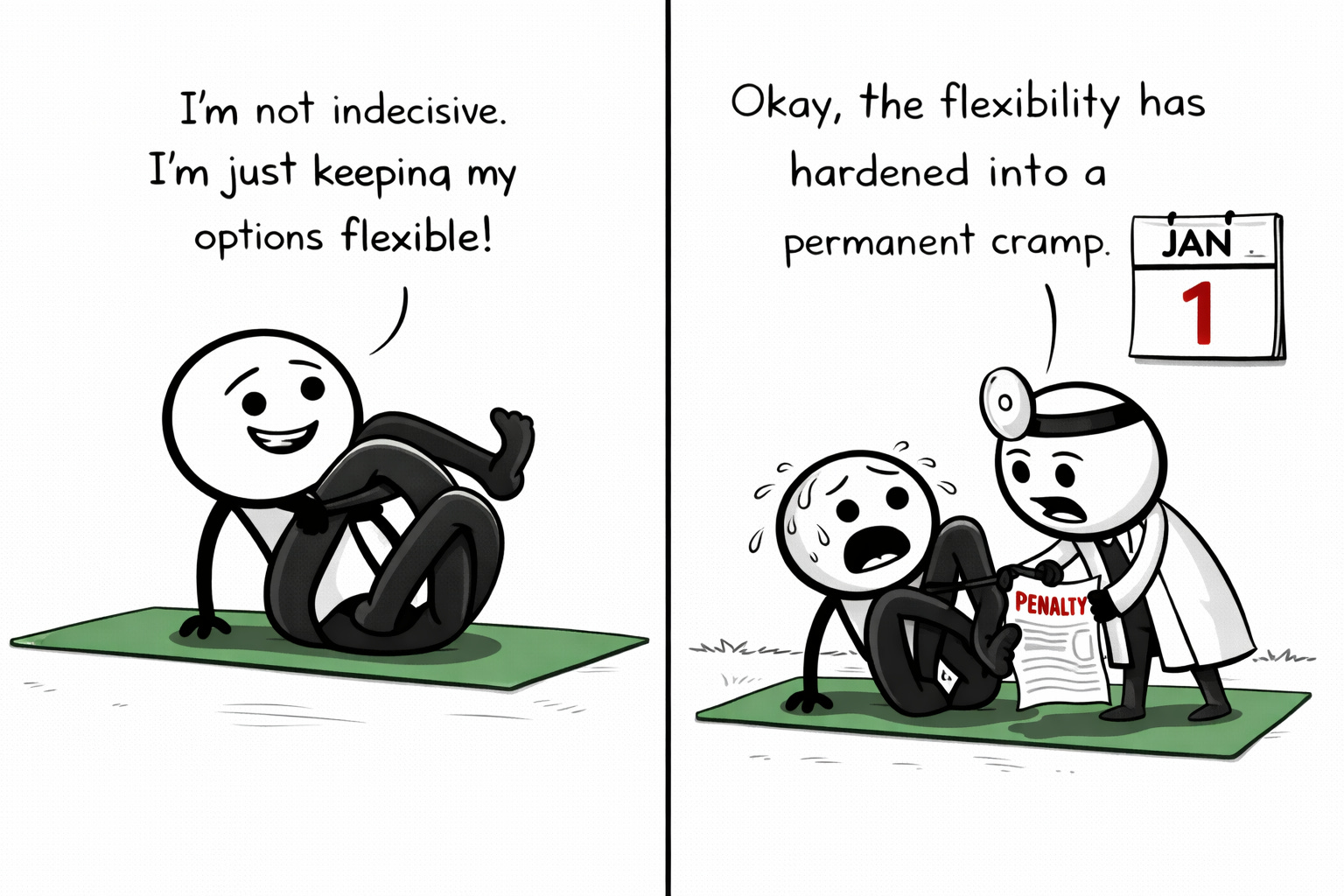
Flexibility feels responsible.
It sounds cautious, mature, even prudent. People say things like “I wanted to keep my options open” or “I didn’t want to lock myself into anything yet.” Retirement accounts are especially good at encouraging this mindset because they rarely force decisions in the moment.
Money can sit. Contributions can be delayed. Distributions can be postponed. Corrections can be made later. Nothing breaks immediately.
That quiet is seductive. It creates the impression that flexibility is free.
It isn’t.
Flexibility without a plan is not neutral. It has a cost. That cost just doesn’t show up right away.
Most retirement rules are structured to allow action before they require judgment. The system lets people move first and evaluates later. That design creates flexibility, but it also creates responsibility.
Calendar year deadlines are where flexibility starts to collapse into outcomes. December 31 is when contribution limits, income eligibility, RMD compliance, and account classifications become fixed. Until that date passes, many choices remain provisional.
Tax filing deadlines come later. They allow reporting and certain corrections. They do not reopen the calendar year. They simply document what already happened.
Correction windows exist for specific situations. They allow certain mistakes to be fixed after the year ends without ongoing penalties. Those windows are narrow and rule specific. Once they close, flexibility disappears.
If something is done later instead, the system does not treat it as cautious delay. It treats it as late action, failed action, or uncorrected action, depending on the rule involved.
Flexibility only works when it is paired with timing awareness.
Roth IRA contributions are a common place where flexibility quietly turns expensive.
Someone decides to contribute early in the year because it feels productive. Income is uncertain, but flexibility feels safer than waiting. The contribution posts. Investments grow. Nothing indicates a problem because income eligibility cannot be confirmed until the year ends.
December 31 arrives. Final income numbers exist. The rule finally gets applied.
If income ended up too high, the contribution becomes excess retroactively. The system does not care that the decision felt flexible at the time.
If the excess is corrected by the tax filing deadline or extension, the situation can often be resolved cleanly. If it is done later instead, after the correction window closes, the excess remains and generates penalties for each year it stays.
The cost is not the contribution. The cost is choosing flexibility without a plan for correction.
Required minimum distributions tell the same story.
The system allows RMDs to be taken anytime during the year. There is no enforcement mechanism that forces the withdrawal on a schedule. Flexibility exists by design.
That flexibility ends on December 31.
If the required amount has not left the account by then, the RMD is officially missed. Taking it in January does not convert it into an acceptable late distribution. It becomes a missed RMD followed by a corrective distribution.
If relief is available and handled properly, penalties may be reduced or waived. If it is done later instead or not addressed correctly, penalties apply based on the year that already closed.
The flexibility was real. The deadline was firmer.
Rollovers add another example where flexibility is often misunderstood.
A distribution can be taken with rollover intent without resistance. The system does not block it. The money leaves the account. Everything feels fine.
Flexibility exists during the rollover window.
Once that window closes, the system evaluates the outcome.
If the funds landed in another eligible retirement account within the allowed time, the transaction qualifies. If they did not, the entire distribution is reclassified as taxable.
If the deposit happens later instead, even slightly later, the classification does not soften. Taxes and penalties apply based on the original distribution date.
The flexibility was temporary. The cost shows up when the plan never existed.
Roth conversions often look like the ultimate flexible move.
There is no income limit. Conversions are allowed at any time during the year. Assets move cleanly. Taxes may even be withheld properly.
The system waits until year end to evaluate the tax result.
At that point, it looks across all traditional IRAs to determine whether pre tax and after tax money existed during the year. That snapshot determines how much of the conversion is taxable under the pro rata rule.
If other IRA balances remained in the account on December 31, the conversion becomes taxable based on that year-end total.
If accounts are cleaned up later instead, the conversion from the closed year does not get recalculated. The flexibility existed earlier. The outcome is locked later.
This pattern explains why flexibility often feels like it betrayed people.
In reality, it behaved exactly as designed. The system allowed choices to be made without friction. It expected the person making them to understand when flexibility ended.
Problems arise when flexibility is mistaken for forgiveness.
Calendar year deadlines define when outcomes become permanent. Tax filing deadlines define how those outcomes are reported. Correction windows define whether mistakes can be fixed without lasting cost.
If something is done later instead, the system does not reward patience. It applies a different rule set.
Understanding this removes a lot of fear. It reframes surprises as timing mismatches rather than hidden traps.
Flexibility is not bad. It is powerful. But without a plan for when flexibility expires, it becomes expensive silence.
Once you know where the lines are, you can see exactly where you stand.
And that clarity is worth far more than flexibility alone.
I write one of these every day, one retirement rule, explained in plain language and verified against the source. The daily email is free: subscribe here.
Disclaimer
This article is for educational and informational purposes only. It is not tax, legal, or financial advice and does not create an advisor–client relationship. Always consult appropriate professionals regarding your specific situation.