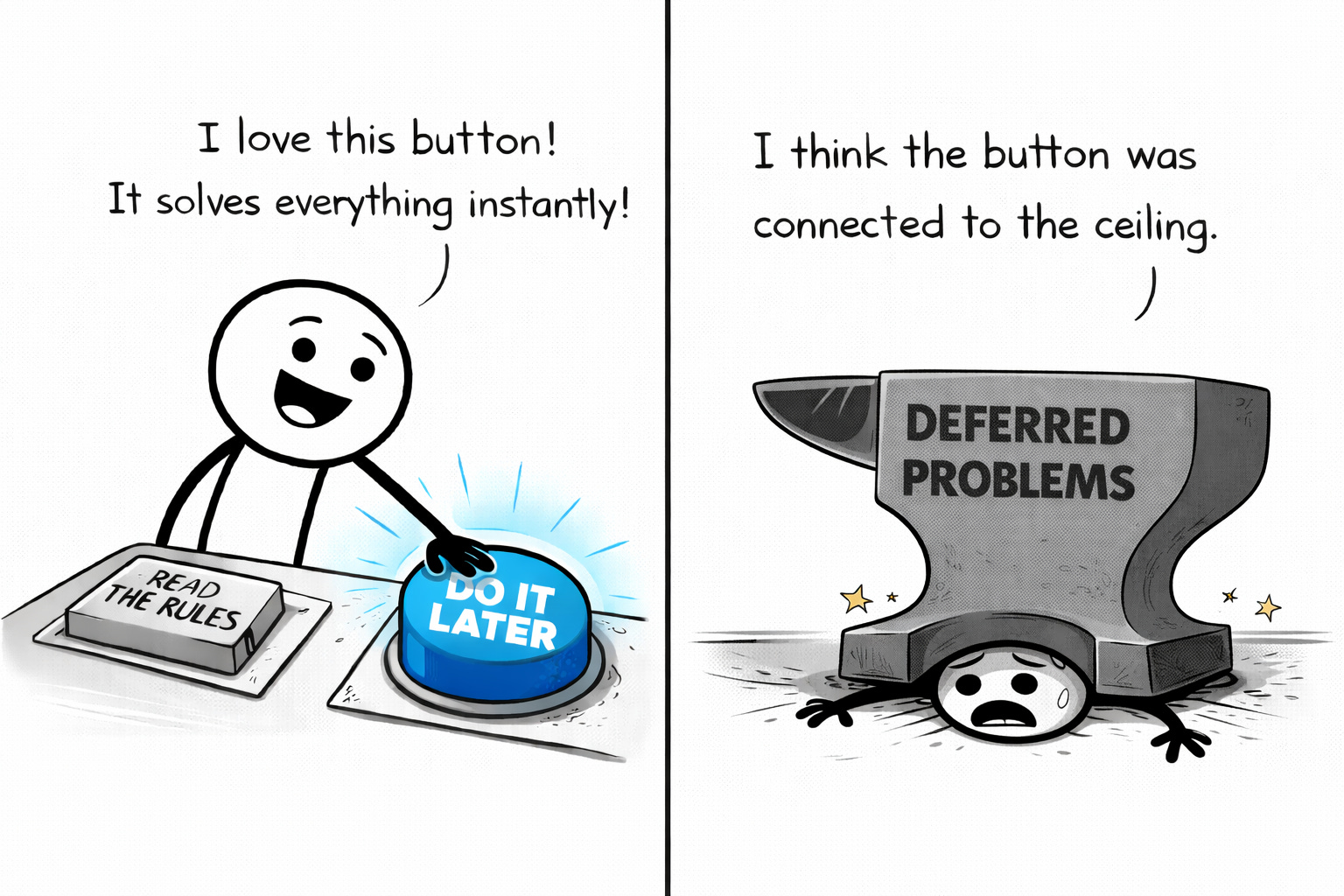
Convenience has a way of disguising itself as intelligence.
People choose convenience because it feels efficient. They consolidate accounts to simplify logins. They take distributions when it fits their schedule. They delay paperwork because life is busy and nothing seems urgent. Retirement accounts make this easy because they rarely object in the moment.
Money moves. Accounts update. Statements look normal. Nothing breaks.
That quiet approval is where the trouble starts.
Most expensive retirement mistakes do not come from reckless decisions. They come from choosing the easiest option today and assuming the system will gently adapt later.
It will not.
Retirement rules are built to tolerate convenience at the front end and evaluate consequences at the back end.
Calendar year deadlines are where convenience stops being flexible. December 31 is the date that locks in contribution eligibility, RMD compliance, IRA balances for pro rata purposes, and whether certain actions qualify at all. Until that date passes, many choices remain unresolved.
Tax filing deadlines arrive later. They exist to report what already happened. Filing does not change the classification of a transaction. It documents it.
Correction windows sit between those two. They allow specific mistakes to be fixed after the year ends without ongoing penalties. Those windows are narrow, rule specific, and unforgiving once closed.
If something is done later instead, convenience does not buy forgiveness. It often converts a correctable issue into a permanent one.
Roth IRA contributions are a common place where convenience quietly becomes expensive.
Contributing early feels proactive. Waiting feels unnecessary. Income is uncertain, but convenience wins and the contribution gets made anyway.
The system allows this because income eligibility cannot be verified until the year ends. The contribution posts. Investments grow. No warnings appear.
When December 31 passes, final income numbers exist and the rule gets applied.
If income ended up too high, the contribution becomes excess retroactively. Nothing changed in December except the system finally had enough information to judge the action.
If the excess is corrected by the tax filing deadline or extension, the issue can usually be resolved without lasting damage. If it is done later instead, after the correction window closes, penalties begin to accrue for each year the excess remains.
The convenience was choosing speed over certainty. The cost shows up later.
Required minimum distributions tell a similar story.
Convenience encourages people to delay distributions until later in the year. Accounts do not block activity when an RMD has not been taken. Everything appears normal.
The rule gets enforced when the calendar year closes.
If the required amount has not left the account by December 31, the RMD is officially missed. Taking it in January does not make it a late but acceptable distribution. It becomes a missed RMD followed by a corrective one.
If the correction is handled properly, penalties may be reduced or waived. If it is done later instead or ignored, penalties apply based on the year that already closed.
Convenience delayed the action. The deadline did not move.
Rollovers are another place where ease creates risk.
Taking a distribution with rollover intent is convenient. The system allows the funds to leave without friction. The money can sit in a bank account while other things are handled. Nothing feels urgent.
The rule only cares about timing.
If the funds land in another eligible retirement account within the rollover window, the transaction qualifies. If they do not, the entire distribution is reclassified as taxable.
If the deposit happens later instead, even slightly later, the classification does not soften. Taxes and potential penalties apply based on the original distribution date.
The convenience was separating the steps. The cost was assuming the window was flexible.
Roth conversions often feel like the most convenient strategy of all.
There is no income limit. Conversions can happen anytime during the year. Assets move cleanly. Taxes may even be withheld automatically. Everything feels controlled.
The system waits until the year ends to evaluate the tax result.
At that point, it looks at the aggregate traditional, SEP, and SIMPLE IRA balances that remained on December 31. That snapshot determines whether the conversion is subject to the pro rata rule.
If other IRA balances remained at year end, the conversion becomes taxable based on that total.
If those balances are moved out before December 31, even if they were large earlier in the year, the pro rata rule does not apply.
If cleanup happens later instead, after the year closes, the conversion outcome does not change. The system already recorded the year end facts.
Convenience favored timing flexibility. The rule favored precision.
This pattern repeats because the system separates execution from evaluation.
Transactions are allowed to occur without interruption so accounts remain usable. Outcomes are determined later so rules can be applied consistently.
Problems feel sudden because people assume convenience implies acceptance. It does not. It implies deferred judgment.
Calendar year deadlines define when convenience expires. Tax filing deadlines define how results are reported. Correction windows define whether mistakes can be fixed without permanent cost.
If something is done later instead, it does not slide into compliance. It moves into a different rule set entirely.
Understanding this removes unnecessary fear. It explains why nothing seemed wrong at the time. It explains why consequences arrive long after the decision.
Convenience is not a mistake. It just needs boundaries.
Once those boundaries are understood, the system becomes predictable instead of punitive.
And predictability is far cheaper than surprise.
I write one of these every day, one retirement rule, explained in plain language and verified against the source. The daily email is free: subscribe here.
Disclaimer
This article is for educational and informational purposes only. It is not tax, legal, or financial advice and does not create an advisor–client relationship. Always consult appropriate professionals regarding your specific situation.