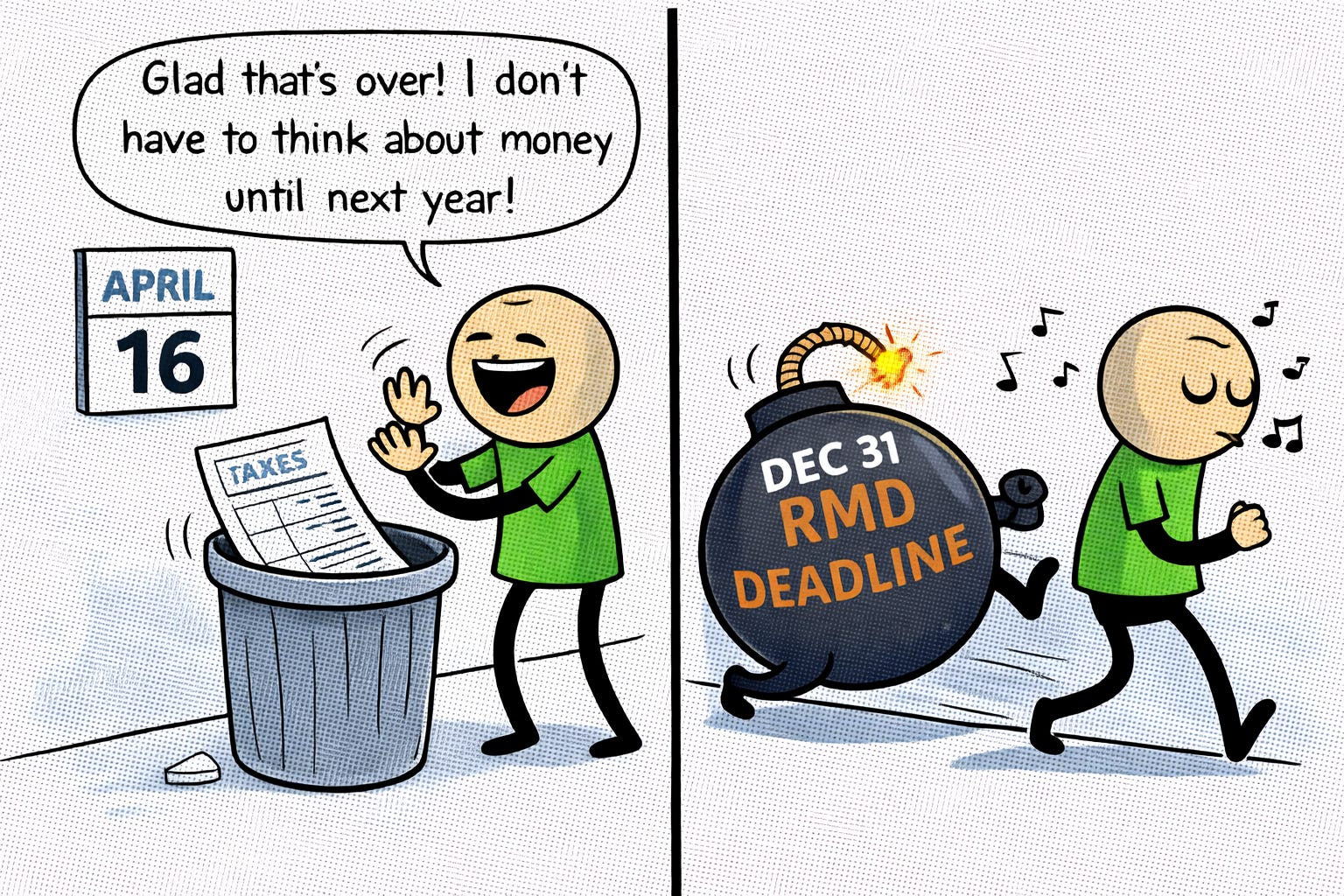
April 15 has a gravity to it. Everything in the financial calendar seems to orbit around that date. File by then. Pay by then. Contribute by then. When it passes, the instinct is to mentally close the books. Tax season is over. New year starts now.
Except retirement accounts do not reset on April 16. The decisions you made during the tax year, the contributions, the conversions, the distributions you took or did not take, all of those carry forward. The consequences do not expire because the calendar flipped.
The most common version of this misunderstanding involves IRA contributions. You can make a Traditional or Roth IRA contribution for 2025 up until April 15, 2026. Once that date passes, the 2025 contribution window is closed permanently. There is no extension for IRA contributions. Filing an extension gives you more time to file your return. It does not give you more time to fund your IRA for the prior year.
If you meant to contribute $8,000 for 2025 and only put in $5,000 before April 15, the remaining $3,000 is gone. Not deferred. Gone. You cannot make it up by contributing $11,000 in 2026. The annual limit resets, but the missed contribution from the prior year does not carry over. Every year you do not maximize your contribution is a year of tax-advantaged growth you never get back.
The math on that lost contribution is not dramatic in a single year. But compound it over 20 years and the gap is significant. $3,000 growing at 7% for 20 years is roughly $11,600. That is not a penalty. It is an opportunity cost. And it is invisible because nothing on your tax return tells you what you could have contributed but did not.
SEP IRAs are the exception. If you are self-employed and filed an extension, your SEP contribution deadline extends to October 15, 2026 for the 2025 tax year. This is one of the few cases where the extension actually buys you more contribution time. But only if the extension was filed before April 15. If you did not file an extension, the SEP deadline was April 15, same as everything else.
Solo 401(k) plans split the difference. Employee deferrals (the $23,500 limit for 2025, or $31,000 if 50 or older) must be made by December 31, 2025. That deadline is already gone by the time tax season arrives. Employer profit-sharing contributions follow the tax filing deadline including extensions, similar to a SEP. Missing the December 31 deferral deadline means that portion of the contribution cannot be recovered. April does not help.
Roth conversions are another area where April creates a false sense of closure. A conversion done in 2025 is taxable in 2025, regardless of when you file the return. If you converted $50,000 in November 2025 and regret it because the market dropped, you cannot undo it. The recharacterization option for conversions was eliminated by the Tax Cuts and Jobs Act in 2018. The conversion is permanent.
April 15 is when you pay the tax on it. But the decision was locked the moment the conversion was processed. People sometimes assume they have until tax day to “decide” whether to keep the conversion. They do not. The only decision left by April is how to pay the bill.
RMDs operate on their own calendar entirely. If you turned 73 in 2025, your first RMD is due by April 1, 2026. That deadline has nothing to do with your tax filing. It is a distribution deadline, not a filing deadline. Taking it on April 1 versus January 15 has no impact on your return for 2025 because the first RMD under the first-year exception is reported as 2026 income regardless of when you take it.
But starting in 2027, your RMD deadline is December 31. Not April. Not the filing deadline. December 31 of the year the distribution applies to. Miss that and the penalty is 25% of the shortfall, reduced to 10% if corrected within two years under SECURE 2.0.
April has no role in the RMD calendar after your first year. The December 31 deadline governs everything going forward. People who associate retirement account deadlines with tax season miss this completely. By the time April arrives, the current year’s RMD deadline is eight months away, not imminent. But the prior year’s deadline is already four months gone.
The broader pattern is this. April 15 is a tax filing deadline. It is not a retirement planning deadline. Some contribution windows close on April 15. Some closed months earlier. Some extend to October if you filed the right paperwork. And some deadlines, like RMDs, have nothing to do with April at all.
Treating April as a reset means you stop paying attention to the rules that are still running. The accounts do not pause because tax season ended. The growth continues. The deadlines continue. The penalties for inaction continue.
April is a checkpoint, not a finish line.
I write one of these every day, one retirement rule, explained in plain language and verified against the source. The daily email is free: subscribe here.
Full archive, worksheets, and search live at RetirementNewsRundown.com
Disclaimer This article is for educational and informational purposes only. It is not tax, legal, or financial advice and does not create an advisor-client relationship. Always consult appropriate professionals regarding your specific situation.