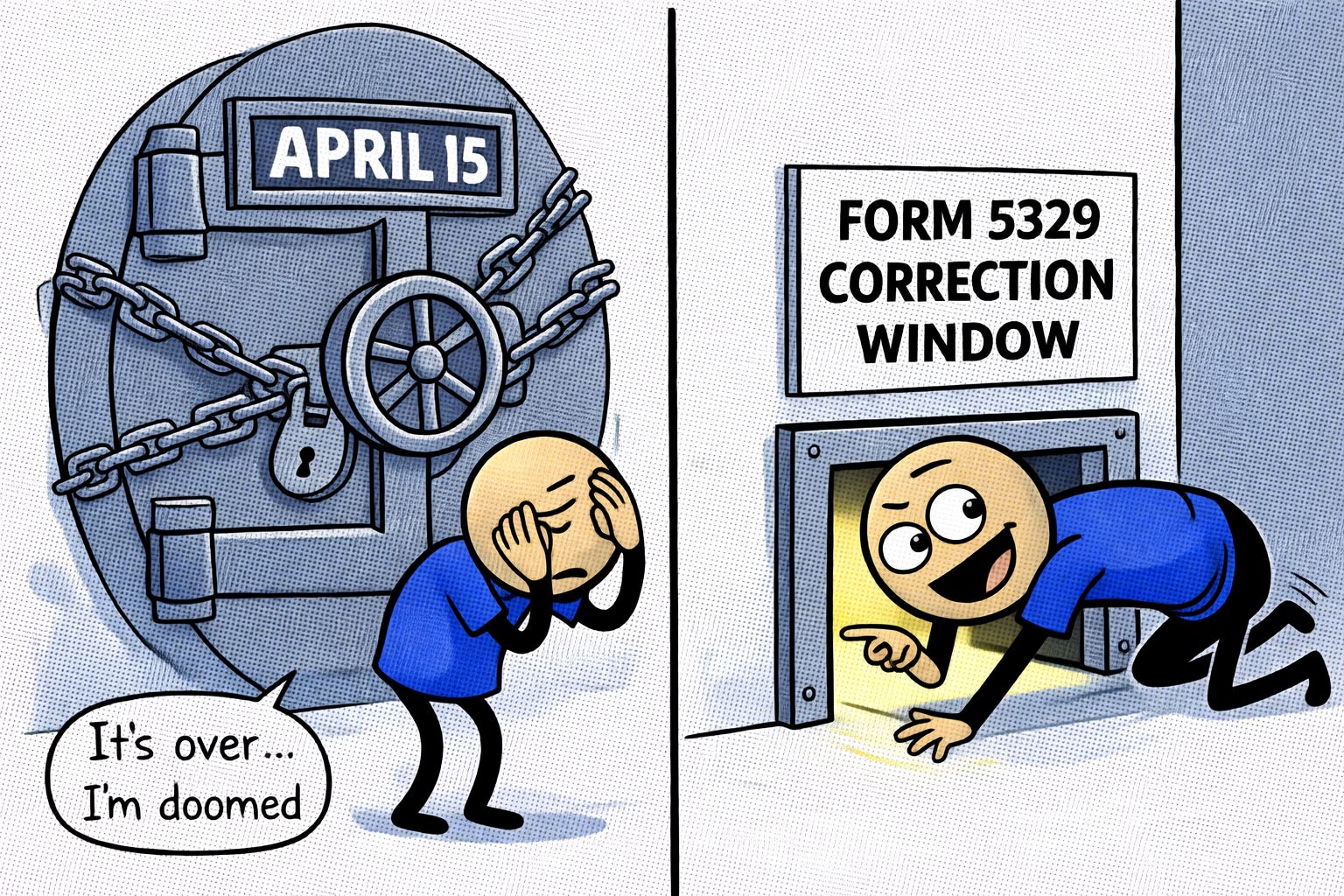
April 15 passes and you realize something is wrong. Maybe you contributed too much to your Roth IRA. Maybe you forgot to take an RMD. Maybe you converted to a Roth and never made an estimated payment. The deadline is gone. The instinct is to assume you are stuck.
You are usually not.
The tax code is built with correction windows. Some are generous. Some are narrow. Almost none of them slam shut on April 15. The key is knowing which window applies to your specific situation, because each one has different rules, different deadlines, and different consequences for missing it.
Start with excess IRA contributions. If you put too much into a Traditional or Roth IRA for 2025, your first correction deadline is your tax filing deadline including extensions. If you filed an extension, that means October 15, 2026. If you did not file an extension, it was April 15, 2026. Miss that window and the IRS assesses a 6% excise tax on the excess amount for every year it remains in the account.
But even after that window closes, you can still fix it. You have two options. First, you can withdraw the excess amount (without the earnings) before December 31, 2026. You will owe the 6% penalty for one year, but the excess is gone and the penalty stops. Second, you can absorb the excess into the following year’s contribution. If you contributed $8,000 for 2025 but your limit was $4,800, the $3,200 excess can count toward your 2026 contribution, assuming your income allows it. You still owe the 6% for the year it was excess, but it resolves itself without a withdrawal.
The worst outcome is doing nothing. The 6% compounds every year. A $3,200 excess that sits untouched for five years costs $960 in penalties. That is money burned for no reason other than not acting.
Missed RMDs have their own correction path. If you were required to take a distribution in 2025 and did not, the standard penalty is 25% of the amount you should have withdrawn. On a $20,000 RMD, that is $5,000.
But SECURE 2.0 created an escape hatch. If you correct the missed RMD within two years, the penalty drops to 10%. Same $20,000 RMD, now $2,000 instead of $5,000. Correcting means taking the distribution you should have taken and filing Form 5329 with the penalty payment. The IRS does not require you to explain why you missed it. You just fix it and pay the reduced penalty.
There is also a full waiver option. If you can show reasonable cause for the miss, the IRS can waive the penalty entirely. Reasonable cause is not defined precisely, but common examples include serious illness, a custodian error, or incorrect advice from a financial professional. You request the waiver by filing Form 5329, paying $0 for the penalty, and attaching a letter explaining what happened. The IRS approves these more often than people expect, particularly for first-time misses.
Estimated tax underpayments work differently. If you owed more than $1,000 beyond your withholding when you filed, the IRS calculates the underpayment penalty automatically. There is no correction window because the penalty is retroactive. It applies to each quarter where you fell short, calculated from the quarterly due date through the date you paid.
The penalty rate is the federal short-term rate plus 3 percentage points, compounded daily. For most people, the penalty on a single missed quarter amounts to a few hundred dollars. Not catastrophic. But avoidable.
If you realize after April 15 that you underpaid, paying the balance immediately limits the damage. The penalty stops accruing the day the payment clears. Waiting until the IRS sends a notice adds months of additional interest. The notice is not a deadline. It is a reminder that the clock has been running since April.
Here is what this looks like in practice. Sarah is 58, contributed $8,000 to her Roth IRA for 2025, and her MAGI came in at $162,000 as a single filer. The phase-out range is $150,000 to $165,000, so her allowable contribution is approximately $1,600. She has a $6,400 excess. She filed in March 2026 without an extension and did not realize the problem until July.
April 15 has passed. Her filing deadline correction window is closed. But she can still withdraw the $6,400 (without earnings) before December 31, 2026. She will owe 6% on $6,400 for one year, which is $384. She files Form 5329 with her 2025 return (or an amended return) and pays the penalty. The excess is gone. The 6% stops.
If Sarah does nothing, she owes $384 again for 2026. And again for 2027. The penalty only stops when the excess is removed or absorbed.
The pattern across all of these situations is the same. Missing the first deadline is expensive but not permanent. Missing the second deadline is more expensive. Doing nothing is the most expensive option of all.
The IRS built correction windows because they know people make mistakes. The penalties exist to motivate you to fix them, not to trap you. The deadlines that already passed cannot be recovered. But the ones still ahead of you can be met, and most of them are more forgiving than you think.
I write one of these every day, one retirement rule, explained in plain language and verified against the source. The daily email is free: subscribe here.
Full archive, worksheets, and search live at RetirementNewsRundown.com
Disclaimer This article is for educational and informational purposes only. It is not tax, legal, or financial advice and does not create an advisor-client relationship. Always consult appropriate professionals regarding your specific situation.