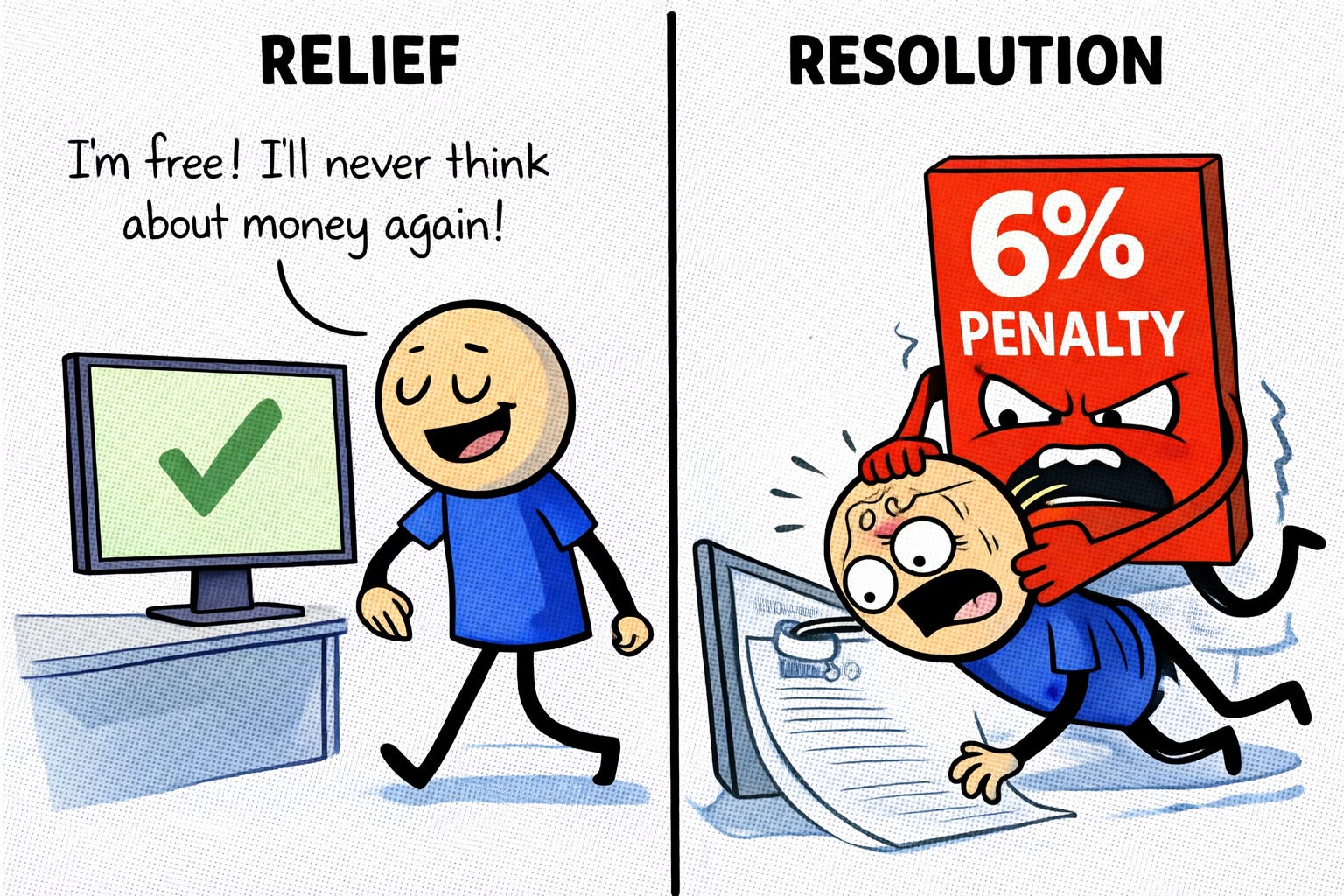
The second your e-file status switches to “accepted,” something happens in your chest. A release. The thing you have been dreading for weeks is over. You can stop thinking about taxes for another year.
That feeling is relief. It is real. It is also completely unrelated to whether anything is actually resolved.
Relief is an emotional event. Resolution is a financial one. Relief happens when the return is submitted. Resolution happens when every open item tied to your retirement accounts is closed, corrected, or confirmed. Those two things almost never happen on the same day.
The IRS accepting your return means the formatting passed. Your name matched your Social Security number. The math did not throw an error. That is it. Acceptance does not verify that your IRA contributions were within the limit. It does not confirm that your Roth conversion was reported correctly. It does not flag an RMD you were supposed to take but did not. Those issues surface later, sometimes months later, sometimes years later, and always at a worse time than if you had caught them yourself.
The gap between relief and resolution is where penalties live.
Take excess contributions. You contributed $8,000 to your Roth IRA for 2025 because you are over 50 and that is the limit. But your MAGI came in at $240,000 on a joint return. The phase-out range for married filing jointly in 2025 is $236,000 to $246,000. At $240,000, your allowable contribution is reduced to roughly $4,800. The remaining $3,200 is excess.
Your return gets accepted in February. Relief. But that $3,200 is still sitting in the Roth account. No resolution.
You have until your filing deadline, including extensions, to remove it. If you filed an extension, that gives you until October 15, 2026. If you did not file an extension and your return was accepted in February, your deadline is April 15, 2026. Miss that window and the IRS charges 6% on the excess. Not once. Every year the excess remains. A $3,200 excess generates $192 in penalties the first year. Leave it for five years and you have paid $960 in penalties on money that should never have been there.
The relief of filing did not create the problem. But it made you stop looking for it.
Missed RMDs follow the same pattern. Say you turned 73 in 2025. Your first RMD is due by April 1, 2026 under the first-year exception. You file your 2025 return in February 2026. Everything looks clean. Relief.
But you have not taken the RMD yet. April 1 comes and goes. The penalty for a missed RMD used to be 50% of the amount you should have withdrawn. SECURE 2.0 reduced it to 25%, or 10% if you correct it within two years. On a $20,000 RMD, the 25% penalty is $5,000. The 10% reduced penalty is $2,000. Either number is larger than any refund you rushed to collect.
Your return being accepted had nothing to do with the RMD. The IRS does not cross-reference your filing date with your distribution schedule. They catch it later, usually through Form 5498, which your custodian files in May, well after the relief of filing has faded. That form reports your year-end account balance and whether an RMD was required. The IRS compares it against the distributions reported on your 1099-R. If the numbers do not match, a notice follows. By then the deadline has passed.
Conversions create a subtler version of the same gap. You converted $60,000 from a Traditional IRA to a Roth in 2025. You reported it on your return. The return was accepted. Relief.
But did you actually pay the tax on it? If your withholding and estimated payments did not cover the additional $60,000 in income, you owe a balance when you file. And if that balance exceeds $1,000, the IRS assesses an underpayment penalty. Filing an extension does not help because extensions give you more time to file, not more time to pay. The tax was due April 15 regardless.
Resolution for a conversion means the tax is paid, not just reported. Plenty of people report the conversion correctly and still owe penalties because they confused reporting with paying.
Resolution is not complicated. It is a short list of confirmations. Were all contributions within the limits for your income level? Were all conversions accounted for in your tax payments? Were any required distributions taken on time? If you can answer yes to all three, your return is not just filed. It is finished.
If you cannot answer those questions confidently, the filing deadline has not passed yet. And if it has, the correction windows may still be open. Extensions extend more than your filing date. They extend your opportunity to fix things before penalties start.
Relief feels like the end. Resolution is the end.
I write one of these every day, one retirement rule, explained in plain language and verified against the source. The daily email is free: subscribe here.
Full archive, worksheets, and search live at RetirementNewsRundown.com
Disclaimer This article is for educational and informational purposes only. It is not tax, legal, or financial advice and does not create an advisor-client relationship. Always consult appropriate professionals regarding your specific situation.