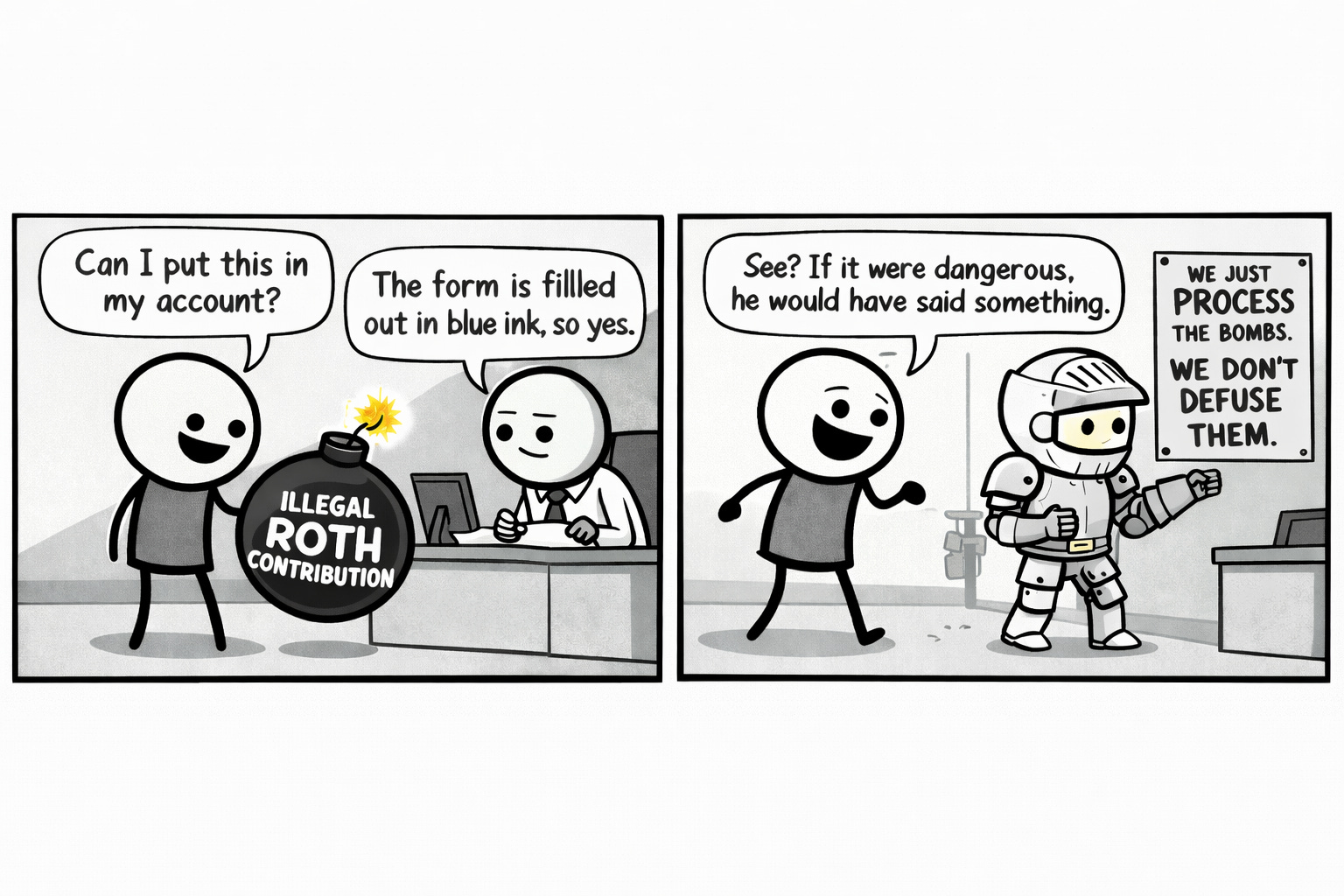
One of the most common phrases I hear that sounds reassuring at first.
“Well, the custodian let it go through.”
The money moved.
The contribution posted.
The conversion settled.
Nothing bounced. Nothing was flagged. No warning box popped up.
So the assumption follows naturally: if it went through, it must be fine.
That assumption is doing a lot of work it was never hired to do.
Most people assume custodians act like referees. If something violates a rule, surely someone would blow a whistle. Stop the play. Send the money back. At the very least, flash a yellow warning sign.
That’s not how this system works.
Custodians are processors. They move money based on instructions. They do not adjudicate intent. They do not check whether what you’re doing makes sense in the context of your entire financial life.
They check whether the instruction is permitted by their operational rules. That’s it.
If the form is complete and the transaction type is allowed, the system proceeds. Silence follows. Confidence grows.
And later, the reconciliation happens somewhere else entirely.
This distinction matters because retirement rules are enforced downstream. Not at the moment you act, but when the IRS matches transactions to reporting and timing rules.
A custodian will accept an IRA contribution even if your income later turns out to be too high. They don’t know your final income when the contribution is made. They’re not supposed to.
They will process a Roth conversion even if you have other pre-tax IRAs that will trigger the pro-rata rule. They don’t calculate that for you. They report what happened and move on.
They will let you take a distribution without reminding you it might have been an RMD you already missed. They’re not tracking your entire obligation across accounts.
None of this is a mistake. It’s the design.
Here’s where the clocks come in, because timing is the quiet enforcer.
Some actions are judged by the tax year. IRA contributions fall into this category. You generally have until the tax-filing deadline, usually April 15, to make a contribution for the prior year. That deadline can include extensions in certain correction scenarios, but the contribution itself lives in a specific tax year.
Conversions do not care about that deadline. A Roth conversion is taxed in the calendar year it occurs. If it happens on December 31, it’s part of that year. If it happens on January 1, it’s part of the next year. The custodian doesn’t wait for your return. The calendar decides.
Then there are rules that only care about what things look like at a specific moment. The pro-rata rule uses a December 31 snapshot. RMDs are tied to year-end balances and age thresholds. Excess contributions carry penalties that accrue annually until corrected.
The custodian processes the transaction when you ask. The IRS evaluates the consequences when the clock stops.
Those are two different jobs.
A concrete example makes this clearer.
Say someone contributes $6,500 to a Roth IRA in March 2024. The custodian accepts it. The account statement updates. Everything looks normal.
In December 2024, a bonus hits that pushes their income over the Roth eligibility limit. The contribution is now excess. Nothing changes at the custodian level. The money stays invested. The account keeps growing.
What happens if this is handled later instead?
If the excess and its earnings are removed by the tax-filing deadline, including extensions if applicable, the 6 percent excise tax can often be avoided. The fix is annoying but manageable.
If it’s discovered two years later, the 6 percent penalty applies for each year the excess remained. The correction becomes more complex. Forms need to be amended. The cost grows quietly.
The custodian did exactly what they were supposed to do. The penalty clock was running anyway.
Another familiar scenario involves rollovers and conversions.
In February 2025, someone converts $7,000 from a traditional IRA to a Roth IRA. The custodian processes it without hesitation. The transaction is allowed.
They also have an old rollover IRA with $93,000 in it. They plan to move it into their 401(k) at some point, but they’re busy and decide to deal with it later.
On December 31, 2025, that $93,000 is still sitting in an IRA.
When the tax return is prepared, the pro-rata rule pulls that balance into the calculation. Most of the conversion becomes taxable income for 2025.
What happens if the rollover into the 401(k) is done later instead?
If it happens in January 2026, it helps future years. It does nothing for 2025. The snapshot already happened. The tax result is locked.
Again, the custodian allowed everything. The system simply waited.
Required minimum distributions add another layer of false reassurance.
If you miss an RMD, the custodian doesn’t always stop you. Sometimes the calculation is wrong. Sometimes inherited account rules are misunderstood. Sometimes people assume one distribution satisfied everything.
The penalty used to be severe. It’s lower now, but the obligation still exists. The mistake can sit until a notice arrives or until a future review forces someone to look backward.
Fixing it promptly is very different from fixing it years later. Relief may be available, but paperwork, explanations, and uncertainty pile up with time.
Silence doesn’t mean compliance. It means the check hasn’t happened yet.
This is usually the moment people feel uneasy. That’s understandable.
The takeaway is not that custodians are careless or that the system is out to get you. It’s that responsibility is split across timelines and institutions.
Custodians process.
The IRS reconciles.
Time enforces.
Once you see that division clearly, a lot of confusion disappears.
You stop asking, “Why didn’t anyone stop me?”
And start asking, “Which rule decides this, and when does it get judged?”
That question is far more useful.
The resolution here is calmer than it sounds.
Most quiet mistakes are fixable when caught early. Penalties are not automatic in every case. Relief exists. Correction windows matter. Deadlines matter. The order of events matters.
What doesn’t help is assuming silence means approval.
If something was judged by the calendar year, December 31 is the referee.
If it was judged by the tax year, the filing deadline is the referee.
If there’s a correction window, that window closes whether you’re watching or not.
Custodians don’t stop you because that’s not their role.
Understanding that doesn’t make the system scary. It makes it predictable.
And predictability is usually enough to understand where you stand now.
I write one of these every day, one retirement rule, explained in plain language and verified against the source. The daily email is free: subscribe here.
Disclaimer
This article is for educational and informational purposes only. It is not tax, legal, or financial advice and does not create an advisor–client relationship. Always consult appropriate professionals regarding your specific situation.