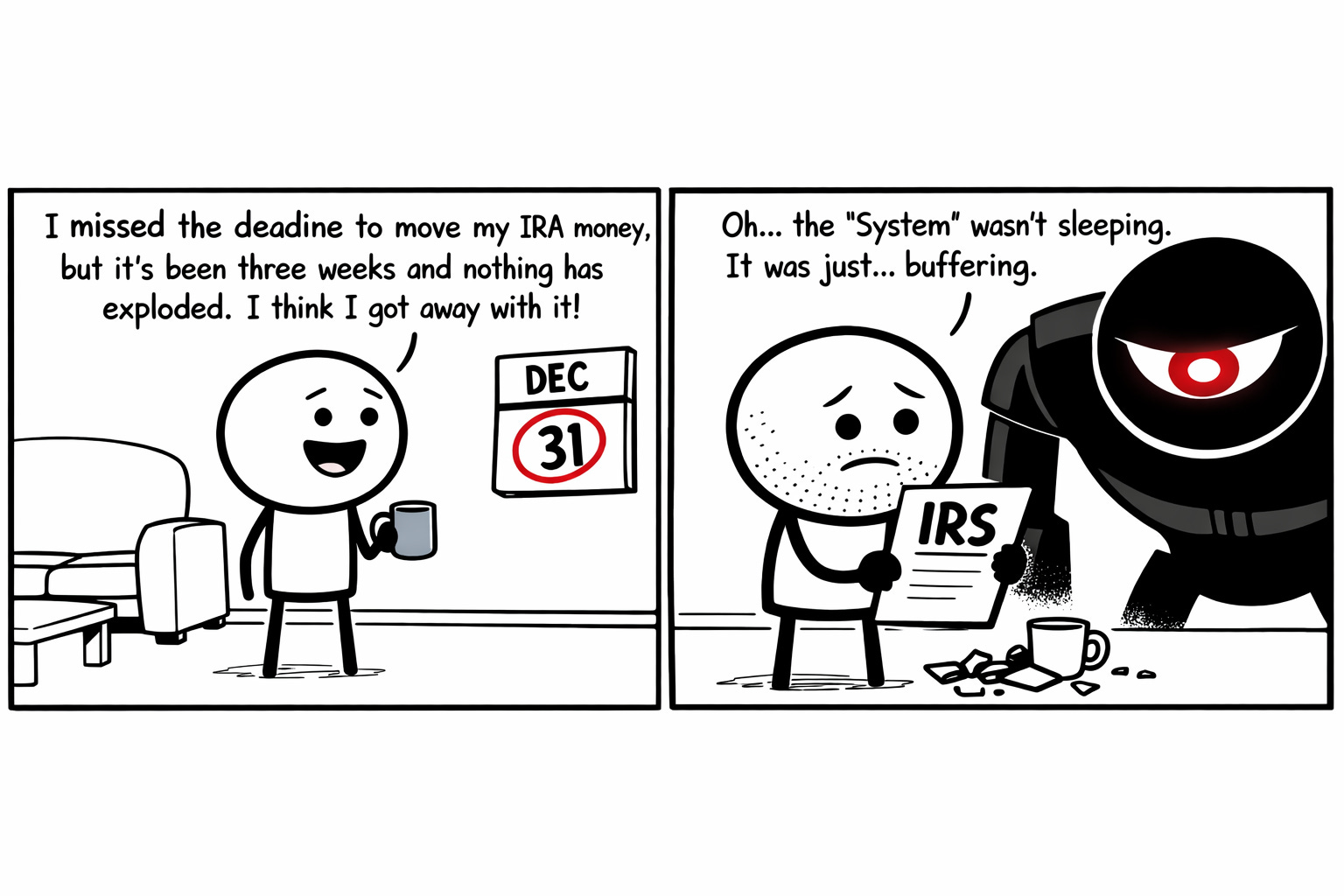
Most people assume retirement accounts work like a bank account with a memory problem. If no one notices something right away, it must not matter. If a form doesn’t show up instantly, maybe the system forgot. If a mistake happened years ago and nothing exploded, maybe it fixed itself.
That belief is comforting. It’s also really wrong.
The retirement system does not forget. It does not forgive by default. And it definitely does not rely on you actively watching it in order to keep track of what happened.
People usually discover this months or years later, when a letter shows up that starts with “Our records indicate…” which is government for “We’ve been watching this the whole time.”
A common trigger is the belief that timing only matters when money physically moves. If the account balance looks fine and no penalty showed up immediately, the assumption is that nothing bad happened. This shows up with late rollovers, delayed corrections, missed RMDs, Roth conversions done at the end of the year, excess contributions that quietly sit there, or SIMPLE IRAs that people treat like normal IRAs after two years because no one stopped them.
The system doesn't require a “red flag” to trigger a penalty; it only requires a date that doesn't match a rule.
The rule underneath all of this is simple and uncomfortable, retirement accounts are governed by event timing, not awareness timing.
When money moves, when it was eligible to move, when it should have been reported, and when it was supposed to be corrected are all recorded based on calendar rules that do not change just because someone didn’t know.
If something is done later instead, the system does not reinterpret the original event. It layers consequences on top of it.
A rollover done on day sixty one is not a rollover that “almost made it.” It is a distribution that failed to qualify. The system tracks the date the funds left the account, not the date someone realized the clock started.
An excess contribution that sits for three years without being corrected does not quietly age into compliance. It remains an excess for each year it exists and generates penalties for each year it remains unresolved.
A missed RMD does not become a late RMD with interest. It becomes a missed RMD with a separate correction process and its own penalty framework, even if the distribution eventually happens.
Nothing resets just because time passed quietly.
Calendar year deadlines are the backbone of this tracking.
Roth conversions live and die by December 31. It does not matter when the tax return is filed. It does not matter when withholding happens. It does not matter when the client realizes what they did. The conversion either occurred by December 31 or it didn’t. Doing it in January means it belongs to the new tax year, even if the intention was different.
If it’s done later instead, it does not retroactively attach to the prior year. The system assigns it to the year it actually happened and moves on.
Tax filing deadlines are a different lane entirely.
Some corrections, such as recharacterizing an IRA contribution or removing an excess contribution, can be handled up to the tax filing deadline plus extension. That window exists because the IRS allows contribution corrections after the calendar year closes.
What happens if it’s done later instead depends on the event. Miss that correction window and the system no longer treats the contribution as fixable in place. Penalties begin to stack annually until the excess is removed properly.
Correction windows are the quiet third category that causes the most confusion.
These are the periods where the system allows a mistake to be corrected without assuming intent. The sixty day rollover window is one of these. The RMD penalty waiver process is another. SIMPLE IRA two year restrictions fall into this category as well.
If an action happens outside its correction window, the system doesn’t argue. It just categorizes the transaction differently and applies the rules that come with that category.
Here’s how this plays out in real life.
A client takes a distribution from a traditional IRA on November 15, intending to roll it over. Life happens. The funds don’t make it back into another retirement account until January 20.
From the client’s perspective, the money was out for about two months. From the system’s perspective, day sixty one arrived in mid January and the rollover failed.
What happens if it’s done later instead is not subtle. The entire distribution is now taxable. If the client is under 59½, early distribution penalties apply. If taxes were not withheld, there may also be an underpayment issue. None of this changes because the intent was rollover related.
The system logged the distribution date on November 15. Everything else flowed from that.
Another example shows up with excess contributions.
Someone makes a Roth IRA contribution for 2022. Their income ends up too high. No one notices. The contribution stays put through 2023 and 2024.
By the time it’s discovered, the system has already assessed an excess contribution penalty for each year the excess existed. Removing it in 2025 stops future penalties, but it does not erase the prior ones. Filing late corrections does not rewrite the earlier years.
What happens if it’s done later instead is more expensive than fixing it early, even though the account balance may look perfectly fine the entire time.
The same principle applies to RMDs.
If an RMD is missed for 2024 and taken in 2025, the system does not treat it as “late but fixed.” It treats it as “missed and then corrected.” Those are not the same thing.
The missed year still exists. The correction process exists separately. Penalty relief may be available, but it is not automatic and it does not change the original classification.
Again, the system tracks the year the RMD should have occurred, not the year it was eventually taken.
The resolution here is not fear. It’s clarity.
The retirement system is not actively looking to punish people. It is designed to apply rules consistently based on dates, classifications, and reporting. Most problems get worse not because the rule is harsh, but because the delay compounds it.
The most important takeaway is that silence does not mean neutrality. It usually means the system is waiting for the next reporting cycle to reconcile what already happened.
If something was done later instead, the consequence is not that the system adjusts the rule. The consequence is that the system applies a different rule set altogether.
Understanding that distinction removes a lot of anxiety. It replaces guessing with awareness. It explains why letters arrive years later without assuming anyone did something intentionally wrong.
The system isn’t emotional. It’s procedural. Once you understand what it tracks and when, the fog lifts.
You don’t need to watch it constantly. You just need to know it never stops watching.
I write one of these every day, one retirement rule, explained in plain language and verified against the source. The daily email is free: subscribe here.
Disclaimer
This article is for educational and informational purposes only. It is not tax, legal, or financial advice and does not create an advisor–client relationship. Always consult appropriate professionals regarding your specific situation.