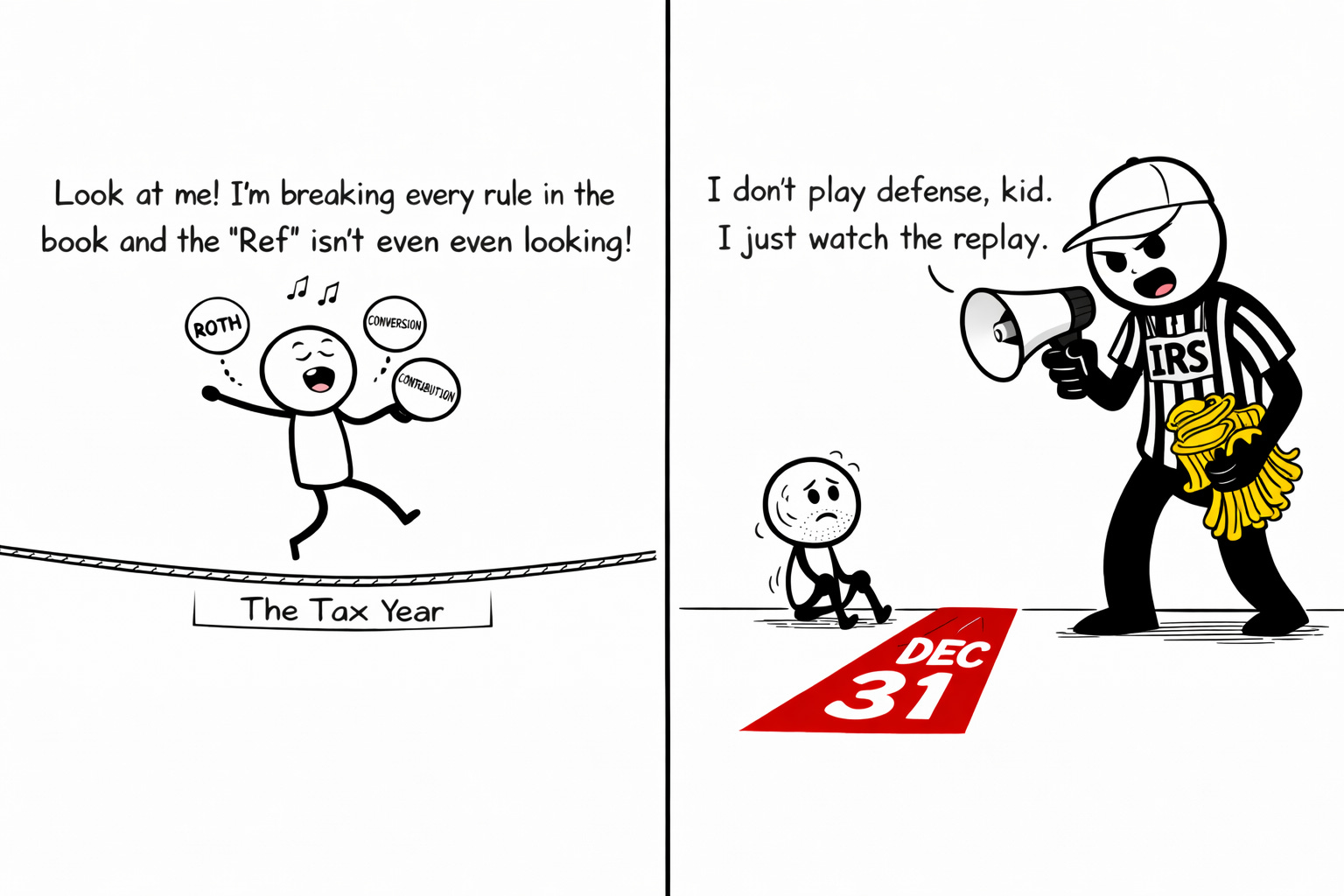
Most retirement mistakes don’t feel like mistakes at the time. They feel like nothing happened.
Money moved. An account balance looks fine. No warning popped up. No letter arrived. No one called. Life continued. The quiet creates a dangerous assumption that if a rule really mattered, someone would have stopped you in real time.
People assume the system works like a credit card decline. If it lets the transaction go through, it must be allowed. If no one flags it immediately, maybe it doesn’t count.
That belief holds right up until the year closes, forms are generated, totals are calculated, and suddenly a rule that seemed optional turns out to have been mandatory the entire time.
Here is the uncomfortable truth. Many retirement rules are not enforced at the moment of action. They are evaluated at the end of a defined period. The system often waits until the year is complete before it decides whether what happened earlier was acceptable.
That does not make the rules flexible. It just means enforcement is delayed.
Contribution limits are checked after the calendar year ends. RMD compliance is reviewed after December 31 passes. Income eligibility for Roth contributions is determined after final income is known. Pro rata rules do not care how clean the conversion looked on the day it happened. They only care what the account landscape looked like when the year closed.
If something is done later instead, the system does not reclassify the earlier action. It applies consequences based on the condition that existed at the end of the measuring period.
Calendar year deadlines drive most of these rules. December 31 is not a suggestion. It is the line where the system freezes the snapshot and runs the math.
Tax filing deadlines come later and serve a different purpose. They allow reporting and correction. They do not change what the calendar year already locked in.
Correction windows exist in between. Some errors can be fixed after the year ends without penalties. Others cannot. The difference depends on the rule involved, not on intent or awareness.
A clear example shows how this plays out.
Someone makes a Roth IRA contribution early in the year. At the time, income estimates suggest eligibility. No issue appears. The contribution posts. The account invests. Months pass.
By December, income ends up higher than expected. The calendar year closes. Only now does the rule get checked.
At that point, the contribution is retroactively considered excess. Not because something new happened, but because the full year income picture finally exists.
If the excess is addressed within the tax filing deadline or extension, it can usually be corrected without ongoing penalties. If it is done later instead, after the correction window closes, the excess does not disappear. It carries forward and generates penalties for each year it remains.
Nothing about the original contribution changes. The timing of correction determines the cost.
Another example shows up with required minimum distributions.
An RMD is required for a given year. No system forces the withdrawal in real time. The account balance continues to grow. Everything appears fine.
December 31 arrives. The year closes. Only then does the system check whether the required amount left the account.
If the RMD was not taken by the end of the calendar year, it is officially missed. Taking it in January does not convert it into a late RMD. It becomes a missed RMD followed by a corrective distribution.
If it is done later instead, penalties may apply unless waived. The rule does not bend because the money eventually moved.
The same delayed enforcement applies to rollovers.
A distribution taken with rollover intent is not evaluated on the day the money leaves the account. It is evaluated after the rollover window expires.
If the funds are not deposited into another eligible account within the allowed time, the system does not partially accept the transaction. It fully reclassifies it as a taxable distribution.
Doing it later instead does not rescue it. Once the window closes, the rule outcome is final.
Pro rata rules operate on the same logic.
A Roth conversion can look clean in isolation. The conversion posts. Taxes may even be withheld properly. No alerts trigger.
At year end, the system evaluates all IRA balances. If pre tax and after tax money existed anywhere across traditional IRAs during the year, the conversion becomes subject to the pro rata calculation.
It does not matter when the conversion happened. It does not matter what the balance looked like that day. The year end snapshot controls the outcome.
If accounts are cleaned up later instead, the prior year conversion does not get recalculated. The rule was checked when the year closed.
This delayed enforcement model causes unnecessary anxiety because people think silence means approval. It doesn’t. Silence usually means the measurement period is still open.
The system is not watching actions one by one. It is collecting data and reconciling it at the checkpoint.
Once you understand that, the rules become easier to live with. Nothing is secretly lurking in the background waiting to surprise you out of spite. The process is mechanical.
Calendar year deadlines determine eligibility and compliance. Tax filing deadlines determine how issues are reported. Correction windows determine whether penalties can be avoided.
If something is done later instead, that later timing determines whether the fix is clean, costly, or unavailable.
The key is not fear. It is knowing which rules wait until the end to be checked and which ones do not allow rewrites once the clock stops.
Most people do not get into trouble because they acted recklessly. They get into trouble because they assumed the system was watching in real time.
It isn’t.
It watches quietly, waits patiently, and only speaks when the year is over.
I write one of these every day, one retirement rule, explained in plain language and verified against the source. The daily email is free: subscribe here.
Disclaimer
This article is for educational and informational purposes only. It is not tax, legal, or financial advice and does not create an advisor–client relationship. Always consult appropriate professionals regarding your specific situation.