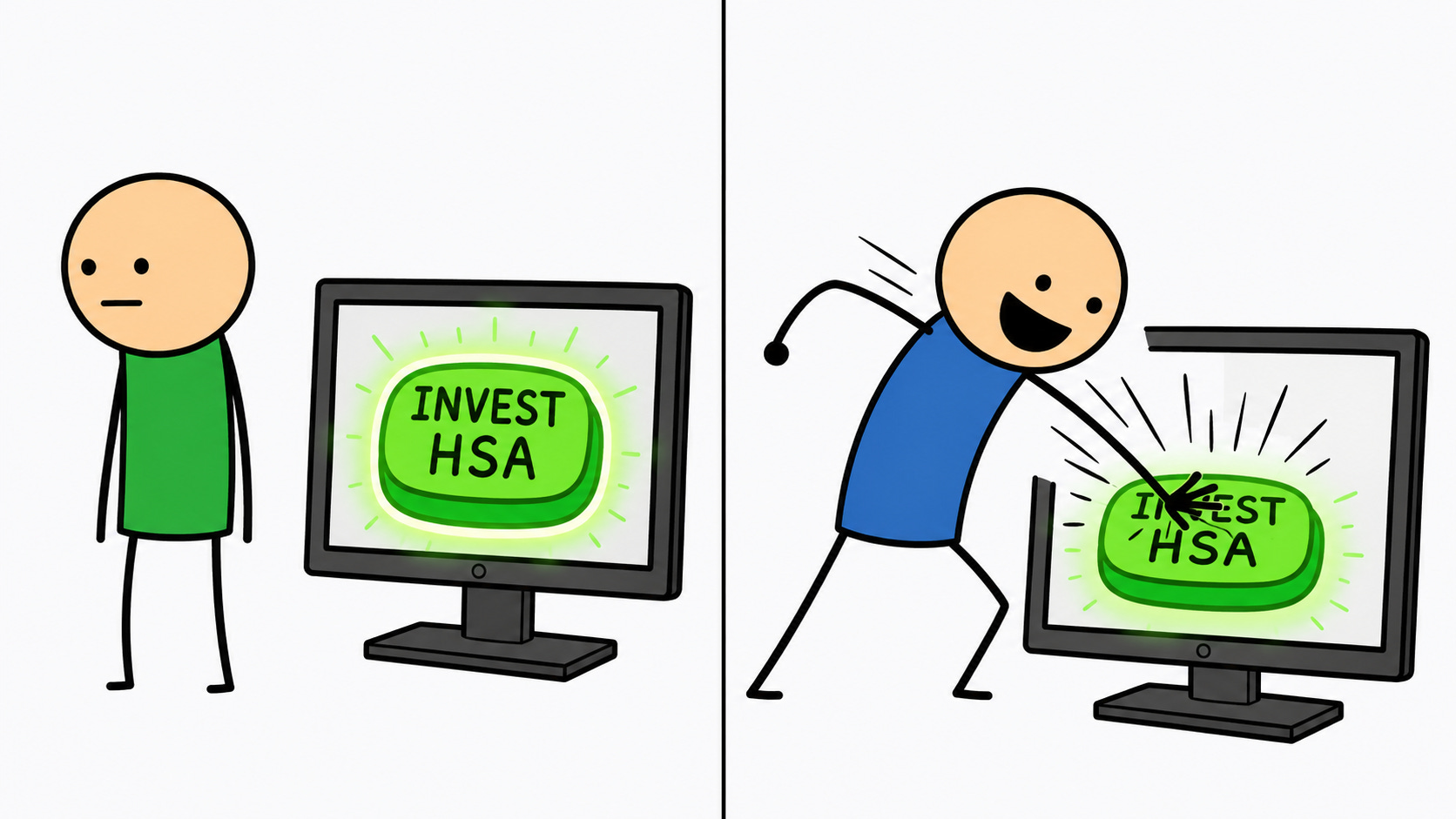
The HSA gets opened the day someone enrolls in a high-deductible health plan, often through an employer benefits portal that includes a debit card and a deposit account. Contributions get deducted from payroll. Medical expenses get paid with the debit card. The account behaves like a checking account, because the platform was designed to behave like a checking account.
That design choice is the source of the most common HSA mistake. Industry surveys consistently show that the majority of HSA balances sit in cash, earning whatever the custodian’s interest rate offers, which is usually close to nothing. The investment option, if the custodian offers one, sits behind a button that most account holders never click.
The result is a tax-advantaged account behaving like a low-yield savings account, which defeats most of the reason the account exists in the first place.
HSA funds can generally be invested. Many HSA custodians offer investment options, often through mutual funds, ETFs, or a linked investment platform. The exact menu and minimum balances depend on the custodian.
The cash threshold is the structural friction that traps balances in cash. Many custodians require a minimum cash balance before the account holder can invest the rest. Typical thresholds run from one thousand to two thousand dollars, though some custodians require more and some require none. Below that threshold, the account holder cannot move funds into investments. Above it, the holder must affirmatively choose to invest, which means logging in, finding the investment section, picking funds, and confirming the trade.
Most people never get past the affirmative-choice step. The account sits in cash by default, and default behavior wins in the absence of intentional action.
HSAs do not expire. There is no use-it-or-lose-it deadline on contributions. Balance carries forward indefinitely until withdrawn. That is the foundational difference between an HSA and an FSA. The FSA forfeits unspent balance at year end with limited grace exceptions. The HSA carries it forever.
The reimbursement strategy is the part most people miss. A medical expense paid out of pocket today does not have to be reimbursed from the HSA today. The IRS does not impose a deadline on when a qualified medical expense can be reimbursed from the HSA, as long as the expense was incurred after the HSA was established, the expense was not already reimbursed from another source, and the account holder keeps the documentation. The reimbursement can happen years or decades later.
That timing flexibility creates a different use of the HSA. Contributions go in. Investments grow tax-free. Current medical expenses get paid out of pocket. Receipts get saved. Decades later, the much-larger HSA balance can reimburse those old receipts on a tax-free basis, or fund retirement medical costs directly.
After age 65, a separate rule applies. Non-qualified HSA withdrawals become subject to ordinary income tax but no longer carry the twenty percent additional tax that applies to non-qualified withdrawals before 65. From a tax-treatment standpoint, the fallback after age sixty-five resembles traditional retirement income treatment for non-medical withdrawals.
What happens if the HSA is left in cash indefinitely. The contributions remain in the account. The tax deduction at contribution time still applies. The withdrawals for qualified medical expenses remain tax-free. The triple tax advantage technically still functions. The lost piece is the growth, which is the most consequential of the three tax advantages over a long enough timeline.
Consider a worker contributing four thousand dollars per year to an HSA from age thirty through age sixty-five, with all spending on current medical expenses done out of pocket and reimbursed years later.
In a simplified illustration, assuming annual contributions, no withdrawals, no fees, and steady returns, four thousand dollars per year for thirty-five years at two percent grows to roughly two hundred thousand dollars. At seven percent, it grows to roughly five hundred fifty thousand dollars. Real returns do not arrive in a neat little spreadsheet line, because markets are rude like that, but the point is the same: the investment decision can matter more than the contribution decision over long periods.
The choice that helped create that difference was not only the contribution. It was whether the money stayed in cash by default or moved into investments with a long enough timeline to let compounding matter.
The HSA system rewards intentional behavior. Cash position is the default. Investment position requires the account holder to click through, choose funds, and stay invested for the timeline.
Most people who leave HSAs in cash do it for two reasons. The first is that they think of the account as a current medical expense account, which the custodian platform reinforces. The second is that they hit a cash threshold they did not know about and never came back to invest the excess.
What matters is awareness that the HSA is one of the few accounts in the U.S. tax code where every dollar can grow tax-free for decades and come out tax-free for medical expenses. Leaving it in cash is a defensible decision for someone using the account for current medical expenses without growth intent. Leaving it in cash without realizing the investment option exists is a different situation, and the second one is the more common.
The system rewards those who treat the HSA as a retirement account that happens to also fund medical bills. The default treatment makes it a medical bill account with growth left on the table.
I write one of these every day, one retirement rule, explained in plain language and verified against the source. The daily email is free: subscribe here.
Full archive, worksheets, and search live at RetirementNewsRundown.com.
Disclaimer
This article is for educational and informational purposes only. It is not tax, legal, or financial advice and does not create an advisor–client relationship. Always consult appropriate professionals regarding your specific situation.